
Paul McStay on refusing Celtic autobiography request and saying ‘polite no thanks’ to Rangers

Former captain releases independent memoirs after rejecting Celtic agreement
The Paul McStay paradox has been a feature of Scottish football for many years. Although his name continues to be sung at nearly every Celtic game, the man himself has been one of the least visible former players of the modern era.
He was an elegant presence in the centre of the Parkhead side’s midfield for almost all the 1980s and a good chunk of the 1990s, albeit injury dogged him in the later stages of his magnificent one-club career. A clip of a podcast he recorded with former teammate Brian McClair recently caught the eye, as it also featured a remarkably well-preserved copy of an old Edinburgh-based music newspaper called Cut.
An equally well preserved McStay, now 62, and McClair discussed featuring on the wrap around front cover of the February 1987 edition. Pat Nevin was not the only thinking man’s footballer at the time. Now based in Australia, which might account for McStay’s healthy radiance as well as the infrequent appearances, all of this must feel like another lifetime ago.
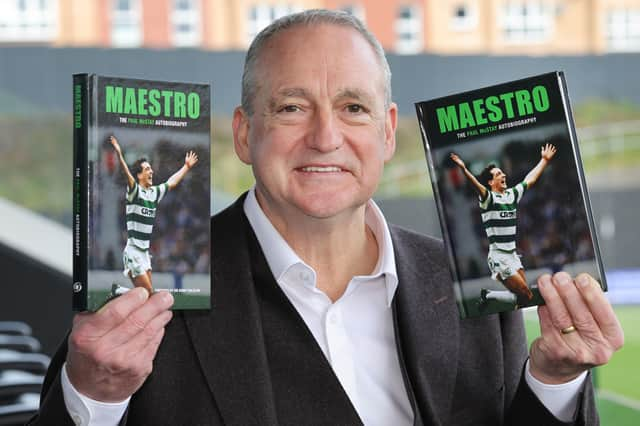

So why has it taken him so long to publish his memoirs? That is itself a long story and is one of the reasons why McStay, whose family has playing ties to Celtic dating back to the 1920s, is launching his long-awaited autobiography at the home of …….Queen’s Park Football Club.
It was originally meant to be launched at the slightly more appropriate Celtic Park last year, while on a trip home to raise the title flag before the opening league game against St Mirren. “It didn’t work out that way,” he explains. “Basically the club sent an agreement for them to sign off on the book.”
Celtic were unhappy with some parts, probably related to the vexed matter of his eventual exit in 1997 after 16 years of stellar, some might even say genius, service.
The upshot is McStay has published his own book on his own terms. “I’m doing it independently, doing it on my own,” he says. “And I have been quite honest. It’s my book, my story, my life. So I just said I couldn’t sign the agreement. I’ll do my own thing.”
If the club’s mantra is let the people sing then surely allowing former players, especially such loyal servants as McStay, to tell their own story should be taken as read. “I just thought: No, I can’t have that,” he says.
McStay was sent off just once (at Dens Park in a 1994 League Cup tie v Dundee) and was described by Alex Ferguson, after his testimonial against Manchester United in 1995, as the “ultimate professional”. He was also awarded an MBE by the Queen and picked it up from Her Majesty herself in 1997 at Holyrood Palace. Happily married to Ann Marie, with whom he has six children, he is one of the most uncontroversial players ever to play the game. He nevertheless makes for ravishingly good copy.
“I’ve just got to tell my story,” McStay says. “If people are not aware of that, that's why I'm happy to share it. I just felt it was time to put how I lived it and my perception about certain things that happened as well, and put it in black and white.”
Rangers question and the ‘polite’ rejection
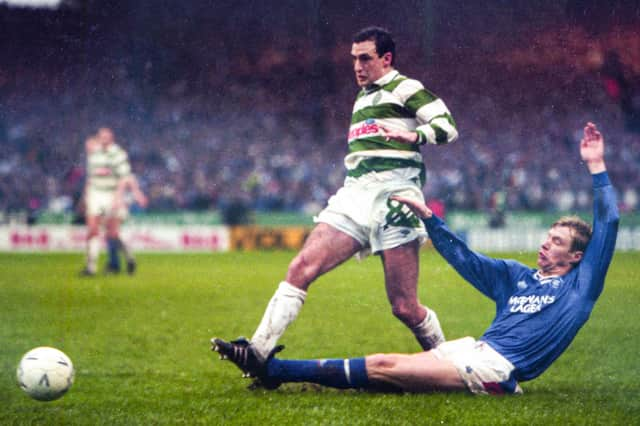
One regrettable consequence of the delay in his story getting out there is that we have been denied knowledge of a transfer tale to end nearly all transfer tales. Never mind music magazines, McStay would have featured on the front page of every newspaper in the land if the then Celtic skipper had joined Rangers in 1992.
The Ibrox club were buying nearly everyone else, including Mo Johnston in 1989, during this era, so why not make a play for the best player at their biggest rivals? The religion thing had already been put to bed with Johnston…..ahem. Manager Walter Smith made the cheeky enquiry through a mutual contact.
“That was a question put to me in ’92, yes,” confirms McStay, who includes this startling snippet in Maestro: The Paul McStay Autobiography. “It was a polite ‘no thanks’. I think that’s the best way of putting it.”
He is sworn to secrecy on the identity of who was sent by Smith to sound him out. “I can't say,” he says. “But I know he's a friend of Walter. I never spoke to Walter about it.” His relationship with the Rangers legend dated back to their involvement in Scotland youth teams, Smith as the budding coach and McStay one of the country’s brightest young hopes. “When you talk about mentors and things like that, Walter was up there,” he says. “Andy Roxburgh was youth team manager in ’82 when we won the Euros and Walter was part of that. Since then, there’s always been a bond. He is a wonderful man and obviously, he did well at Rangers, which had an effect on me. But as a person, I got on really well with Walter.”
The phrase ‘had an effect on me’ is a wonderful way of saying McStay, towards the end of his Celtic career, seemed perpetually pitted in an almost one-man battle to stop Rangers winning nine-in-a-row. It was unfair to him, just as the financial imbalance - McStay has a few things to say about Rangers' spending power in his book - was unfair for the rest of Scottish football.
Aberdeen rather than Celtic came closest to stopping the Ibrox side’s march. McStay endured six trophyless years between 1989 and an emotional Scottish Cup win under Tommy Burns in 1995.
‘I never thought I’d leave Celtic in that way’
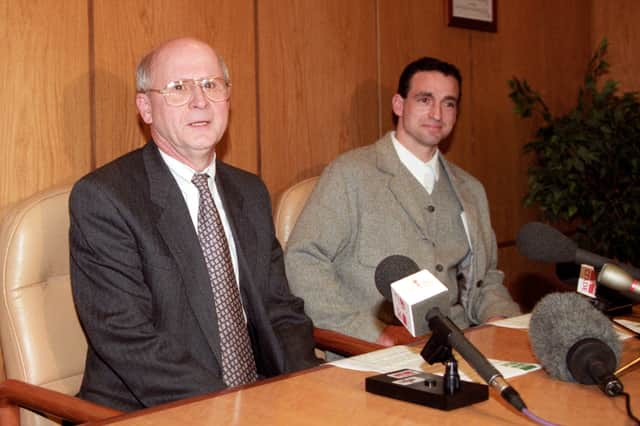
Not long afterwards, reeling from an X-ray report confirming the “virtual obliteration” of part of his ankle joint, McStay accepted that he had to consider retirement. But intense rehabilitation work saw him make another return, although he was clearly toiling. He finally called it a day at the end of the 1996-97 season. The then owner Fergus McCann, along with others, helped make this already difficult decision a horrendous experience. He was given the feeling that Celtic thought he was “bluffing” about the injury in a bid to negotiate a new deal with another club.
“The exit wasn't great,” he says, understating things hugely. "I never ever thought I'd leave Celtic in that way. There were a lot of good times along the way, as well as ups and downs…
"But to me, it was very important to get that message out about how it ended. Because even at that time, there was a bit of PR coming out about certain things. And it wasn't quite accurate. I don't know what the club will feel about that. But I've got to tell the story the way it happened. And that's it.”
Encouraged by Tommy Burns, he gained his coaching certificates and applied for the Under-16 Academy coach’s position at Celtic during Martin O’Neill’s first stint in charge. However, former teammate Jim McInally got the job instead. Australia beckoned in 2010.
READ MORE: Celtic legend tells protesters there is ‘better way forward’ as he reveals Michael Nicholson chat
“I do enjoy the element of being able to hide away, out of the road,” he says. It must have been comforting to know that across the other side of the world, every time Celtic played, his name was being sung in the chorus of the stirring “Willie Maley” song, which will be familiar to nearly everyone who watches football in Scotland: “And they gave us James McGrory and Paul McStay….” It’s a paean to storied past, one McStay is an integral part of.
“That started when I stopped playing,” he says. “James McStay was actually in the original song and then, through time, the younger generations changed it to Paul.” Every day’s a school day in the company of a Maestro.
Paul McStay was speaking at the launch of his autobiography Maestro. To purchase copies of the Celtic legend's book go to paulmcstay.com.
Comments
Want to join the conversation? Please or to comment on this article.