
Ministers accused of 'catastrophic failure' for approving gas power station amid climate and energy bill fears



The power station is reliant on carbon capture technology to mitigate some of the climate impact of burning gas to generate electricity
Ministers have been accused of a “catastrophic failure" after approving a controversial gas-fired power station amid fears it could contribute to energy bills continuing to soar.
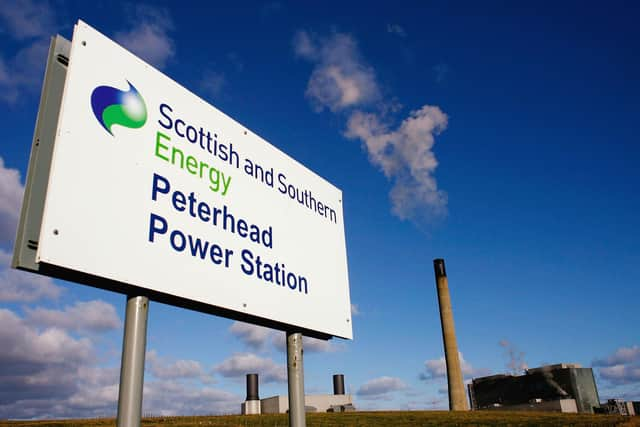
The decision to approve SSE and Equinor’s contentious plans for a gas-fired power station at Peterhead comes as the Scottish government faces pressure from campaigners to reaffirm its commitment to tackling climate change.
The SNP government has been flirting with embracing oil and gas after previously holding a draft “presumption against” supporting new North Sea drilling.
The government has insisted that its focus is on scaling up Scotland’s renewables sector as the oil and gas sector declines.
READ MORE: Chancellor warned not to axe North Sea energy project to fund defence in carbon capture 'betrayal'
Campaigners have wared the power station will “lock in” fossil fuels being used for electricity for decades, potentially undermining plans by the UK government to unlink power and gas prices to help cut energy bills.
Under the plans, the plant will generate around 750MW of power and will use carbon capture technology that developers claim will cut its emissions.
SNP ministers concluded that “subject to conditions to secure environmental mitigation, including carbon capture and storage”, it was determined “the environmental effects of the proposed development are mostly overcome with the exception of some significant, localised landscape effects and some significant visual effects”.
They added: “The Scottish ministers consider the proposed development will support the resilience of the electricity network through the electricity it generates.
“A project of this scale delivers a very significant national benefit in terms of energy and security of supply weighing heavily in favour of consent.”
Friends of the Earth Scotland’s head of campaigns, Caroline Rance, said: “Giving the green light for new fossil fuelled power at Peterhead is a catastrophic failure from the Scottish government to protect people from both climate breakdown and the increasing burden of rocketing household bills.
“The pain from today’s terrible decision will be felt by Scottish households for the next 30 years or more because it traps people in relying on volatile fossil gas where the prices are set internationally.”
Finlay McCutcheon, managing director of SSE Thermal, said the project “has the potential to provide the flexible, low-carbon electricity needed to support a renewables-led energy system while creating and sustaining good jobs in the north-east of Scotland”.
READ MORE: Jackdaw gas field approval cannot be distraction from wider crisis facing Aberdeen and the North Sea
The row emerged as new statistics show that Scotland’s renewable energy industry supported an estimated 49,200 full-time equivalent jobs and £14.9 billion of economic output in 2024.
Angela Hepworth, CEO of Scottish Renewables, said the figures show “why renewable energy must be at the heart of any serious plan for growth, strengthening energy security, driving reindustrialisation and attracting investment to Scotland”.

She added: "The UK government must back Scotland’s pipeline in its strategic energy plans and ensure projects can compete in future auctions, while the Scottish government must speed up planning decisions.”
Offshore Energies UK has called for the Chancellor to bring forward reforms to the controversial energy profits levy - to become the oil and gas revenue levy (OGRL) from 2030 - in today’s Budget.
OEUK chief executive, David Whitehouse, said: “Businesses need certainty to invest. Bringing forward the OGRL to January 2027 would create a permanent framework that taxes windfalls when prices are high while creating the confidence needed to invest when prices are lower.

“But this is about more than oil and gas - Britain needs investment right across its offshore energy mix.
“Continued support for offshore wind and sustained deployment of carbon capture and storage can help turn our world-class energy expertise into jobs, growth and greater energy security as we confront risks to imported supplies from conflicts around the world.”
Comments
Want to join the conversation? Please or to comment on this article.