
Glenrothes is living proof why UK needs a second Clement Attlee in charge
Recently returned to Scotland after 40 years away, Martin Roche visits Glenrothes on the penultimate leg of his journey of discovery around the country
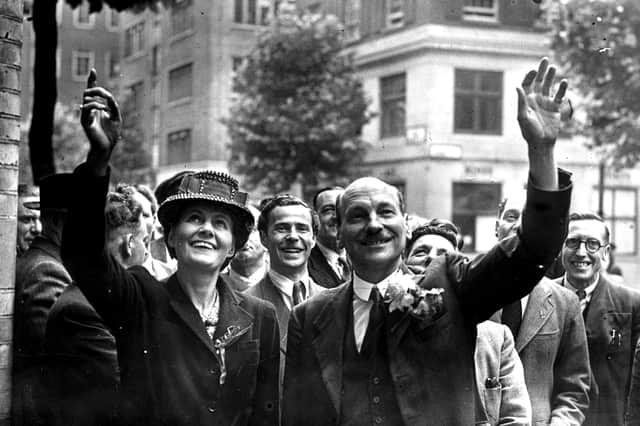
On the back of its landslide victory at the 1945 general election, Clement Attlee’s Labour government decided that a better Britain should be built. A high-point of this vision was the 35 new towns built across the UK, with five in Scotland: Cumbernauld, East Kilbride, Glenrothes, Irvine and Livingston.
Their role was to give working-class families decent homes, fresh air away from polluted industrial cities, modern schools and easy access to leisure and culture in places that separated industry and busy roads from where people lived.
The British state financed, planned, built and ran the towns. Everything was developed from scratch on what had been green fields. Until the mid-90s, when their management transferred to local authorities, all this was done by unelected development corporations. This was moderate, gradualist, altruistic social democracy writ large.
READ MORE: NHS at 75: SNP and Conservative policy of managed decline is a shocking betrayal of health service


A modern mining town
I was once the London representative of the Scottish new towns. Since then, I’ve had a lingering affection for them. I opted for a visit to Glenrothes, a town born in 1947.
Glenrothes’ genesis was the Rothes Colliery ‘super pit’. Opened in 1948, it was forecast to produce coal for many decades. Glenrothes was to be a modern mining town. Geological problems closed the pit in 1962. Glenrothes joined the other new towns in seeking fresh types of employment, mainly through inward investment by US electronics concerns.
My day in the town starts with coffee at the recently refurbished Kingdom Shopping Centre. Bakers & Barista’s manager Jackie Beveridge says the centre is busy all day, “and getting busier”.
I find a library is part of the Kingdom Centre. Library assistant Sheena Balls helps me find books on the architecture of the town and on the many sculptures by the artists once employed by Glenrothes Development Corporation. Almost all the works still exist and are much loved by locals. The motivation for the sculptures was the same as that which brought us the Arts Council and the Open University: a better society.
‘A glorified housing estate’
Sheena Balls lives in the town. She thinks the idealism and vision that created the place has been lost. “Subsequent leaders have strayed very far from the original concept. Glenrothes is now a glorified housing estate.”
Church of Scotland minister, the Rev Alan Kimmitt, has a rosier view of Glenrothes, though his feet are firmly planted on the ground. He deals daily with every sort of despair, isolation and joy that human beings encounter. Kimmitt had a business career before taking the cloth. St Columba’s is his first charge.
Forty years ago, the Church of Scotland was a dominant force in Scottish and Glenrothes life. Today, Kimmitt’s architecturally magnificent St Columba’s Church, built in 1962, is part of an alliance of six local kirks, mustering only some 150 people for Sunday services, which rotate between the parishes.
Kimmitt acknowledges Scotland’s growing secularism, finding it hard to pin down how it has happened. He’s more comfortable discussing his pastoral role. He knows his parish and can read the heartbeat of Glenrothes. He sees a place of civic pride, perhaps less insular and more welcoming than older, more traditional places.
“There's a strong and distinct civic identity tied up with the new town. Everybody’s an incomer or the child of an incomer.”
Dancing pumps
If religious observance has changed dramatically in Glenrothes, so too have other elements of its canvas. Where once multi-national, high-tech businesses made Glenrothes a key part of Scotland’s “Silicon Glen”, most have now gone. The companies making things today are mainly smaller concerns.
Local SNP MSP Jenny Gilruth says small-to-medium enterprises are “the backbone” of the local economy. “Last year, 9,270 properties in Fife, including in Glenrothes, received £39.9 million from the Scottish Government in non-domestic rates relief,” she says.
I visit Thistle Shoes, a 40-year-old family business making dance pumps and supplying shoes to pipe bands internationally. Managing director Pamela McDowall tells me her business is the official supplier of pumps to the Royal Edinburgh Military Tattoo. Each dancer goes through three pairs of pumps. Three of her six staff live in Glenrothes. She says she couldn’t ask for better folk. “Everybody here mucks in.”
Richard Baker, the town’s Labour MP, found a minute to call and talk about the various renewable energy projects in the district. We spoke the day after the Reform party announced that if it wins the next UK general election it will end all subsidies for renewable energy. Baker was scathing in his response.
“Reform’s proposals are reckless in the extreme. Their idiot plan would be devastating for Scotland, for consumers, for industry and for energy security. It would lead to lost jobs, higher prices and businesses collapsing.”
Paternalistic social engineering?
Glenrothes has its poverty and deprivation and its fair share of often struggling immigrants and disaffected young people. However, it felt livelier and a bit more self-confident than other towns of similar size I’ve visited on my tour.
Critics of the post-war new towns accused them of social engineering, a paternalistic state telling the working classes how to live, while giving their early inhabitants no democratic say in the priorities of the towns. Some British new towns are far from socially or economically successful. Glenrothes, I think, is not among them.
Is there any political party with the vision, courage and ideas for improving the economic and social lot of ordinary people shown by Clement Attlee’s 1945 government? If there is, they’re doing a good job of hiding their boldness from us.
Martin Roche worked in foreign direct investment and had a 35-year career in international public relations
Comments
Want to join the conversation? Please or to comment on this article.