
Why troubled Borders region is pinning its hopes on 'game-changer' Center Parcs
After returning to Scotland following 40 years away, Martin Roche visits the Borders on the third leg of his journey of discovery around the country and finds a region grappling with population challenges
When I left the Borders in 1985, there was no Borders Railway, no wind farms, no Scottish Parliament. The world-famous textile industry was the biggest private sector employer, but was struggling to find its way in an increasingly globalised economy. The few textile businesses that remain are at the top of the world for quality and innovation. High skills, high quality and the highest reputation.
Forty years ago, the magnificent Tapestry of Scotland didn’t exist, nor its fine home in the centre of Galashiels (it is now in my top ten Scottish visitor attractions). Nor were there food banks. I saw these in Galashiels, Hawick and Chirnside when I visited in mid-June.
The Borders suffers the same core problem today as 40 years ago. There are not enough people and its population is ageing. It is one of the least densely populated parts of Western Europe, with a land mass of 1,827 square miles and a population of 115,270. Edinburgh has 4,730 people per square mile. The Borders figure is 63.
READ MORE: 'Ripping the heart out of our communities': Residents' fury over proposed Scottish Borders closures

Energy market needs reform
Trevor Jackson chairs the Scottish Borders Chamber of Commerce. He estimates the region needs a population boost of 20,000 to 30,000 people to keep services viable. Jackson is a farmer, property developer and renewable energy champion who pioneered a biogas facility that now produces enough methane from locally grown crops to power more than 4,000 homes. A serial entrepreneur, Jackson says he’s almost always had to head to London to raise risk capital.
He wants to see big change and argues there’s a strong case for a work visa scheme that can help ease some critical skills shortages. He views the British energy marketplace as ripe for reform, including decoupling electricity prices from global gas prices and dramatically lowering National Grid connection charges. “Those moves would benefit household energy bills and be a great incentive for business to invest, including in rural areas like the Borders,” he says.
I ask about the food banks I’d spotted in Border towns. Jackson sees a world of haves and have nots as indefensible and destabilising. The Brexit vote in 2016, he argues, represented a cry of pain from parts of the British population that not only felt their towns were being left behind but that they were, as individuals and families. growing poorer, “but Westminster didn’t hear their pain”.
Jackson struck me as a man with an ethos I have long associated with Borderers: work hard, face the world’s challenges head on, contribute to society and do it so that everyone has opportunities and sufficient income from honest work to live with dignity. It doesn’t seem much to ask, though it is proving to be one of the greatest political challenges of our time.
Public crave leadership
When I meet Euan Jardine, the Conservative leader of the Scottish Borders Council, for lunch, he is in no doubt that economic inequality is a clear and present danger to stable and effective local government.
He’s only too conscious of Reform’s success in wiping out the Conservative party on Kent County Council in the May elections in England. “I can feel Farage and Reform. I get it on the doorsteps.”
Jardine says that today’s Church of Scotland, of which he’s a member, is a great analogy for mainstream politics in general and the Tory party in particular. “You don’t see bibles on Church of Scotland pews anymore. It doesn’t know what it is for. In Scotland, we were so focussed on the Union that we ignored everything else. People crave something to believe in. They crave leadership.”
Jardine senses in Farage and Reform a revolution that would effectively destroy local government services and see functions like health, schooling and social care wholly privatised.
The council leader talks about a coordinated local programme to embed robotics skills across the local economy. “In five years, every home will have a robot. In ten, there’ll be as many robots as humans,” he says.
Center Parcs’ potential
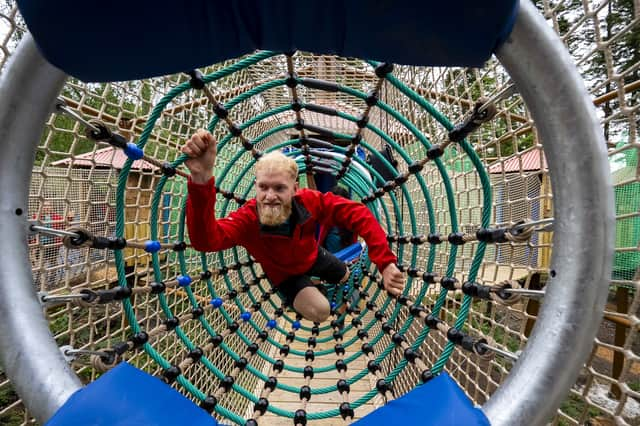
What most excites Jardine is the planned development by the specialist leisure operator Center Parcs. It aims to build a £400 million holiday village between Hawick and Selkirk, employing some 1,200 people when complete. The company already runs five holiday villages in England and one in Ireland.
“This is a game-changer,” says Jardine. He draws a comparison between the high-end clothmakers who took the name of Hawick across the globe and the culture of the Center Parcs business, which lays great store on delivering a quality product, customer service, staff training and skills development.
“Center Parcs will bring all-year, well-paid jobs. It can help revive Hawick and create stronger local markets in housing and retail. In every location the company has opened a holiday village, the wider economy of the surrounding locality has benefited,” he says.
Center Parcs undoubtedly has the potential to be the catalyst for something of a Hawick and Borders renaissance. And its contribution to stimulating new enterprises and reducing poverty could be significantly multiplied if there was cheaper energy and cheaper connections to the National Grid, in return for pylons and turbines on the landscape.
Those changes, in common with the need for locally available risk capital, are credible and achievable. What’s currently missing is UK and Scottish political imagination, will and vision.
Domestic and industrial robots will bring a new economic and social revolution. But robots can’t vote, and the voters will surely punish those who don’t act now to look after the humans.
Martin Roche worked in foreign direct investment and had a 35-year career in international public relations
Comments
Want to join the conversation? Please or to comment on this article.