
Mutually beneficial: How the Scottish Building Society is beating the odds
A multi-faceted transformation has seen the mutual’s balance sheet double to £866 million


“There are real people in here. Actual people.”
These words, printed in the window of Scottish Building Society (SBS)’s Edinburgh branch, hint at why building societies stand out in crowded financial supermarket of high street banks and digital challengers like Revolut.
Owned by their members, rooted in the communities where they were founded, they have made a virtue of not needing to drive returns for shareholders. Instead, they have focused on offering keener savings rates and flexible mortgages, particularly for first-time buyers. Many kept lending during Covid as banks stepped back. Trust and the human touch have mattered as much as turnover.
This has helped building societies stay relevant in an era still scarred by the 2008 financial crisis, pandemic, and now a cost-of-living crisis and the difficulty faced by young people getting a toehold on the property ladder.
Building societies accounted for 29 per cent of all UK mortgages and 37 per cent of first-time buyer lending in 2024, according to the Building Societies Association (BSA).
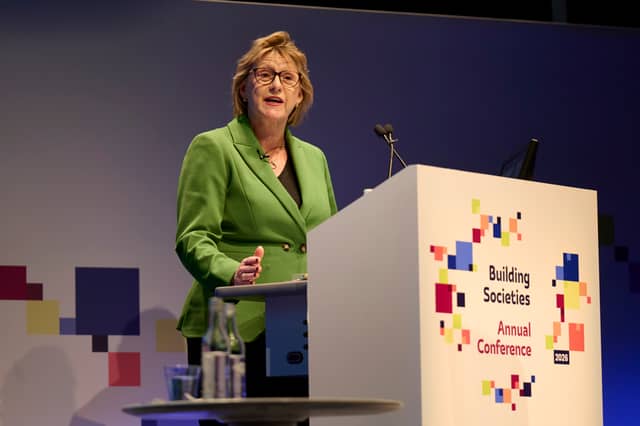
“In an economy seeking stability and a society looking for trust, the mutual model is not a legacy of the past. It is a very practical, a very modern solution to today’s challenges,” Sarah Harrison, BSA chief executive, told the organisation’s annual conference in Edinburgh this week.

Yet as the recent story of Scotland’s only remaining building society shows, the sector faces a moment of reckoning as competition, AI and digital transformation, and pressure to consolidate all bear down. The sector “is at a pivotal point”, Harrison warned.
SBS is the UK’s oldest building society, marking its 175th anniversary in 2023. When Paul Denton arrived as chief executive 2019, he found a business that hadn’t kept pace.
“I saw a brand that hadn’t really understood the changing nature of the mortgage market and that there was also a significant digital shift going on,” the former RBS and Cooperative Bank executive says in an interview. “This meant there was an opportunity to introduce digital into savings, to work with the intermediated mortgage market, and to raise the profile of the brand.”
Denton set about overhauling key roles, hiring IT, risk and social media marketing experts, many in former roles at RBS, Bank of Scotland, Clydesdale and Tesco Bank. In came a new head of marketing from advertising group JCDecaux. Campaigns were launched on Facebook and LinkedIn.
A chief risk officer - previously absent - now sits at the heart of decision making. “The capability, skills and experience of the people we brought in moved us away from a more traditional building society to where we have more experienced financial services professionals,” Denton explains.
The mutual’s public presence has also been bolstered with the launch in 2023 of The Scottish Building Society Foundation, which has supported 43 charities across Scotland.
Digital modernisation was a key move. Denton inherited a business still heavily reliant on paper and passbooks. Now, over half of all new savings accounts are opened digitally, compared with a mere 10 per cent in 2019. Behind this shift lies the closure of 50 odd “agencies” - a 1980s model where local law firms and accountants handled passbook updates on the society’s behalf.

Branches remain, but have morphed. Each of the six branches - Edinburgh, Glasgow, Aberdeen, Inverness, Galashiels and Troon – handles a specific group-wide task, with only 20 per cent of work handled in a branch related to footfall. For example, Galashiels handles retention of fixed-rate bonds, while Glasgow handles customer calls. “If I centralised it, I’d struggle to justify the branches,” Denton says.
Human contact remains important in other ways. Last year he hired Malted, a Scottish firm specialising in AI for financial services, to analyse customer calls.
This revealed that 10 per cent of help related calls related to bereavement, leading SBS to set up a dedicated bereavement team.
The mortgage business, meanwhile, has shifted from variable rate lending to the fixed rate products preferred by most UK borrowers. SBS now writes 90 per cent fixed mortgages, up from roughly half before Denton’s arrival. Lending to first-time buyers has doubled in two years.
Finally, in 2022, SBS began lending beyond Scotland for the first time, in the north of England. A few weeks ago, the board approved moving to coverage across the whole of England.
This multi-faceted transformation has seen the mutual’s balance sheet double to £866 million, propelling it to 21st largest of the UK’s 42 building societies by assets, from 29th . In the latest financial year to the end of January, SBS grew its mortgage portfolio by seven per cent.
Further growth may come if, as expected this summer, the UK government revises the Building Societies Act to allow building societies more flexibility in how to fund their lending beyond using savings deposits.
Yet had SBS not transformed, it likely would have struggled in the face of mounting sector headwinds. Among them is competition from banks, which are targeting significantly lower cost-to-income ratios through the use of AI-driven efficiencies, as Harrison told the conference.
“In a capital constrained environment, to enable good growth and maintain resilience, scale will matter more than ever,” she said, warning that rising costs and squeezed margins would be “particularly acute challenges” for smaller building societies.
Denton says that SBS is now “one of the most productive of the building societies for our size”. It has also picked a useful niche by focusing on mortgages for first-time buyers and interest-only mortgages for the over-55s looking to release equity from their homes.
“We needed to find our place within the market. And that’s what we’ve done successfully at Scottish Building Society,” he says.
Comments
Want to join the conversation? Please or to comment on this article.