
Music: Aidan O'Rourke on working with musicians from Greenland for Nordic Music Days


The fiddler and Lau frontman on creating a ‘forward-looking’ piece rooted in Greenlandic culture
When the call went out to Scots composers to submit project ideas for the first ever Nordic Music Days (NMD) festival to be held in Scotland, traditional fiddler and Lau frontman Aidan O’Rourke responded with several. The last thing he expected, though, was a call back offering a trip to Greenland. “It came out of the blue,” he recalls. “There had been a lot of response from most Nordic countries, but not Greenland.”
What had that to do with him, he asked Andy Saunders, project manager and festival planner for the Glasgow-based five-day event? “It appeared there was a healthy pop scene in Greenland, but not much in the way of new experimentalism that took its lead from indigenous music. “This was to be a kind of reach-out to Greenland to collaborate with me in creating a forward-looking piece rooted in Greenlandic culture.”
The result is Qullaq (meaning “ascending”), which O’Rourke performs with his Greenlandic co-creators and the classically-orientated Scottish Ensemble as part of NMD’s opening concert in Glasgow’s Old Fruitmarket on 30 October.
It all began last March, the day O’Rourke touched down at Kangerlussuaq Airport. “The first thing you notice about Greenland is that the air is very different, so clean, so cold, so crisp.” Among the several pointers he received on arrival was how to deal with polar bears. “If you see one just back off, don’t run, they’re generally not hungry this time of year.”
“We flew on to Sisimiut, Greenland’s second town, and there was this amazing festival, Arctic Sounds. The place was buzzing.” Here O’Rourke met his project team: vocalist Nive Nielsen, drummer/vocalist Hans-Henrik Suersaq (“we call him Ho-Ho”) and guitarist/vocalist Mikè Fencer Thomsen. “They are the most amazing polymaths - actors as well as musicians. Ho-Ho even makes clothes based on old Inuit designs.”
Traditional culture was to play a key part in shaping Qullaq, including the lingering colonial tensions between Greenland and Denmark. “That was very apparent from the start,” O’Rourke explains. “There’s a huge conversation around this among Greenlanders, whose culture [during colonial rule] was stifled.
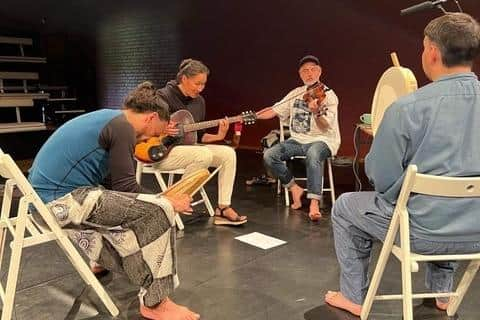
“Many were taken away from Greenland and sent to school in Denmark and told not to speak Greenlandic, rather like what happened in Scotland with Gaelic culture. All that was so apparent as we got to know each other. At one point I asked the guys, is this to be a political piece? For us, they said, it’s impossible for it not to be.” Ironically, the ground work for Qullaq took place in Denmark’s state-of-the-art Nordisk Teaterlaboratorium in August. “And the Danes were paying for the whole thing,” O’Rourke laughs.
The creative process drew on everyone’s distinctive strengths. “Ho-Ho is an encyclopaedic tradition bearer, so there’s drum dancing and Inuit poetry involved. There’s a leaning, too, towards the 1970s politically-motivated post-Beatles pop movement in Greenland, in particular a beautiful song inspired by one of its iconic groups Sumé. That’s where Nive comes in.”
O’Rourke naturally led from the fiddle, and has pulled everything together with additional scoring for the Scottish Ensemble. “It’s my string writing that bridges the gap. I try to push the limits, drawing on influences from minimalism to post-modern 20th century writing, but at its core is a recognisable melodic, folkish feel.”
He describes Qullaq as “a continuation of the journey I’ve been on for the last 20 years, looking at tradition as a starting point for innovation while believing it should continually move forward by drawing on different influences. That’s why Andy brought me into this project, knowing I’d tap into the Greenlanders shared belief that their own fascinating tradition should not become a museum piece.”
As for Scotland hosting the festival, O’Rourke hopes that NMD’ first staging in Scotland will focus minds here on the proven benefits of arts funding elsewhere. “Look at those Nordic countries with populations similar to Scotland, the percentage that’s invested in their arts and music, and the rich returns they get from that. In such an encouraging environment there’s much more scope for experimentation and collaboration, where new and exciting things can happen. Here, people are just getting by, so everything’s a bit stagnant.”
Nordic Music Days runs from 30 Oct-3 Nov in Glasgow. Full programme details and ticket information at https://nordicmusicdays.org