
Emerging composers launch new work created on SCO's Soundbox programme - 'It's been a steep learning curve'
Two concerts in Edinburgh and Glasgow later this month will showcase new work by composers mentored by Jay Capperauld as part of the SCO’s Soundbox initiative. Ken Walton finds out what’s in store
For the three composers nearing the end of their year-long mentorship on the Scottish Chamber Orchestra’s Soundbox artistic development programme, the process has been challenging and rewarding in equal measure.
“Developing an idea into an eight-minute piece is very different from writing a three-minute song,” says Irish-born Emily Scott-Moncrieff, the Glasgow-based singer/songwriter and double bassist more used to her frontline role as lead singer in the pop band Modern Studies.
Naafi, meanwhile, an erstwhile Glasgow School of Art student who turned to songwriting, DJ-ing, creating ambient electronica and for a while fronted their own radio show, A Fix, on EHFM, has also found the experience tough but stimulating. “When writing for a live ensemble there are so many more factors to consider,” says the Fife-born exponent of experimental, left-field dance and pop. “Being self-taught, I’d never scored anything before. It was a big task to take on.”

Dan Abrahams, an Edinburgh engineering graduate who worked full-time in renewable energy before tipping the professional scales towards music, has spread his wings wider than most, and is active across jazz, funk, soul and folk. Getting to grips with the classical challenge has required new thinking, new approaches, he says. “For me, a limitation has never been creative ideas or enthusiasm, but to write for a big ensemble like the SCO, doing the notation thing and understanding how to develop an extended piece has been a steep learning curve.”
As such, the SCO’s Soundbox has provided the perfect vehicle for these musical creatives and their journey of discovery. It allows them to learn and develop on the job, not just with the SCO’s brilliant musicians at hand to road test their ideas, but under the lead mentorship of the one of Scotland’s most interesting, original and open-minded creatives, SCO associate composer Jay Capperauld.
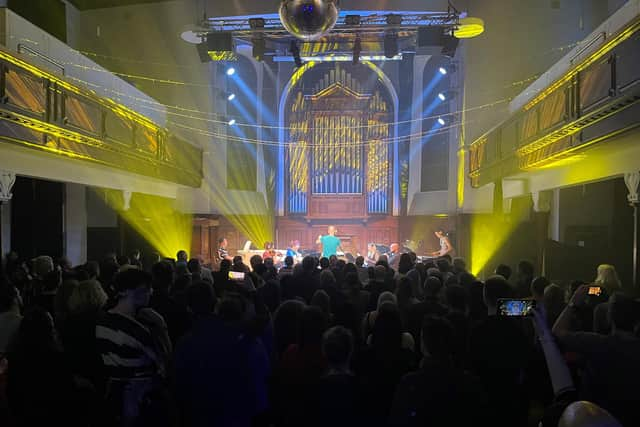
Their collective responses come to fruition this month in UN:TITLED 2024, a showcase SCO programme at Edinburgh’s Assembly Roxy on 15 June and Saint Luke’s, Glasgow, on 16 June, where the products of this year’s Soundbox – one composition apiece moulded through successive workshops and discussion sessions with SCO players, Capperauld and external mentors Nathan Hall and Ben Lunn – will feature alongside music by Guillaume Connesson, John Adams and Capperauld himself. Both nights are co-hosted by Capperauld and DJ Dolphin Boy.
Foremost among Capperauld’s aspirations was to encourage self-expression among the participants. “Each comes from a different background with different creative practices, musical experiences and interests. My main desire was to try and find a way for the cohort members to become the creative forces they want to be,” he says. “As mentors we had to learn how they tick, then try to facilitate their development without being prescriptive. So rather than showing them a blueprint for their process, it was important to get to know Emily, naafi and Dan well enough to respond to their interests with longer term goals in mind.”

So what does Capperauld make of the immediate results? “These are all fantastic works which will be a real musical treat for the audiences at UN:TITLED,” he says. But what do the composers themselves have to say about their music?
Scott-Moncrieff’s She Breathes, She Becomes is “about mortality”, she says, the inspiration coming from a bunch of flowers she bought from a supermarket which she watched die over two weeks “until my husband made me chuck them away.”
“When writing it, I was thinking about the human condition, about women,” she says. “There’s a lot of stuff on social media about young girls growing up who aren’t even women yet are concerned about ageing.”
Chiefly a songwriter, there is, she says, a natural melodic flow to the music. “But it was exciting to have such a wonderful string section to create the dense romantic sounds I wanted. I think this piece is recognisably me. It’s not a drastic departure from what I normally do, but it’s made me want to step into this new world as a composer, to write a lot more classical instrumental music and combine it with my own world. I now know how to find the instrument I have in mind and make it work for me, and how to extend my musical thoughts.”

Abrahams hopes the title of his SCO work is “not too cheesy”. It’s called Hope in the Dark, after an essay by Rebecca Solnit arguing the positive case for social and environmental activism. “As an environmental engineer, I genuinely worry about the world, the climate crisis, wars raging, it’s scary,” he says. “I’ve tried to express that in my music through the contrasts and interweaving of darkness and light.”
“The discipline of writing this has definitely changed my outlook on what might be possible for me as a composer. I never thought I’d be someone who’d be able to write for an orchestra. It’s given me a lot of confidence, and I’ve now written a string quartet, even found an ensemble to play it.”
For naafi, the journey from initial thoughts to finished article was tough but adventurous, especially the transition required from their familiar electronic musical world to the acoustic one. “Suddenly music was being played by real people, not instruments you can programme. It was quite intense to go from just making things by yourself to providing material for an ensemble. It’s about being sure of your idea and I guess I wasn’t really sure about mine. I have to try stuff out,” they say.
In the end they struck a productive compromise, improvising the framework of the piece – Joyride in your Aura – on piano and synthesiser before arranging it into parts. “Working with the SCO players helped me move away from purely electronic stuff,” they say. “There are things I can now take into my future work.”

Such comments are music to Capperauld ears. “That, for me, is the real reward from my involvement: helping people in a much longer career trajectory. It’s about planting a seed for each individual participant. Soundbox is fundamentally a development scheme that puts the individual at the heart of the experience.”
The SCO performs works by this year’s Soundbox Music Creators in UN:TITLED 2024 at the Assembly Roxy, Edinburgh, 15 June and Saint Luke’s, Glasgow, 16 June, see www.sco.org.uk
The Scotsman is the official media partner of the SCO’s 2024-25 Season. For a 20% discount on tickets, use the code TSMSCO20 when booking – available from 24 June via venue box offices