
Early Music Festival, Glasgow reviews: Hepburn IV | iuchair
The first night of the Early Music Festival in Govan had performances to entertain, stimulate, surprise and provoke, writes David Kettle
Hepburn IV, Govan Old Parish Church, Glasgow *****
iuchair, Govan Old Parish Church, Glasgow *****
Whisper it, but there’s something quietly visionary going on in Govan. You hear a lot about social change through the power of music, but it’s far rarer to see it actually happening. Head to Govan and you will, however, courtesy of the hyper-local and community-focused activities led by the Glasgow Barons and its seemingly indefatigable leader and conductor Paul MacAlinden. The orchestra puts on concerts of its own, but the organisation is deeply embedded in the local community in supporting and showcasing the skills of refugee musicians, celebrating Scottish talent, nurturing a hip-hop underground, training local youngsters in early strings – the list goes on.
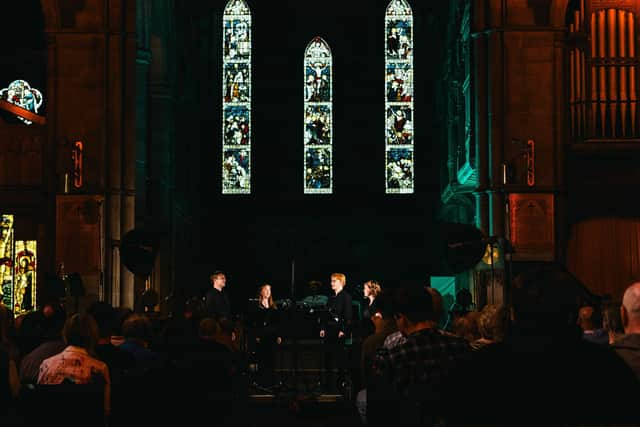

Which goes some way to explaining the sizeable audiences for what were somewhat esoteric, if not downright challenging programmes of choral music from as far back as the 13th century at the opening night of the Glasgow Barons’ second annual Early Music Festival.
And what they got were two contrasting concerts from two very different Scottish singing quartets. The youthful Hepburn IV met as choral scholars at St Andrews University, and their velvety, assured performance belied their somewhat tender years – as did their clever choice of repertoire.
The concert’s first half was deeply devotional, and delivered with a fluid gracefulness and remarkable sense of balance and ensemble that made for exquisite sonic beauty. Their Josquin Missa Pange lingua, for example, stressed meaning over immaculate sound, with a rhythmic swing to the Gloria and real joy to its peal of closing Osannas. After two intricately florid Palestina motets, which the Hepburns attacked with vigour and conviction, they moved to an anonymous Scottish ‘Descendi in hortum meum’ from the Biblical ‘Song of Solomon’, austere, monumental and granitic, but still sensuous in the group’s shapely account.
The mood shifted entirely after the interval, however, with a set of witty madrigals from France, England and Italy. Certon’s ‘La, la, la, je ne l’ose dire’ is virtually a 16th-century pop song, and a lot of fun in the Hepburns’ dancing, prancing account. If you put a beat behind Passereau’s ‘Il est bon et bon’ it wouldn’t be out of place in Eurovision. It’s testament to the group’s enthusiasm that they retained their earlier poise and precision while clearly conveying so much enjoyment.
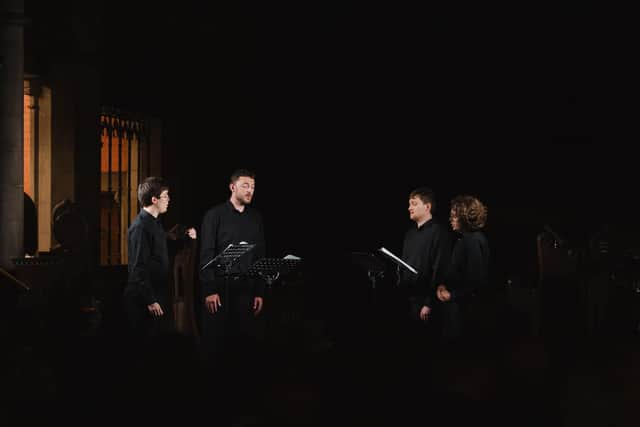
Where there was sweetness and buoyancy in the Hepburn IV’s accounts, Glasgow-based all-male quartet iuchair revelled in vocal rawness and austerity in their late-night concert, to hugely powerful effect.
The main meat of their hour was a collision between Machaut’s hard-edged, sometimes ear-tweaking 14th-century Messe de Notre Dame and the rich, sensuous and sophisticated Quatre petites prières de Saint François d’Assise by Poulenc. There were more similarities than you might imagine, from Machaut’s arcane harmonies finding parallels in Poulenc’s passing dissonances, and winding melodic melismas decorating both. The singers might have made more of those surprisingly connections by running the movements more closely together, but it was a revelation nonetheless – as was iuchair’s reedy, sinewy vocal timbre, a world away from the richness and opulence of earlier in the evening, and seemingly a reminder of just how challenging and alien music from centuries past can be to modern listeners.
It was an evening to entertain and stimulate, sometimes even to surprise and provoke, and a reminder, too, that building the level of trust with a community that the Glasgow Barons have achieved in Govan can allow you to take listeners on some surprisingly challenging journeys.
Comments
Want to join the conversation? Please or to comment on this article.