
Exclusive:Beating Ireland in Dublin: how we managed to do it - Scotland's Hugo Southwell on Six Nations glory
Full-back on a famous afternoon and what the current team need to do

When Scotland last beat Ireland in Dublin it was the wooden spoon on the line rather than the title.
It happened 16 long years ago and the victory meant Italy ended up with the booby prize, despite beating the Scots in Rome earlier in the campaign.
Hugo Southwell, who was at full-back for the visitors, remembers the victory being extra sweet because it was the final international rugby match to be played at Croke Park.


Ireland had decamped to the famous Gaelic games citadel while the Aviva Stadium was being built on the site of the old Lansdowne Road. The match against Scotland should have been a glorious send off for the hosts who were aiming for the Triple Crown but the visitors spoiled the party, winning 23-20 thanks to an inspired kicking display from Dan Parks and a fine try by Johnnie Beattie.
“What a place, I mean, I don't think I've ever experienced playing in such an amazing stadium,” says Southwell. “It was such a vociferous crowd, well, for the first 65, 70 minutes…”
He is returning to Dublin this weekend. It will be the first time he has watched Scotland in the Irish capital since calling time on a career that saw him win 59 caps between 2004 and 2011 and play club rugby for Bristol, Worcester Warriors, Edinburgh, Stade Français and Wasps. Not a bad CV for someone who says cricket was his first love and was recently accepted as a playing member of the MCC.
‘We were always underdogs’
Southwell, 45, still turns out for Carlton in Edinburgh when he can and the cricket season is just around the corner but the focus is squarely on rugby this weekend.
Scotland’s match with Ireland is their biggest for a generation, their chance to win a major honour for the first time since 1999. The victors on Saturday will lift the Triple Crown, and maybe even more. The Six Nations title is a three-way race between France, Scotland and Ireland and if Gregor Townsend’s side are to prevail they are going to have to emulate the side of 2010 and hope the French stumble against England in Paris.
Over 80,000 crammed into ‘Croker’ 16 years ago, the majority expecting to see silverware presented to Brian O'Driscoll who captained an Ireland team boasting some stellar talents. The peerless outside centre had Geordan Murphy, Tommy Bowe, Gordon D'Arcy, Keith Earls and a young Johnny Sexton alongside him in the backline while the pack included Paul O'Connell, Jamie Heaslip, Donncha O'Callaghan, Rory Best and Cian Healy. Quite a team.
“Sexton was starting and Ronan O’Gara was coming off the bench,” recalls Southwell. “Let's be honest, with where Scotland were then, we were always underdogs, but that’s when we seemed to perform the best. And we probably still do, but on a much more consistent basis now.
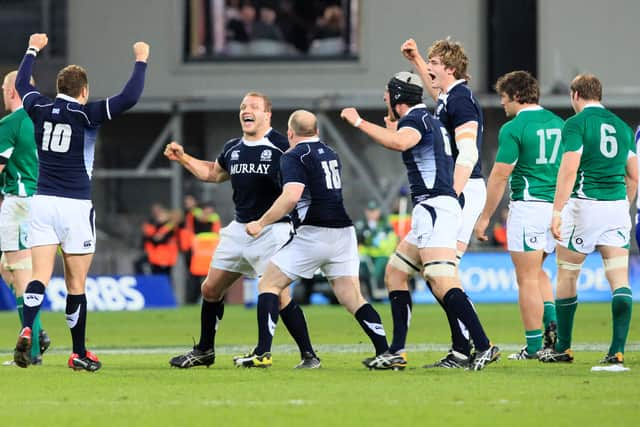
“We went into that game having lost our first three and then drawn with England, whom we had a good record against at Murrayfield, winning in 2006, 2008. So we went to Ireland with nothing to lose, really
The stand-off with the stylish sideburns
“They had a lot to lose, because they were going for the Triple Crown, which, again, is very familiar with this weekend, and we managed to do it, against the run of play, you would say. We put in a performance that we could celebrate, and it was the last game at Croke Park so it was an amazing finish to the Six Nations, but it was needed after what we'd done for the rest of the tournament.”
Parks, the stand-off with the stylish sideburns, kicked five penalties and a drop goal and, as was often the way in those days, turned in the sort of controlled performance which edged Scotland over the line. The Aussie-born playmaker wasn’t everyone’s cup of tea and lacked a little bit of adventure in his play but his trusty boot seldom let Scotland down.
“He got quite a bit of unfair criticism,” says Southwell. “The type of game he played, it was more about his phenomenal kicking game, out of hand, and a goal. Chris Paterson was the main kicker but Parksy was tasked with the ones from further back, and he had a fairly good record on that front.
“OK, he maybe didn't have the attacking flair that Finn Russell does, but at the same time, he won more games for us than he lost and I think he deserves quite a bit of credit in situations like that.”
It was Parks’ last-gasp penalty which won the day for the Scots in Dublin in 2010 after his long, deep kick had put Irish replacement Rob Kearney under pressure. It was no gimme either: close to the left touchline and very much in earshot of the booing Irish supporters who had made their temporary home a fortress. It was a venue Southwell loved and he had the honour of booting the ball into touch from a ruck to seal the win.
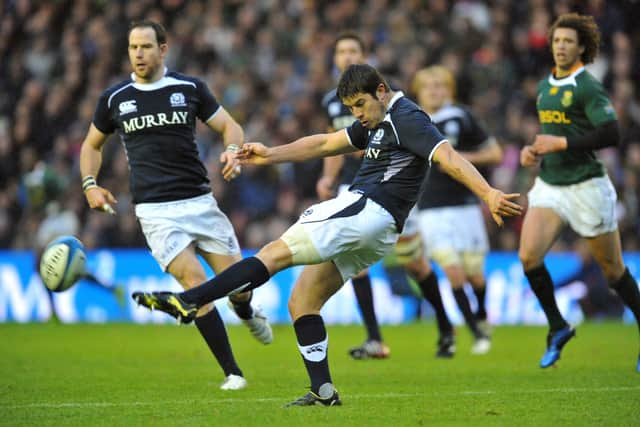
“I remember warming up on the Friday with Dan Parks, just doing some kicking and stuff, in an empty stadium. It was probably the best surface I've ever played on because a minimal amount of games had been played on it throughout the season.
“It was an amazing place to play, and it was a shame they moved away from that, but, you know, the Aviva's a great place too and I'm looking forward to being there this weekend, first time as a fan.”
Have we worked out a way to beat Ireland?
The Scotland of today is a very different beast. During Southwell’s time there weren’t too many tries to celebrate and the kicking of Paterson and Parks was key along with a very good defence led by Jason White. Gregor Townsend’s Scotland are a more freewheeling outfit, a side capable of scoring an incredible seven tries against a previously unbeaten France, as we witnessed last week. So how does Southwell rate their chances in Dublin, a graveyard for Scotland for so long?
“I mean, the reason you're speaking to me now is because we haven't won in Ireland for 16 years, so I think that speaks for itself,” he smiles.
“My biggest concern is have we worked out a way to beat Ireland? We have come on as a team, we have matured and we have got better as the tournament's gone on. We're scoring loads of points, which we'll need to do again at the weekend. But I’m not as confident as I was against France. We have a really good record against France at Murrayfield. We haven't got a really good record against Ireland in Ireland, and that's the biggest concern. When we come up against Ireland in games where it means something to us, we haven't performed. Both World Cup games [in 2019 and 2023], everyone's hyped it up and we've not played to our potential.
“They will come so hard at us. They know, if they can out-muscle us up front, which has been a real problem for us, and strain us up front, and slow the ball down and not give us what we got against France, which was a really quick ball, then it becomes a hard slog for Finn, for Ben White, and it makes our job very difficult. Have we managed to work that out in all the times we've played against them? That is the biggest question.”
A Scottish win in Dublin is long overdue, just as it was in 2010. That was their first victory in the Irish capital since 1998, making it just two in 28 years.

Southwell doesn’t buy into the theory that the current Irish team is in decline. He sounds like he will travel with hope rather than expectation this weekend. Regardless of the result, he will enjoy the chance to return to Dublin and perhaps reminisce about 2010 in a Q&A he’s doing on Friday in the city.
“I would say we were definitely behind the eight-ball most of the game in 2010, but we scored a brilliant try early on, I remember, down the blindside involving Graeme Morrison and then Johnnie Beattie finishing it off, a 40-metre run to the line - he'll probably tell you it was 60!
“We didn't score many tries back in the day, it was a lot of kicks, a lot of penalties, but that gave us encouragement and I think from there we just managed to play a very smart game, defended well, kicked well, took our opportunities, which is absolutely key, not just in Ireland, but away from home,
“That's another thing that will come into the game this weekend. Ireland are historically very good at making you work for points. Ireland will make it very difficult for you to score, so you've got to be clinical.”
Russell and co, take note.
Comments
Want to join the conversation? Please or to comment on this article.