
Willie Collum delivers damning verdict on major VAR errors involving Celtic, Hearts and Hibs - but Rangers calls correct

SFA referee chief has say on VAR controversaries
A missed penalty, two goals wrongly chalked off and a red card incorrectly overturned.
Those were the four major VAR errors identified by Scottish FA head of refereeing Willie Collum as he addressed the latest controversy involving match officials in the Scottish Premiership.
Collum, speaking on the VAR Review Show, indicated that VAR was wrong to disallow a Celtic goal for the ball being out of play during their 2-1 defeat to Hibs at Easter Road on February 22.
Daizen Maeda netted what would have been a late equaliser for Celtic but VAR determined that the ball had crossed the by-line before Alistair Johnston delivered the cut-back.
The goal was subsequently ruled out but Collum felt that the camera angles available to the VAR were inconclusive and that the onfield decision to award the goal should have stood.


Collum said: "You need 100 per cent conclusive evidence to disallow the goal here and prove that the ball is over the goal line. In this case, it is not possible to prove categorically that the ball has crossed the line fully. We know from previous examples at World Cups that a ball can look out from certain angles, but then when you look at the camera above, a slight part, a millimetre of the ball can be overhanging the goal-line and that's enough to say the ball is in play.
"So on this occasion, for us, we expect the onfield decision to be supported and the goal to be awarded. If the assistant referee had flagged here, and in his opinion the ball had crossed the line for a goal-kick, we would also expect that decision to be supported, because there is no 100 per cent conclusive evidence. It's impossible to prove otherwise."
Collum also admitted that St Mirren should have been awarded a penalty kick during their 5-2 defeat to Celtic last Saturday. The match was still in the balance, with Celtic 3-2 ahead, when Alistair Johnston appeared to foul Roland Idowu inside the box with four minutes plus stoppage time remaining.
Referee Matthew MacDermid decided to wave play on, and VAR backed him up by failing to intervene, indicating that Johnston had got a slight touch on the ball before making contact with Idowu. However, Collum felt this was the wrong call - a viewpoint backed up unanimously by the KMI panel.
"For us this is a penalty kick and a yellow card," Collum stated. "This is a reckless challenge by the Celtic player. There is fine margins when it comes to decisions like this but there is a clear difference for me between touching the ball and playing the ball. There is a sclaff on the ball, the direction of the ball doesn't change, and then there is reckless contact onto the player. We know now in football you can touch a ball and there can still be a reckless foul."
Collum also determined that VAR was wrong to disallow a Sam Dalby goal for handball during Dundee United's 3-1 defeat to Hibs at Tannadice last midweek. The game was poised at 1-1 in the 62nd minute when the on-loan Wrexham striker headed home at the back post from a United free-kick but the goal was chalked off due to a handball after a five-minute VAR review. Hibs went on to score two late goals to extend their unbeaten run and leapfrog United in the race for third place.

The decision sparked outrage in the United ranks with Tannadice chiefs subsequently requesting access to the VAR audio and video due to an apparent lack of clear evidence that a handball offence had been committed. United manager Jim Goodwin said: "There isn't a conclusive angle that shows there was any handball, therefore we believe that the goal should have stood and it should have put us 2-1 up in a very important game."
The KMI panel were in unanimous agreement that the potentially game-defining goal should have stood, and Collum backed this up, stating: "Could it hit the arm? Yes absolutely it could. But do we have 100 per cent conclusive evidence of the ball striking the arm? We don't, therefore the onfield decision should be supported. People have said to me the other club will complain. But it's about proof. We need to be categorical and clear, especially when it's overturning an onfield decision."
Another error was flagged at Tynecastle Park last midweek when a red card shown to St Mirren's Killian Phillips for a challenge on Hearts defender Jamie McCart was overturned following a VAR review.
Phillips appeared to make no attempt to compete for a high ball as he barged into McCart with force, catching his opponent in the head with his shoulder, and leaving the Hearts man requiring treatment.
Referee Euan Anderson initially gave the Saints player a red card for an elbow but was asked to check the incident again on the VAR monitor due to the point of contact being the shoulder, before downgrading the card to yellow.
Hearts were leading 2-1 at the time and went on to complete a 3-1 victory but manager Neil Critchley felt the challenge amounted to "dangerous play" adding: "Having seen it back, I’m not sure why the referee overturned it."
Both Collum and the KMI panel were in unison that the original red card should have stood with the referee called to the monitor due to “protocol” reasons.
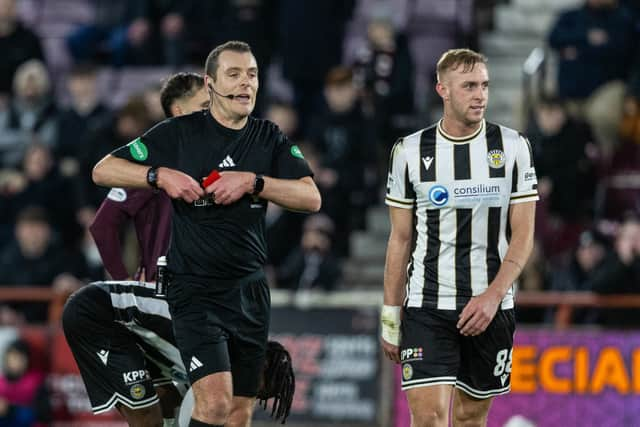
"The reality is it's not an elbow. It's a shoulder," Collum said. “There will be many people watching who say it's still a red card so just stick to it. But for me the problem here is that is technically re-refereeing the match. The VAR would be supporting a red card for a decision that didn't happen, because it's a shoulder. I know people will say we're splitting hairs, shoulder or elbow, but it's the right thing in terms of protocol. The unforuntate thing is, psychologically for a referee, when they are brought to a monitor they think they've made a mistake. But we need our referees to be strong enough to see the images, take into account everything that has happened, and change the decision for the elbow to a shoulder, still being a red card. There is speed, intensity and endangering the safety of an opponent. We've coached on the back of this that if a referee is brought to the monitor for a protocol matter they still need to assess the incident. It doesn't mean the red card is wrong, but it's not for the reason that's given."
Collum also addressed two incidents involving Rangers. The overturning of the red card shown to Hamza Igamane in the 2-0 defeat to St Mirren at Ibrox was described as a "perfect use of VAR" while the Hearts penalty claim for a push on James Wilson by defender Clinton Nsiala in the match at Tynecastle on February 16, which Rangers won 3-1, was dismissed.
"The referee is in an excellent position and is clear and emphatic in his communication," Collum said. "For us this would have been a case of VAR re-refereeing the match to become involved here. There's not enough for a penalty kick. Not everybody will agree, but we are content with no penalty. There are subjective elements but when the referee is well positioned and clear in their communicaiton, we don't expect any VAR involvement."
Comments
Want to join the conversation? Please or to comment on this article.