
Rangers' Iron man of Ibrox always turned up - and should always be remembered

Davis’ incredible story certainly deserves a wider audience
When Rangers TV released a short film about Harold Davis, the former Rangers player and war hero, on YouTube at the end of last month, the idea was to allow an important tribute to reach a wider audience.
It’s hard to imagine they could have predicted the initial interest. The mini documentary from RTV Studios has already attracted over 10,000 views. It is well on the way to the 100,000 (and counting) audience for a similarly essential homage to Davie Cooper to mark last year’s 30th anniversary of the wondrously talented winger’s dreadfully premature death.
Harold Davis: Proud to Serve was actually made three years ago. Originally broadcast on the subscriber-only Rangers TV, it is now free for all to watch. My advice? Do yourself a favour, particularly on Remembrance Sunday weekend.

Familiarise yourself with a tale of derring-do that ought to be turned into a blockbuster. It contains all the ingredients. Davis was in the process of establishing himself as a footballer with East Fife before National Service took him to Fort George, the Black Watch’s regimental base near Inverness, and then to the ‘forgotten war’ in Korea.
According to a telegram delivered to his parents’ house in Perth, “Corporal Harold Davis” was placed on the “dangerously ill” list after being gunned down at the Hook – a ridge around which much of the intense fighting took place – in May 1953.
As well as multiple stomach wounds, he sustained a shattered heel bone. A return to football seemed out of the question but after more than two years of rehabilitation, Scott Symon, his old East Fife manager, signed Davis for Rangers.
His incredible story certainly deserves a wider audience. I have to declare an interest because it’s now 20 years, almost to the day, since my then sports editor handed me an assignment that still ranks among the most memorable of my time in journalism. I was tasked with interviewing Davis for this newspaper.
Like so many things worth doing, it wasn’t a straightforward mission. We had to track Harold down first. Last heard of running a hotel in Gairloch, he had since moved with his wife Vi to Badachro, a small fishing village outside the Wester Ross town.
I drew up outside his beautiful home and sat rapt for hours in his company. When I made moves to leave – after all, a near five-hour drive back to Edinburgh loomed – I was instructed to stay the night. I did what I was told. Nobody disobeyed Harold – or Vi for that matter.
Another place was set at the dinner table and then we sat and watched the League Cup quarter-final between Hibs and Hearts while awaiting updates from Ibrox as Paul Le Guen’s Rangers hosted St Johnstone. A 2-0 home defeat underlined where the Ibrox side were at the time and prompted evident grumbles of disgust from the direction of Harold's chair.
The piece, when it appeared, was headlined: “The forgotten hero of a forgotten war". Harold isn’t forgotten now but it did seem like he was forgotten then. Not, I accept, by knowledgeable Rangers fans of a certain age, who recognised his distinction in bridging two eras.
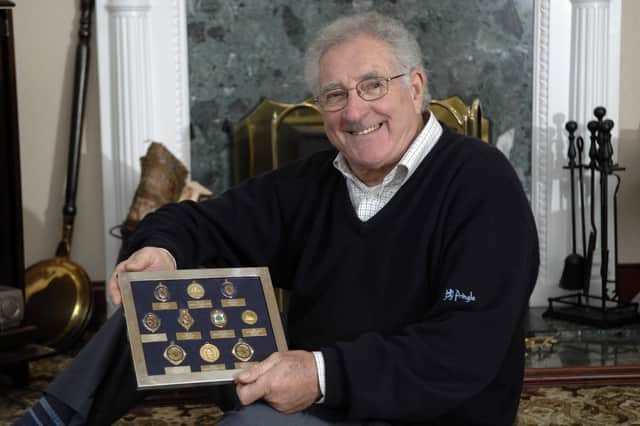
When the right-half joined Rangers in 1956 he played with George Young, Ian McColl, Alex Scott and Johnny Hubbard. When he finished eight years later the likes of John Greig, Jim Baxter and Willie Henderson were in the team with him. He bridged two great eras and won four league championship medals, two League Cups and a Scottish Cup.
The medals are back on display at Ibrox. “Harold’s son Alan sold the medals to raise money for a local kids’ charity in the Gairloch area which unfortunately meant they were leaving Ibrox where they had been on display in the museum,” reports Tom Clark, a friend.
“But the wonderful news is that the buyer who bought them did not want the Rangers fans to miss out on seeing them and loaned them back to Rangers. They are now back in the exact same position where they were. So you have the double bonus of the medals being back on display and children benefitting in Harold’s name.”
Davis was a modest man but there was one claim he made on behalf of himself that sticks in my mind and remains true to this day.
“I might not have been the best player who ever put on a blue jersey,” he told me as the low winter sun dipped into Gairloch Bay. “But not one person who has put on a blue jersey started below where I had been in a physical sense and managed to reach the heights I did.”
It’s why he was so affronted by Jim Baxter’s casual attitude and tendency to turn up for games with the smell of the booze from the previous night – or from earlier the same day – still on his breath. He never toned down his disdain for his talented but wayward old teammate, whom he once pinned against an Ibrox dressing-room wall for some on-field insolence.
Rangers had no finer ambassador than Davis, who was delighted to be offered the honorary life president position of the Rangers Supporters Erskine Appeal (RSEA). This charity, founded by Clark to support Erskine homes for ex-service men and women, celebrates its 20th anniversary early next year and has raised £1.7 million to date.
It goes from strength to strength and remains inspired by Davis, who died eight years ago at the age of 85.
A chair is left empty at fund-raising dinners for both him and Vi, who passed away in 2023. It’s a deserved and poignant gesture but one that might cause Harold to smile. Being 'empty-chaired’ is a horrible modern term denoting those who haven’t contributed or haven’t turned up.
The Iron man of Ibrox always, always turned up. His contribution, while immense to Rangers, extended far beyond the club and merits the gratitude of all.
Comments
Want to join the conversation? Please or to comment on this article.