
Inside Rangers' Nicolas Raskin 30-minute individual talk as future spelled out to Belgium World Cup hopeful

Midfielder has key part to play under Rohl after Martin challenges
The old adage that one player is not bigger than the team was sorely put to the test at Rangers earlier in the season when midfielder Nicolas Raskin and then head coach Russell Martin clashed.
Already fighting a losing battle with the Ibrox support, Martin’s stock with the Rangers faithful plummeted further when he ejected Raskin from the first-team squad on the eve of the first Old Firm match of the season.
That decision - partly vindicated by a 0-0 draw with Celtic - was made on the back of a 6-0 humiliation by Club Brugge. Earlier in August, Martin called out players who he felt had “egos” after the opening-day Premiership draw at Motherwell. It was clear then that he had an issue with certain individuals and the dropping of Raskin put the Belgian firmly in that category.


Raskin is undoubtedly a challenging player to manage. The 24-year-old always speaks well in the press. He has a confident gait, shoots from the hip and has faith in his abilities. He is not the only one. His father Thierry was quick to wade into the debate when Martin hung his son out to dry.
Previous coaches have alluded to Raskin’s defiance. Yet so many talented footballers need managed carefully. Martin failed on that front. His successor Danny Rohl appears to be making a much better fist of it.
Raskin was one of Rangers’ better players in a gloomy 2024/25 campaign. His form has catapulted him into the Belgium starting XI as a No 6. All being well, he will be in Rudi Garcia’s team for their World Cup opener against Egypt on June 15. In the last transfer window there were suggestions he would be allowed to leave as his relationship with Martin disintegrated. Rohl does not want that to happen this time around.
‘Absolutely convinced Raskin recognises what we are doing’
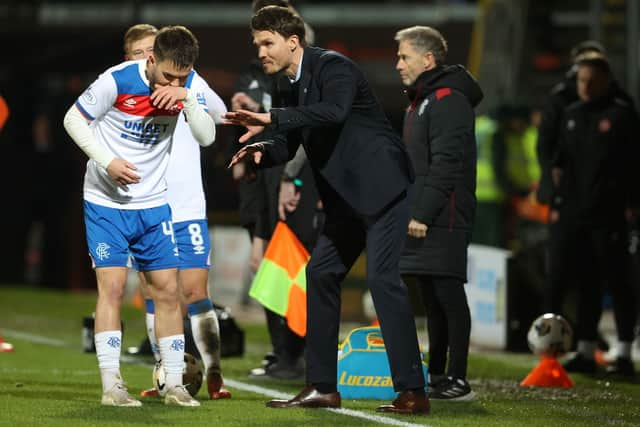
“Nico is an important player for me and the group,” said Rohl. “We worked individually on him, also in meetings I spoke with him what I want to see more.
“I think for me he is a No 6, because he likes to have the game in front of him. I see that he can take it forward from a six, rather than backwards from an eight or ten position. That's very clear for me that he is a six.
“It’s important for players to always to see a development, to see a direction where we want to go. I think this is what we deliver at the moment. I give him a picture of what I want to see from him.
“I had an individual talk with him in the last days, very long, 25-30 minutes. I’m absolutely convinced that he recognises what we are doing.”
Raskin is contracted until the summer of 2028 and in recent interviews has not hinted at any desire to leave. He knows that playing regularly at Rangers will cement his position in the Belgium team. More attractive suitors are likely to come calling after the summer if he impresses in the second half of the season at Ibrox and then at the World Cup.
Rangers have been linked with French midfielder Pierre Ekwah in recent weeks but he is set to be a replacement for Joe Rothwell. The 30-year-old was Martin’s preferred option at No 6, which forced Raskin higher up the pitch. Rothwell is not in Rohl’s plans and is expected to leave Ibrox next month. Raskin, who has started all but one of Rohl’s Rangers matches, is a shoo-in when it comes to configuring Rangers’ midfield. The next step is working out who compliments him best - starting at home to Motherwell in a crucial Premiership match on Saturday.
“I think in general, not just Nico, all parts of the game, the midfield, we need more structure,” added Rohl. “I think we lose sometimes the structure in possession, not against the ball, and against the ball it's very clear what we are doing. I like what I see there, that we have ball winnings, especially Nico when he's in front for defending, he has a lot. But in possession, we have to control the game more. And if we do this, then we help also our players around.
“This is the part that we have to improve in the midfield, but also as a group - our decision making. At the moment, if you have option A and option B, and option B is the advantage, we decide too often to option A, the disadvantage.
“This is what we have, I saw this in some games now. We have on one side, there is a plus one player, we have overload. Instead, we use this side, we play in the wrong side, and then we bring our own problem. This is in some phases and then it looks like we are not connected enough, we have not the net again. And if we do this, then we are much, much, much better.”
Comments
Want to join the conversation? Please or to comment on this article.