
Practical tips for using Studocu AI to prepare for UK university exams


If you’re studying at a UK university right now, you already know how messy things can get.
Many students are juggling lectures, part-time work, and long reading lists all at once. Higher Education Policy Institute (HEPI) reports that 68% of full-time undergraduates now work during term time, while the average student manages only 11.6 hours of independent study a week.
It’s no surprise, then, that an Advance HE survey found that only 26% of students feel their academic experience exceeded expectations. When time and energy are already stretched, it’s easy to fall behind.
The good thing is that revision doesn’t have to rely on long hours alone. Studocu AI has a few tools that help you organise your notes, understand concepts faster, and approach exam prep more confidently.
Use class recording to fill the gaps you miss in fast lectures
Lectures often move quickly, and it’s normal to miss parts of an explanation while trying to follow along. Class Recording helps by letting you revisit the session later and go back over the moments that didn’t fully make sense. Even though the recording is one full lecture, being able to replay the parts you found tricky can make your notes clearer and easier to follow.
This becomes even more helpful during revision. Hearing your lecturer’s examples or small clarifications again often makes the topic “click,” especially since those verbal details rarely appear in the slides.
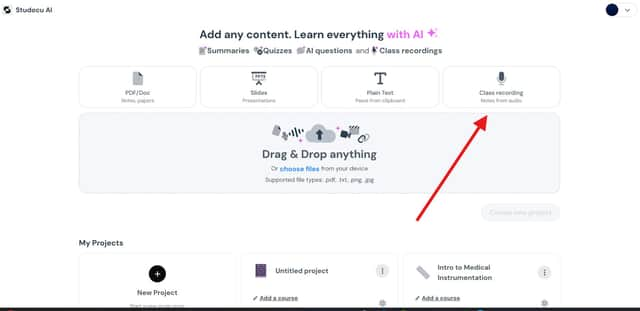
Tip: During the lecture, note down the slide number or the moment when something feels unclear. It makes it much easier to jump to the right section when rewatching.
Turn long materials into clear revision notes with AI Summaries
Most modules come with long slide decks, heavy readings, and detailed theory. AI Summaries helps you turn all of that into shorter, more organised notes. Instead of trying to digest everything at once, you get a clean outline that shows you what the topic is really about.
This makes revision feel more manageable, especially when you’re trying to balance multiple subjects or part-time work. Starting with a clear summary means you’re not wasting time figuring out what matters most.
A useful way to approach this is to compare the AI-generated summary with your module’s learning outcomes. If the key themes match, you know your revision is focused on the essentials.
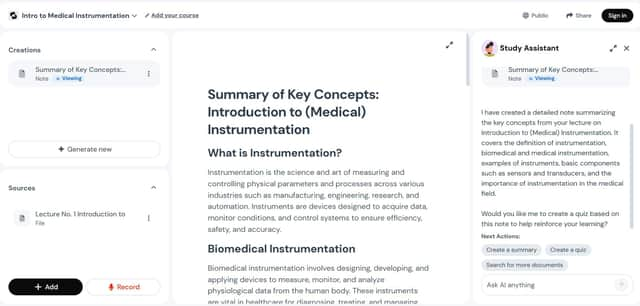
Tip: After reading the summary, quickly skim the original slides. It provides additional examples and context without taking too much time.
Simplify revision notes with AI Notes
Heavy reading lists and dense lectures are the norm. AI Notes condenses slides, PDFs, or class notes into concise, structured summaries so you focus on what really matters for exam prep.

Tip: Compare your AI summary with your module syllabus or lecture outline to ensure nothing important is missed before you start revising.
Use ask AI when a topic still doesn’t make sense
Every student has certain topics that feel confusing, no matter how many times they reread the notes. Ask AI helps by breaking those ideas down into simple, straightforward explanations based on your uploaded materials. This makes the explanation more relevant to your course instead of giving a generic internet answer.
Once you understand the concept properly, the rest of the topic usually becomes much easier to revise. It also stops confusion from building up over the weeks.

Tip: After reading the explanation, try writing a quick one-sentence version in your own words. If you can summarise it simply, you’ve understood it well enough for an exam.
Build recall and confidence using quizzes based on your notes
Remembering information during an exam can be challenging, especially under pressure. The Quiz tool helps you practice this by turning your notes into short, personalised questions. It’s a straightforward way to check what you actually remember and what still needs more practice.
Short, regular quizzes tend to work better than long revision sessions once in a while. Even a few questions every couple of days can help you stay familiar with the material and make revision feel less overwhelming.

Tip: After each quiz, focus only on the questions you struggled with. It helps you strengthen weak areas without having to review everything again.
A weekly study flow that works for busy students
You don’t need a strict study schedule. A simple routine you can repeat each week usually works better:
1. Record your lectures so you don’t miss important details.
2. Use AI Summaries to turn the week’s content into clear notes.
3. Use Ask AI to clarify anything that still feels confusing.
4. Do a few quizzes to reinforce what you’ve learned.
This rhythm fits easily alongside part-time jobs, commutes, and multiple modules.
Use Studocu AI in a way that supports your learning
The HEPI Student Generative AI Survey 2025 shows that 92% of students now use AI tools, but 53% aren’t sure what their university allows. Studocu AI is meant to support your learning, not replace your assignments.
A quick check is: If you can explain a topic without looking at the AI response, you’re using it correctly.
Conclusion: Study smart, enter exams ready
Studocu AI won’t replace your studying, but it can make revision feel more organised and less overwhelming. With clearer notes, quick explanations, and small practice quizzes, it’s easier to make the most of the time you have and go into exams feeling more prepared.
FAQs
How can Studocu AI helps stay consistent with changing schedules?
Studocu AI works well for flexible study routines because tools like AI Summaries and Quizzes let you revise in short bursts. Even if you only have ten minutes between classes or work shifts, you can review a summary or complete a quick quiz without needing a long study session.
How can Studocu AI fill gaps in lecture notes?
Yes, it can help. AI Summaries can organise the material you do have, and Ask AI can explain missing concepts using your uploaded files. It doesn’t replace the actual lecture, but it gives you a clearer picture when your notes feel patchy.
How can Studocu AI help with example-heavy or problem-solving modules?
Ask AI is especially useful here because it can walk you through the logic behind examples, not just the final answer. You can also use Class Recording to revisit the exact examples your lecturer explained, which often mirror exam-style questions.
Is Studocu AI helpful if English isn’t my first language?
Yes. Tools like Ask AI simplify explanations into clearer language, making complex theories easier to follow. AI Summaries also reduce long readings into manageable sections, which helps if you struggle with academic English or dense writing styles.
How do I avoid becoming too dependent on AI tools while preparing for exams?
Use AI tools as a starting point, not the final step. Let AI Summaries give you structure, Ask AI help you understand the basics, and Quizzes test your recall, but always try explaining topics in your own words afterward, to ensure you’re learning, not relying.