
Banning trans prisoners from jail of chosen gender could 'create risk of suicide', court told

Gerry Moynihan KC, for the Scottish government, said it would be a ‘fundamental denial’ of human rights
Banning biological males who identify as transgender from being placed in female prisons would be a “fundamental denial” of their human rights and could create a risk of suicide, a court has been told.
Gerry Moynihan KC, representing the Scottish government, said introducing a “no exception” rule would act as a “straitjacket” on the safe management of prisoners.
He said Scottish ministers could not “run the risk” of a trans prisoner committing suicide as a result of being placed in a jail aligned with their biological sex and not their chosen gender.
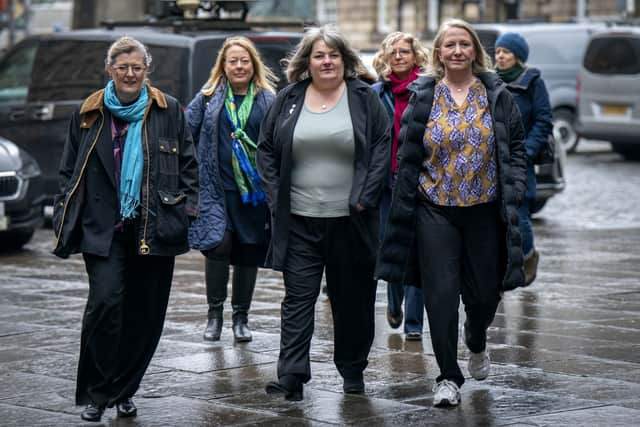

Current rules allow trans people to be held in a prison matching their gender identity if it is considered safe to do so. This does not include those with a history of violence against women and girls, and who are judged to present a risk.
But the campaign group For Women Scotland (FWS) has launched a legal challenge at the Court of Session in Edinburgh seeking to overturn this guidance, arguing it breaches the rights of vulnerable female inmates.
It previously won a landmark Supreme Court fight against the Scottish government over the legal definition of a woman under equality law, which judges ruled is based on biological sex. FWS argues this now clashes with the prison policy.
Aidan O'Neill KC, representing the group, dismissed the Scottish government’s case as “sound and fury, signifying nothing” - a quote from Macbeth. He said the argument about a risk of suicide was “offensive”.
Mr Moynihan said Scottish ministers are seeking to protect the “flexibility” of the existing case-by-case policy.
He told the court: “This case engages very complex, difficult judgments. Ministers try to do their best, but of course they make mistakes. Bad things happen. But they try their best, and what is being asked in this case is that they be put in a straitjacket.
“Their best prison management judgments are constrained, and constrained by an artificial parameter that they must define a man as a man and a woman as a woman, full stop, without exceptions.
“Ministers are here to protect the flexibility, because that is what is judged to be necessary to achieve the objectives of managing prisoners safely and in the public interest rehabilitating them to the best of their ability.”
He said Article 8 of the Human Rights Act protects an individual’s right to private life, but also allows public bodies to interfere with this to protect the rights and freedoms of others.
“The issue is this: where a transgender prisoner...does not threaten the rights of others, are we to have an absolute rule that says that they must be accommodated in the prison of their sex?” Mr Moynihan asked.
“Why? The sole reason is that they are to be classified as a man, even though they live their lives as a woman. It’s the fundamental denial of their choice of gender, and it’s a fundamental denial driven only by semantics.”
He continued: “To simply say, ‘You, trans woman, are a man, full stop, you’re going to a men’s prison’ - that is the fundamental denial of the Article 8 right.”
The lawyer said suicide is a fact of life, but insisted ministers “cannot operate a regime” in which they openly abide a risk of suicide.
He said: “If there is a situation where holding a person who is otherwise suitable for the female estate, holding them in the male estate, challenges their mental health and might - God forbid it’s no more than might - create a risk of suicide, Scottish ministers cannot run that risk.”
Mr Moynihan said the court should “go beyond stereotypes and actually look at the circumstances”, arguing: “It is not as simple as saying, ‘This is a man; because he’s a man he naturally poses a threat to a woman.’”
He said the Supreme Court ruling did not “directly” engage with the issues at stake in the case. “There is no part of my submission that ignores the rights of women,” he said. “The rights of women have to be respected, but they have to be balanced, because equally the rights of transgender persons are entitled to respect.”
Elsewhere, Mr Moynihan said operating a separate trans unit - as exists in England - would present “fundamental challenges” both practically and legally.
He said the number of trans prisoners is low, particularly when it comes to trans men. A trans unit would therefore “create a significant risk of an end result of segregation”, he argued, which would present its own human rights issues.
He also raised transport problems. “A prisoner who is from Inverness who might in other circumstances be held in Inverness because they are close to their family, is in fact sent to a trans unit in Glasgow,” he said. “There are problems.”
Figures from the Scottish Prison Service show there were 19 trans inmates, which is about 0.2 per cent of the prison population, as of June 2025.
Prison rules say female inmates “must not share the same accommodation as male prisoners”. However, Mr Moynihan argued this referred to individual cells, and not shared areas.
Mr O’Neill said the rules were “perfectly clearly worded” and “cannot now be rewritten because it suits the political agenda of the current Scottish government”.
On Tuesday, he called the existing policy “Orwellian” and said it showed contempt for women’s rights. He said vulnerable women were being used as political “pawns” by the Scottish government.
Judge Lady Ross said she would now consider the arguments, but warned it will be “a little while” before she reaches a judgment. “I would not want there to be any expectation that this will be out very rapidly,” she said, bringing an end to three days of hearings.
Comments
Want to join the conversation? Please or to comment on this article.