
Geminid meteor shower set to light sky

This article contains affiliate links. We may earn a small commission on items purchased through this article, but that does not affect our editorial judgement.
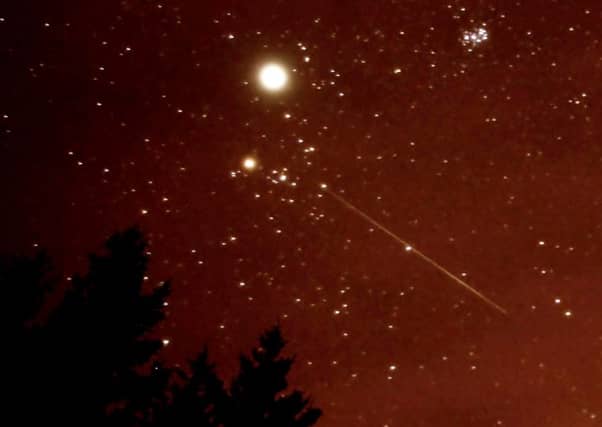
THE north of Scotland will enjoy a celestial fireworks display tonight, when one of the year’s most spectacular meteor showers reaches its fiery peak.At their height, the Geminids could produce between 50 and 100 shooting stars every minute.
They might be glowing in multiple colours and could include occasional rapid bursts of two or three.
The Met Office said the best place to catch the shower in Scotland would be in the North-east, to the north of Aberdeenshire and Moray. However, widespread cloud cover is likely to obscure the spectacle for the rest of the country.
The best time to see the meteors will be at around 2am when the “radiant” – the point in the sky from which the meteors appear to originate – is almost overhead, next to the constellation Gemini. But meteors should be visible throughout the night from about 10pm.
Robin Scagell, vice-president of the Society for Popular Astronomy, said: “It should be a good display, weather permitting – we might not be far off perfect conditions in the UK.
“The constellation is very high in the sky and most of the Moon will have gone away. An average of one comet a minute would be a good rate, and that’s possible. You might also get little bursts of activity with two or three together.”
The official Geminid “maximum”, when the shower will be at its heaviest, is 11am on Sunday – when daylight will prevent them from being seen.
CONNECT WITH THE SCOTSMAN
• Subscribe to our daily newsletter (requires registration) and get the latest news, sport and business headlines delivered to your inbox every morning
Meteor showers occur when the Earth ploughs through clouds of “cometary” dust. The tiny particles, some no bigger than a grain of sand, burn up brightly as they enter the atmosphere.
The meteors are caused by 3200 Phaethon, which was previously known as an asteroid with a “rock comet” orbit but has since been classified as an “extinct comet”. This means it is effectively the rocky skeleton of a comet that has been stripped of its ice after too many close encounters with the sun.
The Earth runs into a stream of debris from 3200 Phaethon every year in mid-December, causing meteors to fly from the constellation Gemini.
Travelling at some 22 miles per second, the meteors burn up about 24 miles above the Earth.
Another unusual feature of the Geminids is that they can shine in different colours. Mostly glowing white, they may also appear yellow, blue, green or red.
Regardless of whether 3200 Phaethon is an asteroid or comet, it is classified as a “potentially hazardous” near-Earth object, with our planet being less than two million miles from its orbit.
At its closest upcoming approach, which will happen on 14 December, 2093, it will be 1,812,640 miles away – quite far enough away to be safe. “It’s not any immediate danger to the Earth,” Mr Scagell said.
SEE ALSO
SCOTSMAN TABLET AND IPHONE APPS