
Risk of another 'devastating' crash unless Network Rail brings all infrastructure work in-house - RMT
Union calls for track body to dispense with contractors after fatal derailment
The “devastating” fatal train crash in Aberdeenshire could be repeated unless Network Rail takes over all of its construction work rather than outsourcing it to contractors, a union leader has warned.
Gordon Martin, Scotland organiser of the Rail, Maritime and Transport union (RMT), said ending the outsourcing of rail infrastructure works was the “only way” of preventing a similar incident.
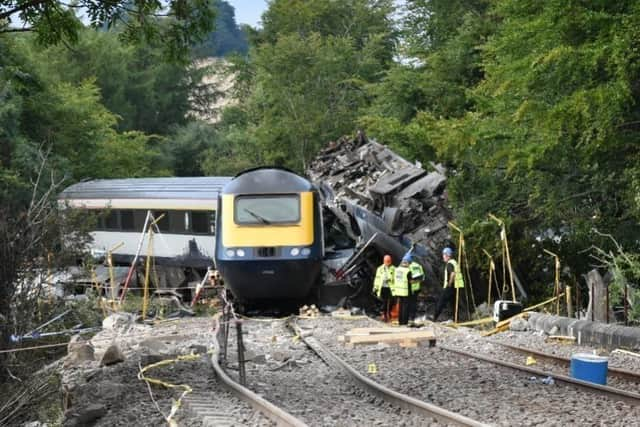

His call came after a fatal accident inquiry (FAI) determined on Wednesday that the death of three people in the derailment near Stonehaven in 2020 “might realistically” have been avoided if a drain had been correctly built at Carmont by contractor Carillion on behalf of Network Rail.
Sheriff Lesley Johnson said the firm had failed to follow the design it had been given.
ScotRail train driver Brett McCullough, 45, conductor Donald Dinnie, 58, and Christopher Stuchbury, 62 - one of the six passengers aboard - were killed after torrential rain overwhelmed the drain and debris was washed onto the track.
The FAI in January heard the three men had suffered “multiple un-survivable blunt force injuries” while the other six people on the train, who included an off-duty conductor, were injured.
Mr Martin said: “I’d like to reiterate our deepest condolences to the families of the three people that unfortunately lost their lives, and best wishes to the people injured and their families.
“(It was) a horrific event. Although it was over six years ago now, it will feel like yesterday to those families, and it’s a traumatic event.
“For the wider railway family, it’s also been traumatic.
“The railway family lost two members that day through an accident that could have been avoided, and that’s why the lessons must be learned to ensure these kind of matters cannot arise again.”
Mr Martin welcomed the 20 recommendations of the 2022 UK Department for Transport Rail Accident Investigation Branch (RAIB) report into the incident, which Sheriff Johnson described in her determination as “comprehensive and wide-ranging”.
However he said the “only way we can ensure this doesn’t happen again” is by ending the outsourcing of infrastructure works by Network Rail.
That was not among the RAIB’s recommendations, but Mr Martin said it “doesn’t take a recommendation from anyone to do this”.
He said: “Until and unless Network Rail stop outsourcing infrastructure work, in other words, to insource it and do the work to Network Rail standards with Network Rail trained, competent, and certified staff, there is always a risk of an infrastructure failure leading to the deaths of other people.
“I hope that never happens, but there is that risk inherent in using staff [where] you don’t know what the fatigue levels are, and you don’t really know what their competence levels are.
“So for me, this is quite an easy fix. But will Network Rail and the UK and Scottish governments demand it? Time will tell.”
A Network Rail Scotland spokesperson said: “We have put in place extensive assurance measures to improve how we deliver engineering projects like the one at Carmont and have reviewed our maintenance procedures.”
Mr Martin also questioned the crashworthiness of ScotRail’s ageing Inter7City “High Speed Train” fleet, saying the sooner it was taken off the network the better.
He said the train involved in the crash was first introduced to the network 50 years ago, and it had “crumbled” in the crash rather than “standing up to it the way modern trains should”.
The sheriff made no recommendations over the crashworthiness of the trains because they are due to be replaced by the end of 2028.
She said there was no “real or lively possibility” that driver Brett McCullough’s death could have been avoided if he had been wearing a seat belt, which are not fitted in trains.
The sheriff also said there was no evidence that seat belts would have avoided Mr Stuchbury’s death.
The trains are due to start being replaced by a refurbished fleet of 20-year trains from the end of next year. The changeover is due to be completed by the end of 2028 but Transport Scotland did not confirm this on Wednesday.
A spokesperson for the agency said: “The Scottish Government takes the matter of safety on Scotland’s Railway very seriously. In doing so, we also fully understand the duty of care that all parties involved in designing, constructing and operating the railway have to each other and to the travelling public, and the duty of co-operation those parties have to facilitate safe operation.”