
Exclusive:Ferguson Marine in running for more contracts as workers reflect on 'wee jewel' Clyde yard
Port Glasgow yard has delivered some 360 ships over more than two centuries

Ferguson Marine is in the running for new contracts and about to press ahead with further modernisation work to make it more competitive, the Scottish Government-owned shipyard has told The Scotsman.
The development came as some of its longest-serving staff told of the enduring attraction of working at the "wee jewel" in Port Glasgow, where hundreds of ships have been built over more than 200 years.
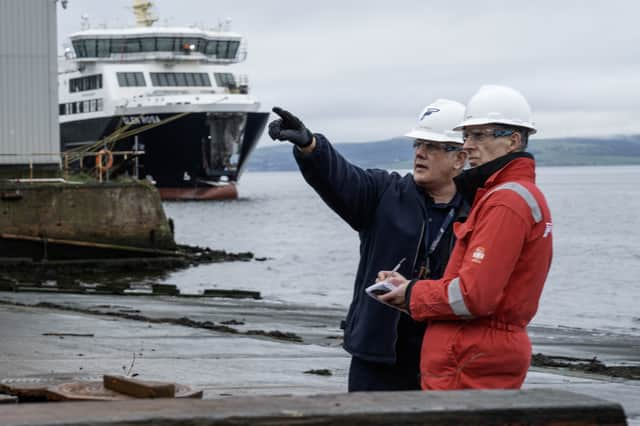

Chief financial officer David Dishon said the yard was at various stages in chasing a number of contracts for new work, including pre-qualifying to submit bids for some, although he declined to provide further details.
These will be vital for the 300-strong workforce after it completes the long-delayed Glen Rosa ferry for CalMac, which is due by June next year - eight years late.
The vessel was the heaviest and largest ever launched at the yard where some 360 new vessels have entered the water since the first recorded, the Jessie, in 1790. Glen Sannox, Glen Rosa’s sister ship, was lighter because it was less complete when launched exactly eight years ago - November 21, 2017 - with its notorious painted-on windows.

Several dozen workers are also employed on constructing parts of the Royal Navy type 26 frigates for BAE Systems in Glasgow.
Mr Dishon said: “We have quite a few options and prefer to get another contract as soon as possible, but we are also focusing on Glen Rosa and the BAE Systems work”.
He also said Ferguson Marine was about to start placing further orders for new equipment to overhaul the yard, funded by £14.2 million pledged last year by the Scottish Government.
He said reports these had previously been cancelled were incorrect and the yard had instead decided to “review all options” to focus on key areas that would improve its chancing of winning new work.
Mr Dishon said the priority was ordering equipment that would take the longest to be delivered, and was confident the Scottish Government funding would be available as it was required.
The yard is already lobbying to construct a series of replacements for vessels it built decades ago. These include a new CalMac ferry to take succeed Lord of the Isles, which went down the Port Glasgow slipway in 1989.
Four other large CalMac vessels still in service were built there between 1984 and 1990 - Isle of Arran, Isle of Mull, Isle of Lewis and Hebrides. Ferguson Marine has since completed three smaller hybrid diesel-electric ferries for CalMac: Hallaig, Lochinvar and Catriona.

The yard is also chasing the potential for building replacements for the Scottish Government’s marine research vessel Scotia, which it completed in 1998, and its marine protection vessel Minna, which was finished five years later.
It would also like to construct a replacement for research vessel Cefas Endeavour, which was also finished in 2003, and is operated by the UK government’s Centre for Environment, Fisheries and Aquaculture Science.
Other vessels built include tugs, dredgers, other ferries, such as for past cross-Clyde links in Glasgow like in Finnieston, and support ships for the Northern Lighthouse Board.

The yard was founded in a settlement where a port had been established for Glasgow in the 17th century before the Clyde was deepened to enable ships to reach the city, giving the town its name.
Ferguson Shipbuilders was formed in 1903 when the yard was taken over by four brothers from the Fleming & Ferguson shipyard in Paisley. It has switched between private and public ownership several times since, including becoming part of state-run British Shipbuilders for nearly a decade from 1977.
The Scottish Government nationalised the yard in 2019 after it collapsed into administration for the second time in five years. However, yard workers said it had a huge amount to offer for the future.
Hugh McKenzie, its general manager operations, has been at the yard for 40 years - the longest continuous service. He worked his way up from being an apprentice plater shipwright to the drawing office and then became a manager.
He said: “Fergusons has always been a wee jewel. My father was involved in shipbuilding and he said ‘go to Fergusons - it’s a small yard that’s somewhere where you’ll learn all aspects of your trade’.
“We can build any ships at Fergusons. We have done tugs, fishery research vessels, ferries, including battery-driven hybrid ferries.
“It’s got a tradition of families and generations being here. It’s word of mouth - people talk about us in the town. You walk about with your Ferguson fleece on and folk ask how you are doing. We’re ingrained in Port Glasgow.”
Other long-serving employees include Ronnie Emerson, who been at the yard for 35 years as a semi-skilled ancillary worker. His jobs have included cleaning, joinery, scaffolding and now slinging, which involves moving heavy objects. Three of his four sons, along with his father, uncle and cousin, have also worked there over the years.

He said: “I’ve picked up many skills. I’m really happy, it’s very enjoyable. I couldn’t fault my time in the yard and thankful for the opportunity I’ve been given.”
Ryan Speirs, 19, one of some 30 apprentices at the yard, said: “Welding has been in my family for a few generations. My great grandpa was a welder and I heard stories about it and was always interested in it, and jumped at the opportunity.
“They offer great training - the apprentice programme is really good.”

A Scottish Government spokesperson said: “Work on Ferguson’s investment programme began in December 2024, with approved funding directed towards addressing essential repairs and new equipment to enhance yard productivity.
“The Scottish Budget 2025-26 allocates £46 million of capital to Ferguson Marine for the financial year commencing on 1 April 2025.
“Up to the financial year 2026-27, the Scottish Government has committed to invest up to £14.2m over two years in Ferguson Marine, subject to due diligence and commercial standards being met.” Those tests are required for each claim by the yard for funding from that investment.
Comments
Want to join the conversation? Please or to comment on this article.