
Cyclists urged to wear masks in heavy traffic to cut intake of dangerous pollution

Riders advised to avoid busy routes and stopping behind large lorries
Cyclists should wear masks in heavy traffic to protect them from dangerous pollution if they can't find a quieter alternative route, a senior doctor has recommended.
Professor Jill Belch, who co-chairs the Royal College of Physicians of Edinburgh’s air pollution working group, said closely-fitting masks could halve their intake of hazardous tiny particles known as particulates.
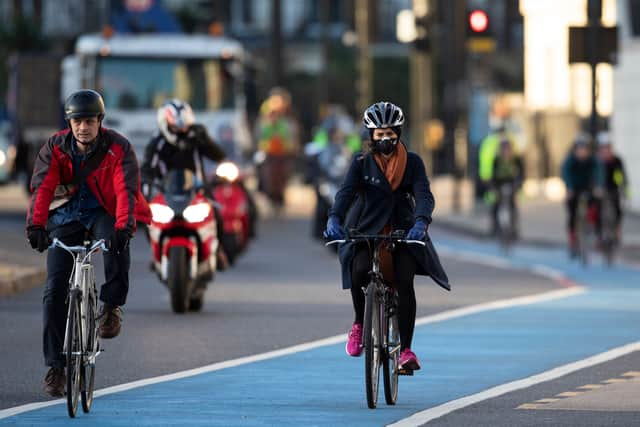

Prof Belch, who is also chair of vascular medicine at the University of Dundee, said riders "hugely increased" their intake of such pollutants compared to drivers and walkers by breathing more heavily.
She told Cycling Scotland’s annual conference in Perth: “Nobody wants to wear a mask while cycling but they can help if you are in a very polluted area.”
Prof Belch said masks, on average, could catch nearly 50 per cent of the particulate PM2.5, and also PM10, which account for one third of air pollutants and damage the lungs, brain and heart.
However, she said they must be well-fitting so they were sucked towards the mouth when inhaling.
In addition, almost all ultrafine particles, which the professor said were considered “really dangerous”, were also filtered out by wearing FFP2 masks - similar to those required on public transport in European countries such as Italy during the Covid pandemic.
However, she said masks did not filter out gases, so they did not prevent the inhalation of “hugely irritating” nitrogen oxide and nitrogen dioxide.
Prof Belch said these were the traffic pollutants with the biggest threat to health because they “burn the eyes, throat and lungs and damage the brain, heart and immune system".
She also advised cyclists not to stop behind large diesel lorries and avoid riding in peak hours - but it was far better to switch to a less busy route instead.
The professor said off-road cycle paths were the safest, while vegetation beside cycle lanes helped reduce pollution, and councils should be lobbied to plant more such greenery.
She added that cycling still had a “huge” net benefit to health as exercise.
A Cycling Scotland spokesperson said: “Air pollution from vehicles affects everyone whether they’re cycling, sitting in a vehicle or a pedestrian.
“The health impacts of these pollutants are worst for the most vulnerable and must be tackled.
“Getting the most dangerous and polluting vehicles out of our communities will benefit everyone’s health.
“Cycling is fantastic for your health and the research at our conference demonstrated yet another benefit of segregated cycle lanes and more green space in urban areas, separating people walking, wheeling and cycling from the worst traffic fumes.
“People may understandably have a specific health reason to wear a close-fitting mask while cycling on polluted streets.
“The most important thing is that more people cycling means fewer polluting vehicles creating congestion.”
Ian Maxwell, of the Lothian cycle campaign Spokes, said: “While this highlights the need for a reduction of motor traffic, it also highlights the health benefits of cycling outweigh the risks of air pollution.
“Although some people might decide to use masks or helmets, they shouldn't feel obliged to chose either.
“They can help more by joining campaigns against urban motor transport.”
Comments
Want to join the conversation? Please or to comment on this article.