
The Edinburgh Easter Play takes on Adolescence, toxic masculinity and Andrew Tate


This year’s Edinburgh Easter Play will explore masculinity – and with Netflix hit Adolescence and Andrew Tate in the news – it couldn’t be more timely, writes Susan Mansfield.
A chilly church hall in Edinburgh on a Wednesday evening. People are arriving in twos and threes, some straight from work with their dinner in Tupperware boxes. There is talk and laughter, cups of tea, and a gradual transformation into disciples, Roman soldiers, Mary, Martha, Mary Magdalene. Week by week, Edinburgh’s Easter Play is being made.
This year marks the 20th anniversary of the passion play which is performed on Easter Saturday in West Princes Street Gardens. Some of these actors have been in almost every production; others are new this year. They’re a diverse group, coming from all backgrounds and walks of life. Some have a Christian faith, others don’t. Casting is colour-blind. One actor has Down’s syndrome, another is visually impaired; everyone is learning the particular cues and directions they need to help them do their jobs.
The play is created from scratch every year. Since 2005, there have been large-scale traditional productions in full costume, and stylised modern versions. There was a contemporary version set in a near-future Scotland, a version devised by the cast themselves, and audio and filmed versions during the Covid years.
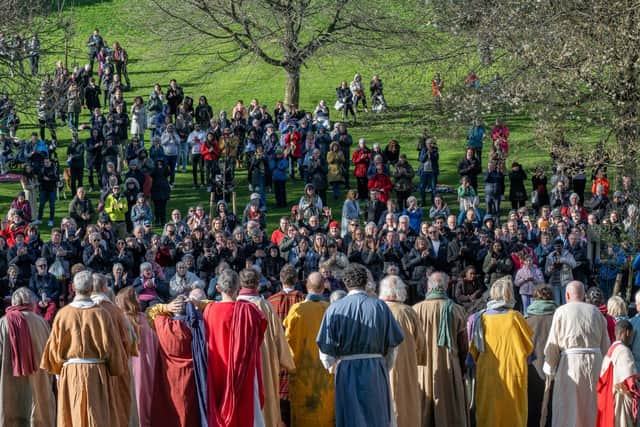
“I made a commitment at the start that the play would be different every year,” says Suzanne Lofthus, artistic director of Cutting Edge Theatre, who has directed almost every production, as well as making passion plays in communities and prisons around the world. “We are always looking for ways the story speaks to contemporary life - and there are always fresh ways it addresses the moment.”
However, last year, after another successful Easter production, she feared the play might have reached the end of the road as sources of funding were in short supply. But hopes have a way of resurrecting themselves round this story, and help was on its way from an unexpected direction.
Dr Shadaab Rahemtulla, a Muslim and senior lecturer in Islamic Studies at Edinburgh University’s School of Theology was in the audience at the 2024 play. “Jesus is a major prophet in the Islamic tradition so I thought that would be a wonderful things to see, especially in Ramadan,” he says. “I loved it. I was struck by the impact that it has within a public setting. I was surrounded by over 600 people watching the play and that really got me thinking about the social consequences of how we relate stories, in particular stories that carry a lot of religious authority.”
And so began a conversation between Lofthus, Rahemtulla and Helen Bond, Professor of Christian Origins at Edinburgh University’s School of Theology. Shadaab and Helen became consultants on the script, and introduced new sources of financial support. From their conversations, a new, dynamic theme emerged for the 2025 production.
Rahemtulla says: “I’m really interested in questions of masculinity and in my own research I have explored the masculinity of Prophet Muhammad. When I was watching the play, I was struck by the way in which Jesus related to his masculinity. The 2024 play focused on the women in the Gospel narratives, but it also got me thinking about the men in the narratives, how they related to the women but also how they related to each other.”
Informed by their discussions, Lofthus wrote Behold the Man, which explores different models of masculinity within the Easter story. Rahemtulla says: “In society, young men and boys in particular are being bombarded with toxic images of what it means to be a man, that to be a real man you have to be strong, even cruel, you have to be deeply competitive, you cannot be vulnerable, you cannot express your emotions and be in a real egalitarian relationship with those around you.
“With this play, we’re trying to reclaim masculinity in a way that is progressive and can act as a form of role modelling, to challenge the idea that there is only one particular way of being a ‘real man’, and doing that through one of the most powerful and authoritative figures in world history, Jesus Christ himself.”
While the theme felt timely, no one realised just how much of a hot topic it would be in 2025. Lofthus says: “What’s really interesting is that we were talking about this last summer. Now, with the Netflix drama Adolescence and people like Andrew Tate in the news again, discussion of masculinity is everywhere. Gareth Southgate gave a lecture the other week about the need for positive role models for boys and young men. The play couldn’t be more relevant.”
Back in the church hall, the cast are running the scene where Jesus visits the house of Mary and Martha, a well known Gospel story. When Martha scolds her sister for listening to Jesus instead of helping in the kitchen, Jesus offers to lend a hand. The disciples are shocked to find him making bread – “women’s work” – prompting hisses and boos from the rest of the cast.
Lofthus says: “This is something Shadaab suggested, it’s one of my favourite scenes. I thought at first Jesus would say his mother had taught him how to make bread, but I realised that it would work better if he was rubbish at it - Martha has to show him what to do.”
Other characters in the play demonstrate different kinds of masculinity: Barabbas, a radical fighting for freedom from the Roman occupation, believes in the power of violence; Pontius Pilate, a refined Roman leader, enjoys authority in his public role and at home, leading to clashes with his wife, Claudia Procula.
These to fit well into Greco-Roman ideals of masculinity, says Helen Bond, who is an expert in first-century society. “The Eastern Mediterranean in the first century was very much a patriarchal society,” she says. “Men were in charge politically and in the home. There was a very strong sense of what a manly man was like, he might be somebody who was victorious on the battlefield but would also be somebody who was in charge and respected. Being the most important man in the room was very important, it was very competitive.
“The picture you get of Jesus in the Gospels is quite ambiguous. Sometimes he is like a typical man, going round with 12 male disciples, beating his opponents in discussions. But scratch the surface a little and you see a different picture which is probably more historically accurate. He has a lot of female disciples too, and when you look at his actual teaching, he is saying, if you want to be my disciple, you have to be last, you have to be a servant of all.
“One of the things I think the play does really well is to challenge both ancient and modern ideas of masculinity. It’s been interesting to see the way that Adolescence has got people talking about the messages we are giving to boys and young men, it has become really big in the public conscience. The story of the play remains the same - the story of Jesus and his remarkable message, his death on the cross and resurrection - but it’s also engaging with issues that we are having trouble with. I think it’s still got a lot to tell us.”
Behold The Man: The Edinburgh Easter Play is performed in West Princes Street Gardens on 19 April at 2pm, the performance is free and unticketed. Treasure Hunt for families at 12:30pm, places must be booked, for more information visit www.easterplay.org