
How Stonehenge, the most iconic prehistoric monument in the UK, is actually Scottish

The altar stone was previously thought to have come from Wales
It is one of the best-known prehistoric monuments in the world and was built around 5,000 years ago in the south of England.
Now it has emerged Stonehenge’s iconic Altar Stone is likely to have come from Scotland - not Wales as previously thought.
A new study has left scientists “stunned” after they concluded it may have been transported around the coast by sea - implying that long-distance trade networks existed during the Neolithic period in Britain around 5,000 years ago.
Researchers said the potential that it had bee transported more than 400 miles demonstrated a “high level of societal organisation in the British Isles”.
It is also not known whether the now horizontal stone once stood upright.
For the last century, the six-tonne sandstone, at the heart of the ancient site, was believed to have come from Wales, as the majority of Stonehenge’s bluestones came from the Preseli Hills area in west Wales and are believed to have been the first stones erected at the site.
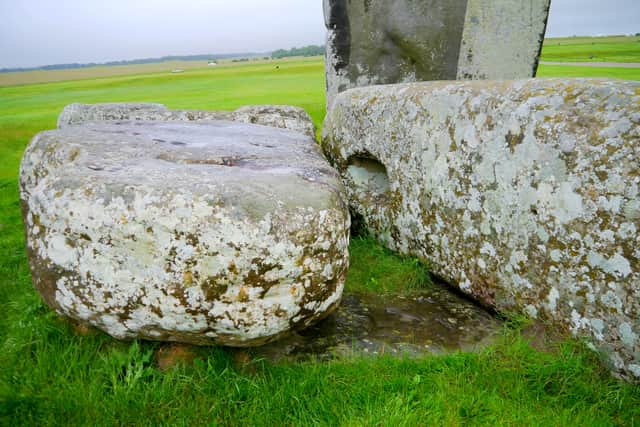

But the new investigation, led by Australian scientists, concluded that the monumental Altar Stone is “95 per cent” likely to actually originate over 460 miles from Salisbury Plain in north east Scotland. The study, however, does not provide direct evidence about how the stone got to its world-famous location in Wiltshire.
The revelation that it travelled so far will raise questions about its journey given the limits of human technology during Neolithic times.
The Australian team used state-of-the-art equipment, including specialist mass spectrometers, to examine the composition of the Altar Stone.
The findings, published in the journal, Nature, indicate a striking similarity between the Old Red Sandstone of the Orcadian Basin in north-east Scotland and the Stonehenge Altar Stone.
The scientists used their analysis of the ages of the mineral grains in the stone to essentially create a fingerprint of the source of those grains.
They matched ages found in rocks of the Orcadian Basin found in the north-east of Scotland, and are completely different from Welsh-sourced stones.
The study also points to the existence of "unexpectedly advanced" transport methods and organisation at the time of the stone's arrival in Wiltshire around 5,000 years ago.
Researchers from Curtin University in Perth, Western Australia, studied the age and chemistry of mineral grains within fragments of the Altar Stone, which is a 50 cm thick sandstone block measuring five metres by one metre, that sits at the centre of Stonehenge's iconic stone circle.
Study lead author Anthony Clarke said analysis of the age and chemical composition of minerals within fragments of the Altar Stone matched it with rocks from Scotland, while also clearly differentiating them from Welsh bedrock.
The Altar Stone is classed as a bluestone, but is very different from the other ones at Stonehenge.
It is about twice the size of the smaller igneous bluestones, weighs six tonnes and is about five metres long, while the others are about a maximum of three tons.
Mr Clarke said: "Our analysis found specific mineral grains in the Altar Stone are mostly between 1,000 to 2,000 million-years-old, while other minerals are around 450 million years old.
"This provides a distinct chemical fingerprint suggesting the stone came from rocks in the Orcadian Basin, Scotland, at least 750 kilometres away from Stonehenge.
"Given its Scottish origins, the findings raise fascinating questions, considering the technological constraints of the Neolithic era, as to how such a massive stone was transported over vast distances around 2600 BC."
He added: “All four of us were stunned. We couldn’t believe it.”
Study co-author Professor Chris Kirkland, also from the Timescales of Mineral Systems Group at Curtin, said the findings had "significant" implications for understanding ancient communities, their connections, and their transport methods.
Prof Kirkland said: "Our discovery of the Altar Stone's origins highlights a significant level of societal coordination during the Neolithic period and helps paint a fascinating picture of prehistoric Britain.
"Transporting such massive cargo overland from Scotland to southern England would have been extremely challenging, indicating a likely marine shipping route along the coast of Britain.
"This implies long-distance trade networks and a higher level of societal organisation than is widely understood to have existed during the Neolithic period in Britain."
The study was conducted in collaboration with Aberystwyth University in Wales, The University of Adelaide and University College London (UCL).
Co-author Professor Richard Bevins said further work would be done to find more details on where exactly the stone originated.
He said: “These findings are truly remarkable – they overturn what had been thought for the past century.
“We have succeeded in working out, if you like, the age and chemical fingerprints of, perhaps, one of the most famous of stones in the world-renowned ancient monument.
“It’s thrilling to know that our chemical analysis and dating work has finally unlocked this great mystery. We can now say that this iconic rock is Scottish and not Welsh.
“Although we can say that much, and confidently – the hunt will still very much be on to pin down where exactly in the north-east of Scotland the Altar Stone came from.”
Co-author Dr Robert Ixer, of the UCL Institute of Archaeology, said: “This is a genuinely shocking result, but if plate tectonics and atomic physics are correct, then the Altar Stone is Scottish.”
Comments
Want to join the conversation? Please or to comment on this article.