
'We're going to keep fighting': How For Women Scotland won its Supreme Court battle - and what comes next
Group’s founder says ‘never say never’ regarding political party ambitions

It began over tea and coffee in a Morningside living room and culminated in a landmark ruling at the UK’s highest court that will have repercussions for generations to come.
In many ways, the ascendancy of For Women Scotland (FWS) has been one of the most remarkable stories in a turbulent era of Scottish politics. At the heart of it all are three women who never thought they would be front and centre of such a fractious and consequential battle, having raised nearly half a million pounds. But they are in it for the long run.
To their supporters, Susan Smith, Trina Budge and Marion Calder are modern-day feminist heroes who have protected the hard-won rights of women around the country. To their critics, they are responsible for dealing a severe blow to an already marginalised transgender community that risks fanning the flames of an already toxic culture war.
As far as FWS is concerned, however, the court’s ruling the terms ‘woman’ and ‘sex’ in the Equality Act refer only to a biological woman and to biological sex is vindication for the fight they have been waging for close to eight long years.
“We didn’t pick this fight,” Smith explained. “We saw the law being misapplied and misrepresented, and we realised that we couldn’t see women’s rights being protected and defended if we couldn’t define what a woman is. We had to get the law straight.”


Nearly 24 hours after the historic judgement, Smith was reflecting on how far FWS had come, and perhaps more importantly, how far it wants to go. What began as an ad-hoc group formed by three middle-aged women with shared interests and concerns has become a leading gender-critical campaign body. And the Supreme Court ruling is not the beginning of the end, but the end of the beginning.
“We’re going to have to keep fighting, there are already people with the most bizarre interpretation of the court’s ruling, and we will have to contend with those people,” Smith told The Scotsman. “But this ruling makes this so much easier with the clarity it provides.
“We know there are more tribunals coming. They’re not in the public domain yet, but we know they’re happening, and we’ll help people with their cases.”
‘No one really wanted to step up’
FWS was formed in June 2018 by Smith, a 53 year-old former fund manager, Budge, a business owner from Wick, Calder, a senior administrator with an NHS health board, and Magdalen Berns, a feminist campaigner and YouTuber.
In the months beforehand, Budge, Calder and Smith, both from Edinburgh, got to know one another via the popular parenting website, Mumsnet, where the online forums featured growing discussions over the impact on women of proposed gender recognition reforms. As they exchanged opinions and realised they had much in common, the three women eventually decided to meet in person.
It was at an informal meeting hosted by Calder, 55, at her home, attended by Budge, Berns and the latter’s partner, Nicole, the idea of forming FWS - a public-facing campaign group - was first mooted. Smith joined soon afterwards. “Up until then, women were worried and were talking in corners about it, but no one really wanted to step up,” she recalled.

For a group united by its determination to protect single sex spaces and services, some of its earliest public acts, while low key, revealed an innate understanding of how to secure column inches. Back in summer 2018, for example, Budge, 54, turned up at a youth hostel in Inverness claiming to self-identify as a man, and was able to secure a bed in a men-only dormitory. The impact, she said, showed how easy it would be for men to stay in women’s dorms.
But just as it was gaining momentum, FWS suffered a significant setback when Berns discovered that a brain tumour she had been diagnosed with in 2017 had evolved into glioblastoma, an aggressive brain cancer that eventually claimed her life in 2019. She was just 36.
Increasingly, Smith and the other women stepped up their commitments. FWS held its first public meeting in January 2019 at the Apex Hotel in Edinburgh’s Grassmarket, featuring hand-made posters and speakers including Maggie Mellon and Professor Rosa Freedman. Smith also addressed the event, stressing “feminism should be the battle for women’s rights”.
After word of mouth got out, the event attracted hundreds of people, both supporters and protestors who accused the organisers of being transphobic. The campaign had begun in earnest, and would quickly expand.
‘We’ve not had holidays in six years’
The group went on to stage rallies and protests outside the Scottish Parliament and at SNP events, yet broadened its scope beyond demonstrations. It wrote letters and editorials for newspapers, organised briefings for MSPs, MPs and peers, hosted book launches, placed advertisements against the Gender Recognition Reform Bill, and took part in roundtable discussions at Holyrood ,as well as numerous events at the annual conferences of both Scottish Labour and the Scottish Conservatives.
Arguably, however, the hard yards were done behind the scenes. FWS engaged extensively in public affairs work, preparing a series of extensive submissions to consultations run by the likes of the Scottish and UK governments, local authorities and health boards. The group also drafted responses to consultations run by institutions such as Scottish Rugby, the Equality and Human Rights Commission, the Financial Conduct Authority, the United Nations and even the Canadian parliament.
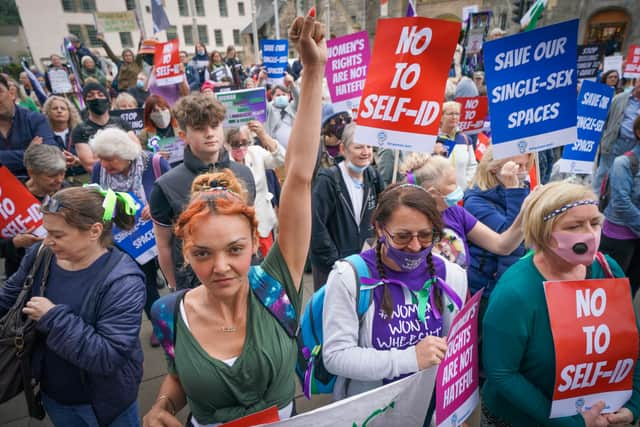
Looking back, Smith said the work has been rewarding, if exhausting. “We’ve not had holidays in six years, and I could really, really use one,” she admits. “I’m really proud of what we’ve done. It’s taken a lot of energy and time.”
Even so, that satisfaction is tinged with an anger that continues to drive FWS forward. The fact the women had to work so hard to make their case, said Smith, made her cross, and it continues to rankle. “There are organisations in Scotland that are supposed to represent women, and they have done very, very little while receiving a vast amount of public money,” she says. “They are lazy and refuse to engage beyond their own little clique.”
She and her colleagues hope the Supreme Court ruling will bring about a shift, but are prepared to step up pressure if need be. “I think the Scottish Government has to look at any guidance they’ve put out, especially around schools, which misrepresents the law,” she says. “A lot of these policies still reflect self identification, and I hope this ruling will persuade the Government to sort it out.”
‘It’s a really expensive business’
That work will consume more time, energy and, above all, money. The cost of running a large-scale campaign has been steep; Smith recalls the expense of staging their inaugural gathering nearly ended the group before it got started. “It nearly bankrupted us, we had to put securities on credit cards just so we could get it done,” she recalls. “It was awful and an absolutely terrifying experience.”
With the legal cases brought by the group to the Court of Session and the Supreme Court also prohibitively expensive. FWS turned to crowdfunding to help support its legal battles. Cumulatively, three appeals set up on the CrowdJustice site secured close to £500,000. Author JK Rowling, a vocal supporter of the group, donated £70,000 to the most recent fundraising drive, which raised more than £232,000 from more than 5,000 pledges for the Supreme Court case.

Such activity, admits Smith, has been a delicate balancing act. “Joanne has been very generous in giving us money for the CrowdJustice campaign, but we’ve almost deliberately tried to not raise too much money at this stage,” she explains. “We always knew going to court there was a risk we could lose and those funds would be at risk.”
She also thanked the “many” supporters who had given FWS what they could afford to show support, stressing that most of the money it receives is via small donations. “It’s a really expensive business, but people have been amazing in difficult times,” she says. “We get people sending us £5 a month or an occasional £10.”
‘I don’t want to fracture that unity’
According to Smith, the current balance of the FWS bank account would be insufficient to fund the salary of a single employee in some of the organisations that have been arguing against the group. That could change.
Although FWS was incorporated as a private limited company in 2020, with Smith, Budge and Calder serving as its directors, it is a not-for-profit concern, and none of the women receive a wage. Smith says that in time, it would be “good” to have a permanent office for the group’s operations, with someone in charge of the copious admin work. “All of that might be possible in the future,” she says.
But she scoffs at the numerous accusations directed at FWS alleging the group is bankrolled entirely by Rowling, or even by far-right evangelical groups. “We’re the kind of women the evangelical right hates,” she hits back. “We’ve got opinions, and we don’t think women should be in the kitchen tending to hearth and home all the time, and we’re pro-choice on abortion. So just because we agree on one issue … it’s laughable. Someone else pointed out it’s like saying if you like dogs, you’re allied to Hitler - it’s that level of stupidity.”
And in the wake of the Supreme Court ruling, is there a chance that an emboldened FWS could go one step further and reinvent itself as a political party, perhaps in time for next year’s Holyrood elections? It is a question, she says, that many of her supporters have posed. The prospect is unlikely, but there is no definitive answer as yet.
“This is an issue that’s united a lot of women in Scotland, which has been wonderful after a time of deep divisions left by both referendums in different ways,” she reasons. “We’ve all come together and I’ve personally met some of the most brilliant women who would have been on different sides to me in those referendum debates.
“I don’t want to fracture that unity. Our focus is and always will be on women, so any kind of political campaigning we could ever think to do would have to be purely neutral in terms of the constitution. I suppose never say never, but it would have to be very carefully done.”
Comments
Want to join the conversation? Please or to comment on this article.