
Human rights group Amnesty International backs former Humza Yousaf's calls for Palestine Action exemption

Humza Yousaf’s intervention comes after senior prosecutor chides ‘unhelpful’ politicians calling for law not to be enforced
A leading human rights organisation has backed calls from former first minister Humza Yousaf for Scotland's most senior law officer not to prosecute peaceful protesters who express support for the banned group, Palestine Action.
In what marks a significant intervention in the debate around the UK government’s decision to proscribe the group under terrorism legislation, Mr Yousaf, the former justice secretary, said there was a “constructive precedent” for “clear public interest guidance” on the issue.
He drew parallels with the non-prosecution policy set out by Lord Advocate Dorothy Bain KC ahead of the opening of Scotland's first drug consumption facility.
Amnesty's Scotland programme director, Liz Thomson, welcomed Mr Yousaf’s remarks, stressing there was no public interest in prosecuting people who were not inciting violence, but were “simply voicing outrage at the ongoing genocide in Gaza”.


However, Ruth Charteris KC, the Solicitor General for Scotland, rejected Mr Yousaf’s calls, stating that it would udnermine the Lord Advocate’s obligation to independently enforce criminal law.
The calls by Mr Yousaf, who warned that “criminalising conscience” is a waste of public resources and a blight on freedom of speech, come after the chief executive of the Crown Office and Procurator Fiscal Service (COPFS) warned the body’s independence risked being undermined by politicians calling for terrorism legislation not to be enforced.
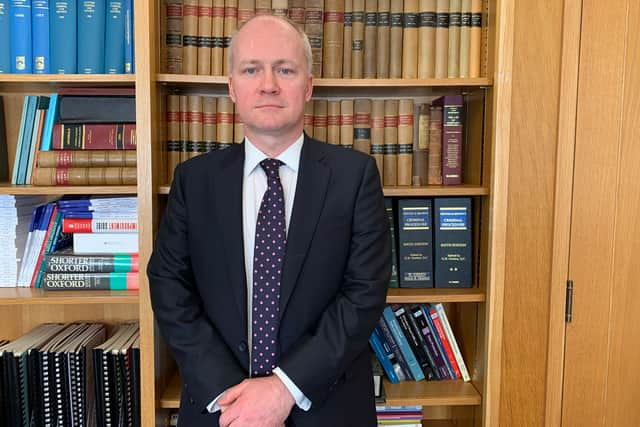
In an exclusive interview with Scotland on Sunday, Crown Agent John Logue rejected suggestions that laws were being applied differently according to the causes of different protests, and said it was “unhelpful” for politicians attempting to influence the COPFS.
“I have some difficulty with politicians calling for a law enacted by elected politicians not to be enforced,” he said. “That, to me, is the very definition of undermining the rule of law.”
Mr Logue added: “I do have a concern that politicians who may perhaps understandably feel a natural affinity to one of the underlying causes for the protests, in seeking to try and argue or persuade in a public forum that police and prosecutors should be taking a particular approach, I worry that inadvertently, what they are doing is creating the impression that there is a different way of the law being applied to different circumstances. It is not.”
Mr Yousaf, a passionate supporter of the Palestinian people, has written to Ms Bain to request a prosecution policy, and express concerns about what he described as a “chilling effect on lawful expression”.
The SNP MSP wrote: “Recent events have created substantial confusion and a chilling effect on lawful expression. Pensioners, priests and playwrights, all of whom have no previous criminal convictions, have been arrested after peacefully expressing solidarity with Palestine Action.
“In my view, prosecutions of this nature are difficult to reconcile with articles 10 and 11 [of the] European Convention on Human Rights, under which political speech - especially expression aimed at ending large-scale human suffering - enjoys the highest level of protection.”
Ms Thomson said: “The Lord Advocate should urgently explore all possible avenues to ensure that Scotland upholds our international human rights obligations in the face of the UK government’s excessively broad use of terrorism laws to criminalise peaceful protest.”
The COPFS has pointed out the Lord Advocate has issued a statement in which she reaffirmed her support for protest within legal boundaries.
Cases involving Palestine Action reported to the procurator fiscal will be considered by a specialist prosecutor, overseen by senior prosecutors. Mr Logue said he hoped to achieve a “sense of consistency” in dealing with such cases.
In a letter responding to Mr Yousaf, Ms Charteris said: “Whilst I recognise the fundamental right of people to protest within legal boundaries, it would not be an appropriate use of the Lord Advocate’s authority to issue a statement of prosecution policy of the type you request. Furthermore, I would consider such a statement to be contrary to the Lord Advocate’s obligation to independently enforce the criminal law.”
She added: “The distinction between expressing a view shared by a proscribed organisation and expressing support for a proscribed organisation is an important one. It will require prosecutors to pay careful attention to what was said and done or displayed, the circumstances in which that happened, and the meaning which the speaker intended to convey. Prosecutors in Scotland will consider these cases carefully.”