
Readers’ letters: Carers betrayed by withdrawal of free Covid vaccination
An unpaid carer writes to say he feels let down by the removal of free vaccine eligibility
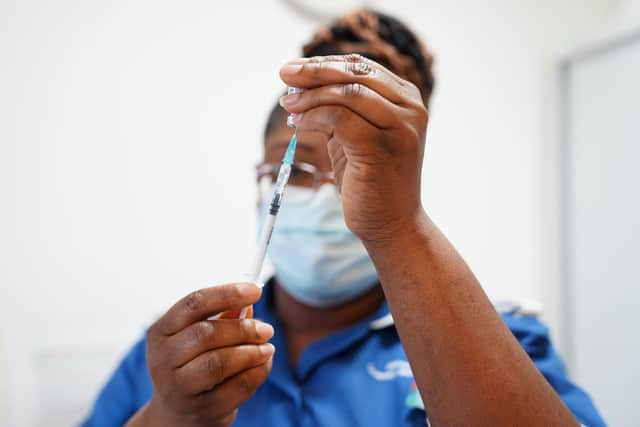
As an unpaid carer in Scotland, I write today with frustration and resolve: the decision to remove unpaid carers from the list of those eligible for free Covid-19 vaccination is a betrayal – of public health, of equity, and of the values Scotland claims to hold dear.
For years, unpaid carers have stood on the front lines – providing personal care, seeing loved ones through illness, and bearing repeated exposure to the virus. The Scottish Government itself previously recognised carers as a priority group during the pandemic. Yet in adopting the latest JCVI advice for autumn 2025, carers were dropped from eligibility, without consultation, without transparent impact analysis, and without justification in public health terms.
This move ignores the fact that many carers are older, have chronic health conditions themselves, or live in deprived areas where Covid risks are higher. It also dismisses the invisible toll: long Covid, functional decline, and the possibility that carers may become vectors to those they support.

Scotland’s ambitions for a National Care Service and its stated commitment to “valuing carers as equal partners” ring hollow when carers’ protection is stripped away. If this policy is not reversed, the cost will not only be personal suffering, but greater hospitalisations, more burden on the health and social care systems, and a broken trust in those who care most.
I call on the Scottish Government to restore free vaccine eligibility to unpaid carers, publish the health and equality impact assessments behind this decision, and commit to inclusive, transparent policymaking in future. We will not be silent while our protection is withdrawn.
Adrian Fletcher, Glasgow
Tactical error
It's interesting that, next May, John Swinney looks like he’ll opt for an entirely different election strategy to Nicola Sturgeon, who had a good record at winning elections. Sturgeon routinely dumbed down, in fact almost whitewashed out, her party’s Scexit monomania when campaigning prior to each election.
Then, when the SNP won, she’d immediately claim the result as an indisputable indyref2 mandate. Sturgeon’s underhand tactics cleverly gained her votes from those lukewarm or even mildly opposed to independence, briefly duping them into believing that the SNP’s raison d’être was managing Scotland’s public services.
Swinney seemingly fails to have learnt from Sturgeon and plans to go big with a focus on the constitution. He’s presumably trying not to lose separatist voters to Alba and the Greens by strongly demonstrating his cessationist credentials – but by doing so, he’s assuredly not going to win over many from the pro-UK majority.
Martin Redfern, Melrose, Scottish Borders
Electoral pacts
It is absolutely extraordinary that some polls are pointing to a potential SNP majority government following the next Scottish election.
How is it that my fellow Scots would forgive one of the most incompetent governments of our time? Catastrophic policy failures across every aspect of Scottish public life, for example the failed A9 dualling project where road traffic deaths continue to mount and the abject failure to procure and construct ferries in budget and on time.
A once world-leading education system trashed, an NHS on the brink of collapse and the highest drugs death rate in Europe. Three leaders in a year with Sturgeon, Yousaf and Swinney making the Tories look like a steady ship.
The opposition parties must now think long and hard about what is best for Scotland and if that means electoral pacts then so be it. They must provide a solution to remove or deprive the SNP of any sort of majority.
Richard Allison, Edinburgh
Pass judgement
It was refreshing to read (your report, 13 October) SNP Minister, Siobhian Brown talking about the issues in the NHS, saying “it needs to be dealt with – it’s unacceptable”.
After 18 years of being the people responsible for this, I do hope the Scottish electorate will pass judgment on nearly two decades of SNP failures across health, education and other vital areas when voting in May. Choosing “both votes SNP” will be voting for further failures and continued calamity when it comes to vital public services in Scotland. It has to be time for a change in Holyrood. Swinney and co need to go. Use both votes to say enough is enough.
J Lewis, Edinburgh
Promises, promises
Don’t you just love political conferences? They are perfect for the politicians as they have an audience who hang on their every word. Who can forget the then First Minister, Nicola Sturgeon announcing at the SNP conference in 2022 that “by the end of this Parliament there will be a Rapid Cancer Diagnostic Service in every health board in Scotland”? Oh, how the conference attendees clapped and cheered at this pronouncement.
It’s now October 2025, we’re approximately seven months away from the current parliament being dissolved. Do we have a Rapid Cancer Diagnostic Service in every health board yet? Any chance of the First Minister’s commitment being fulfilled before the Scottish election next spring? Not a hope! There are 14 health boards in Scotland. Only six have a Rapid Cancer Diagnostic Service.
But it’s OK because the current First Minister has made new pledges. Cancer diagnosis is so last year! Now it’s all about access to GPs.
John Swinney says his government will create a network of walk-in GP services on high streets, close to schools and workplaces open from noon to 8pm, seven days a week (your report, 14 October). We’ve been promised one million additional GP and nurse appointments and the scheme will be up and running within a year. Guess what? The announcement received a standing ovation.
SNP promises are here today, gone tomorrow.
Jane Lax, Aberlour, Moray
Telltale sign
How do we know there is an election forthcoming? Simple. John Swinney has suddenly promised any Scot can see a GP, noon to 8pm, seven days a week and without an appointment.
The big giveaway on this “fantastic” scheme is that it will not come into effect until five months after the Holyrood elections. Where are the extra funds and the extra staff and why not put the scheme in place right now, just before the winter when it is really needed?
Gerald Edwards, Glasgow
Go underground
Eastern Green Link 2 (EGL2) is one of five such links each delivering 2GW of clean energy – enough to power ten million homes – via a 505km subsea cable between Peterhead and Drax in Yorkshire. Part of the Great Grid Upgrade, EGL2 is the UK’s largest electricity transmission project, costing £4.3bn. After landfall in Yorkshire, the subsea cable will connect to the power station by around 68km of underground cable. Once completed it will unlock the rich renewable energy of Scotland.
Part of the wider upgrade of Great Britain’s electricity grid system, SSEN Transmission’s £22bn-plus investment programme, the Greens 400kV substation project near New Deer, Aberdeenshire, a critical part of the proposed Beauly to Peterhead 400kV overhead line (OHL) connection, is designed to deliver renewable electricity to homes and businesses across the area. The development includes a new outdoor 400kV Air Insulated Switchgear substation, located east of Turriff and south of Cuminestown, connected to the proposed Beauly to Peterhead OHL and the existing New Deer substation, again via underground cable.
Recent storms where tens of thousands of homes across the Highlands were left without power for days, cut off from vital supplies, have shown Scotland’s overhead electricity distribution infrastructure is not only inadequate but outmoded.
Building more overhead monster pylons, despite warnings of more frequent and increasingly extreme weather events, needs a more up-to-date and safer approach. A recent report compared costs with overhead lines, and although more costly (four to five times), underground cables will be much safer, more environmentally attractive and cost less in the long run. Underground cabling although more costly initially, is a far superior option.
D W Lowden, Mannofield, Aberdeen
Face the music
It’s been announced Rod Stewart and Ronnie Wood are writing music together for a Faces reunion. Let this be a lesson to everyone who said 2025 could not possibly get any worse.
Mark Boyle, Johnstone, Renfrewshire
Private lesson
Ian Petrie tells us that private schools date from colonial times (Letters, 11 October).
The King’s School in Canterbury was founded in 597, St Peter’s School in York was founded in 627 and Trinity School in Carlisle was founded in 685. These are just a few of the many that predate colonial times.
Private schools provide stellar teaching and an environment and ethos dedicated to bringing out the best in every pupil. These qualities could and should be available in state schools but, in this country, it seems we do not value education sufficiently to demand them. A vital feature of private schools is, for many, that they provide an alternative to the politicised state system.
Doug Clark, Currie, Edinburgh
Write to The Scotsman
We welcome your thoughts – NO letters submitted elsewhere, please. Write to [email protected] including name, address and phone number – we won’t print full details. Keep letters under 300 words, with no attachments, and avoid ‘Letters to the Editor/Readers’ Letters’ or similar in your subject line – be specific. If referring to an article, include date, page number and heading.
Comments
Want to join the conversation? Please or to comment on this article.