
Rare 'flying jewels' insects find home for the future at 15th Century Scottish castle
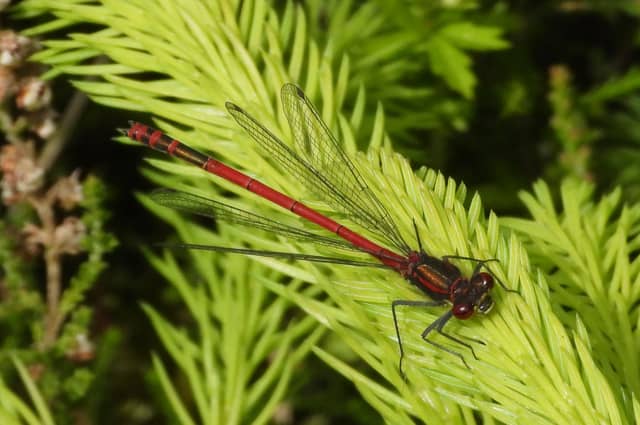

The stage has been set for, hopefully, a great return for these precious creatures
A new home for rare ‘flying jewels’ insects has been created in the grounds of a 15th Century castle.
A new wetland habitat for endangered species of dragonflies and damselflies has been completed by National Trust for Scotland at Castle Fraser in Aberdeenshire.
The freshly dug Birks Pond will provide a new potential home for dragonfly and damselfly species, while acknowledging the original design intention of the castle’s first and only female laird, Elyza Fraser.

The historic castle grounds are one of the few places that support the rare Northern Damselfly (Coenagrion hastulatum), an endangered insect which the charity has adopted as a priority species for conservation.
This makes Castle Fraser a critical location to protect and grow these populations and expand their range within Scotland.
At least 10 different species of dragonflies and damselflies can be found on the castle grounds. They are part of an ancient order of insects called Odonata, a group that pre-dates the dinosaurs at over 300 million years old.

Vivian Bisset, National Trust for Scotland Ranger in the North East, said: “We’re delighted to have introduced a brand new pond habitat to the landscape here at Castle Fraser, a key piece in the mosaic of habitats we’re building for the Odonata assemblages to thrive here.
“As the only site cared for by the Trust where the Northern Damselfly can be found, the grounds at Castle Fraser are critical for us contribute to the protection of this priority species in Scotland.
“It can take a couple of seasons for the Odonata to find their way to a new home and several years until they hatch, so it may be a while before we see our ‘flying jewels’ hovering around the edges of the new Birks Pond.

“The visitor experience has also been enhanced by the addition of interpretation panels and way markers around the Flight Pond, encouraging positive engagement with nature.”
Ms Bisset said that the “continued generosity” of NTS members and supporters - including the Postcode Lottery - allowed the work to be carried out.
Designed in collaboration with the British Dragonfly Society and named for the historic dominance of birch in the area (Birks is Scots for ‘birches’), Birks Pond sits just 400m from the 15th Century castle and is 2m deep.
Surveys of the landscape throughout 2025 investigated topography, soil composition and peat depth to identify the ideal location for the creation of rain-fed ponds.
The survey delivered three possible locations, and the chosen site overlaps with the location of the original Serpentine Lake, as outlined in the Castle Fraser Improvement Plan prepared by landscape gardener Thomas White in 1794.
White’s plan indicates Elyza’s design intent and paintings of the estate from the period suggest her vision for the Serpentine Lake was realised in the landscape.
While laird of Castle Fraser, Elyza played a very active role in the management of the estate in the 18th Century and made significant changes to the designed landscape. Evidence suggests Elyza drew design inspiration from her extensive travels around European gardens with her close companion Mary Bristow, after whom one of the Castle Fraser woodlands is named, and who would’ve inherited the castle, had she survived Elyza.

Chris Wardle, National Trust for Scotland Gardens & Designed Landscapes Manager in the North East, said: “It is by happy coincidence that the pond location which best protects Castle Fraser’s natural heritage also honours its cultural heritage, by echoing the design intent of the influential Laird Elyza Fraser.
“This development maintains the estate’s tradition for natural heritage being given a helping hand by human intervention, not always intentionally.
“The Flight Pond at Castle Fraser, built for wildfowl hunting, created the ideal conditions for the Odonata to originally settle at the estate. The Trust’s united and proactive approach to our range of assets ensures that natural and cultural heritage continue to develop harmoniously at places in our care.”
The creation of Birks Pond at Castle Fraser is part of the Trust’s Plan for Nature, which is supported by funds raised by players of Postcode Lottery. Postcode Lottery players have now raised over £4.3m since 2014 to support the Trust. The funds are awarded through Postcode Earth Trust.
Head of Charities at Postcode Lottery, Laura Chow, said: “It’s wonderful to see that funds raised by players of Postcode Lottery are supporting important nature conservation work at places cared for by the National Trust for Scotland.
Supporting the rare Odonata populations to grow and thrive is vital to the long-term health of the natural ecosystems in our waterways. To address biodiversity loss, restoring important habitats which have previously been destroyed is so important.”
The Northern Damselfly is on the British Red List of endangered species due to overall loss of habitats and has been identified in the Trust's Plan for Nature as one of 26 priority species for which the Trust has special responsibility.
This acknowledges the species as a priority for nature conservation action by the Trust.
Species conservation activity focuses on mountain plants and seabirds but also includes several other species found on NTS land.
They include hen harrier, red-necked phalarope, corncrake, Greenland white-fronted goose, narrow-headed ant, willow tit and vendace (a rare fish).
The charity also cares for several other endemic species that occur nowhere else in the world: the slender Scotch burnet moth (a day flying moth) and three species of whitebeam (trees), which are found only on Arran.
The trust has responsibility for around 200 species of invertebrates, lichens, mosses and fungi, which only occur at a handful of sites in the UK.
To see the rare Odonata at Castle Fraser, visitors should plan their visit for between May and August, which is peak flight season.
There will be no access to the new Birks Pond initially, to allow time for nature to reclaim the space, so the Flight Pond and surrounding area are currently the best locations from which to view them.
Comments
Want to join the conversation? Please or to comment on this article.