
Why Douglas Ross's word is 'worthless' as Scottish Tories face battle to recover from bitter uncivil war
Even though nominations have not yet closed for the Scottish Conservative leadership contest, the party has descended into what is becoming a bitter uncivil war.
On Thursday last week a story broke that is not being denied that last year the Scots’ Tory party leader, Douglas Ross, had asked in a private conversation at his home with Kathleen Robertson – the selected prospective party candidate for Moray West, Nairn and Strathspey – to stand aside in favour of him replacing her so he could seek to remain at Westminster.
If she agreed, Ross would resign as party leader with immediate effect and it was his preference his colleague Russell Findlay MSP would take his place.
Robertson apparently asked for some time to consider what was undoubtedly a surprise conversation and then declined the offer, preferring to stand herself.
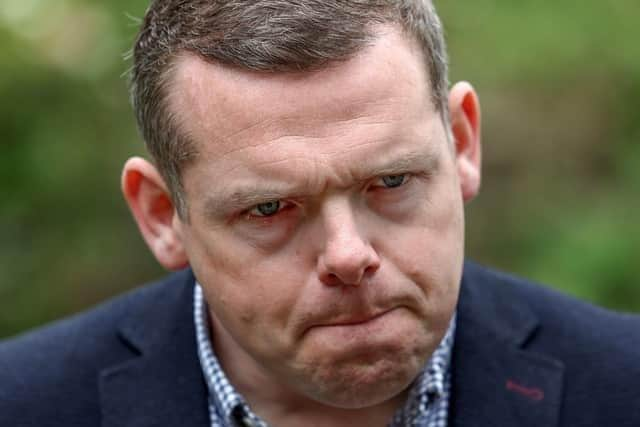

Ross was the sitting member for Moray, but the constituency had been split in the boundary changes and he had previously sworn publicly, on becoming Scottish leader after Jackson Carlaw resigned, to vacate his Westminster seat at the next general election.
This might easily be dismissed as the stuff of politics; that manoeuvrings always go on and participants look for the main chance to further their careers. When opportunities come along, they might change their mind and if they have to break a commitment, they need to show finesse in justifying it.
Yet this episode reveals much more than murky Machiavellian plots that it cannot be easily pushed aside.
Four MSPs who had announced their intention to seek their party’s leadership – Murdo Fraser, Jamie Greene, Liam Kerr and Brian Whittle – took the unusual step of jointly signing a public letter to the party putting eight questions about what officers knew and requested the election process be suspended.
They could have chosen not to do this and let Ross’s skulduggery ride. But once we understand the context of what has been happening within the Tory MSP group these past few years, it should be no surprise they decided to expose the bitter divisions that are at play – even if it costs the party support in the short term.
The reality is many within the party were not happy that Ross was foisted upon the group as leader with no other candidate being offered. It had all the look of a stitch-up in a backroom deal that suited the Scottish party establishment that had taken root under Ruth Davidson’s leadership.
Once Ross became leader, the strategic, tactical and policy decisions were most often taken within his own very small group to the exclusion of the majority of the Tory MSPs. Policy and tactical ideas were regularly ignored.
The reason so many candidates are now seeking to be leader is not that all of them expect to win – expect some tactical withdrawals – but to point to the level of dissatisfaction with what is called “the cabal” that runs the party. Elected MPs, MSPs, councillors, constituency associations and many members feel excluded.
These four candidates all want to open up the party to the antiseptic nature of daylight and the fresh air of democracy.
In writing their letter, they also put another potential leader, Meghan Gallagher MSP, on the spot.
In accepting Ross’s invitation to become his deputy, she had put her trust in him only for Ross to behave abominably in not taking her into his confidence about his true political intentions.
Further, when Ross had announced his resignation as leader during the general election campaign, he had pledged he would remain neutral and not back any particular candidate. Now it was exposed he all along had a preference and it was not his loyal deputy, but another colleague, Russell Findlay. Suddenly Gallacher was blindsided by Ross’s conduct and correctly deduced her position as his deputy was untenable. All trust was gone.
Ross had said he would leave Westminster to focus on Holyrood. The same Ross who did not put himself forward for selection in a Westminster seat, had then sought secretly to acquire one – Moray West, Nairn and Strathspey – without due process of the constituency association’s invitation.
In failing to pull off that betrayal to his colleagues, Ross then sought to acquire the Aberdeenshire North and Moray East nomination – also without that constituency association’s invitation – on the grounds that David Duguid – a sitting MP who had been selected, was too ill to stand, which Duguid disputed. It was no surprise to anyone that such unbecoming behaviour resulted in the seat being lost.
In such circumstances how could Gallacher continue as Ross’s deputy? How, indeed, can any of his MSP colleagues ever trust Ross again? His word and his commitment have been shown to be worthless. His place as a list MSP must now be hanging on a very shoogly peg.
Like he once did when running the line, Ross has tripped himself up and the public is at best bemused or laughing out loud. Carlaw is not wrong when he says Ross's continuation as leader is untenable.
A few weeks ago I asked for the Scottish Conservatives to have an open debate about what they are for, that they ask themselves what they want to achieve and work out how they go about it. Now, before the election of a new leader is even properly underway, they are exposing just how divided they are – and it is nothing to do with policies and everything to do with personalities and who retains or takes power.
The Scottish public could be forgiven for viewing it as like two bald men fighting over a comb. How the winning candidate works with the losers and heals the bitter divide is now a big, big question. The candidate that can deliver unity after the bloodletting will most likely be the winner – but to what purpose?
- Brian Monteith is a former member of the Scottish and European parliaments and editor of ThinkScotland.org
Comments
Want to join the conversation? Please or to comment on this article.