
Social workers call for support as more offenders set for community

The government’s new aim is to have more offenders given community-based sentences - but this could impact an already strained social work system.
Social work leaders have warned that managing more offenders in the community in a bid to reduce the overcrowding crisis in Scotland’s prisons could overwhelm already stretched services.
Social Work Scotland (SWS) has raised concerns about a “very challenging” picture if an increase in community-based sentences is not met with significant additional funding for services.
Proposals put forward by the Scottish government to tackle the prison overcrowding crisis include extending the presumption against short-term prison sentences from 12 months to 24 months.
Any increase in the use of community disposals in place of custodial sentences must be reflected in resources for justice social work (JSW) services, which are already experiencing a “steady increase in workload” in a range of areas, SWS said.
For example, Scottish Courts issued 16500 Community Payback Orders in 2024/2025, 14% increase from the year prior to the pandemic.
“As such, substantial increases in the number of individuals managed in the community by JSW would be very challenging in terms of capacity,” SWS said.
COSLA estimates that the cost to JSW to work with an individual over a 12 month period is around £5,400.
An additional 500 offenders being managed in the community by JSW would cost an additional £2.78m a year.
“This is, of course, considerably lower than the cost of a short-term prison sentence however JSW would have to be adequately resourced to ensure it has the capacity to deliver a community alternative,” the organisation said.
Justice secretary Neil Gray has also proposed that social work reports are mandatory for all cases where a short custodial sentence is being considered.
SWS warned the move could lead to poor quality background reports on offenders and staff being taken off of other key tasks to complete them.

Reports can provide information on trauma, substance use, mental health, housing, family responsibilities and caring roles. At the moment, they are normally used for community sentences of more than 100 hours of unpaid work.
Social Work Scotland said an increase in these reports is “welcome if it helps avoid unnecessary short-term custodial sentences”, but added that this must be “properly resourced”.
In 2024/25, justice social work in Scotland completed almost 30,000 justice social work reports, a 4 per cent increase on the previous year and the highest number since 2016/17.
The cost of providing a justice social work report is £197.88.
SWS, in its official response to the government’s consultation on penal reforms, said: “Any move towards mandatory reports must be accompanied by sufficient capacity within justice social work services.”
It said evidence indicates that short custodial sentences are “less effective” than community-based interventions when it comes to rehabilitation and reducing reoffending.
Prosecutors should look for “compelling reasons” why offenders cannot be managed in the community, rather than considering whether imprisonment is an option available to them, SWS added.
It said there is often “limited information” for why community alternatives are rejected in favour of custody.
SWS said: “Reducing the use of short custodial sentences may help mitigate some of the disproportionate impacts of imprisonment on people experiencing poverty, homelessness, trauma, substance use issues and mental ill health.
“Community-based interventions are often better placed to address these challenges while maintaining access to support networks and services.”
It said short-term prison sentences should be reserved for cases involving “significant risk of harm” or where “public protection cannot be managed”, for example in domestic abuse cases.
But it also warned of “significant variation” in access to programmes and interventions across Scotland, which can undermine confidence in community disposals.
There are 10 different parts to community-based sentencing.
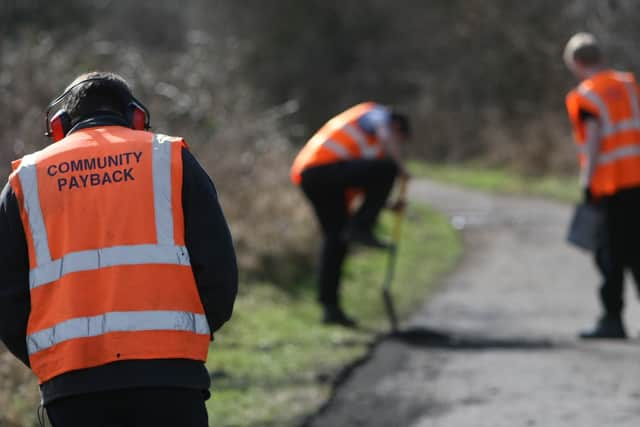
The most common of these is unpaid work, which can include cleaning graffiti and litter, redecorating buildings, gardening, clearing snow and gritting paths, helping in charity shops or community cafes, or doing shop deliveries for the elderly. It can also include learning new skills such as writing a CV to help offenders get a job.
The second most common part is supervision by a social worker to help “address what makes them offend, for example, poor decision-making”.
Other elements include paying compensation to victims, attending rehabilitation programmes and being ordered to live at a certain address such as their parents’ house and treatments to deal with mental health issues and drug and alcohol use.
Those who breach these orders often end up back in court, and this can sometimes lead to an individual getting a prison sentence handed down to them.
The Scottish Conservatives claimed the Scottish Government does not have a grip on the justice system or on managing community-based sentencing.
Stephen Kerr MSP, the party’s justice spokesman, said: “The SNP has already failed to support community sentencing for far too long, which has resulted in them having to write off hundreds of thousands of hours of work that criminals should be doing.
“Now their reckless early release schemes are going to exacerbate this situation for social work services which are already under huge strain.
“[Justice Secretary] Neil Gray needs to listen to these serious concerns before he ploughs ahead with plans to release more criminals back onto Scotland’s streets.”
Justice Secretary Neil Gray said: “We have demonstrated our commitment to community justice with an additional £10 million this year, building on the £25m of extra funding provided over the previous two years.
“This brings total investment for 2026/27 to £169m, recognising the important contribution these services make to Scotland's justice system.
“We know that any increase in community-based interventions would need to be appropriately resourced.
“Community justice services play a vital role in supporting rehabilitation, helping people reintegrate into their communities and reduce reoffending, and we will continue to work closely with partners as part of the consultation process.”
Comments
Want to join the conversation? Please or to comment on this article.