
SNP forced into u-turn over controversial juryless rape trial plans

The Scottish Government has been forced into a u-turn on its plans to pilot juryless rape trials after failing to find support from opposition MSPs.
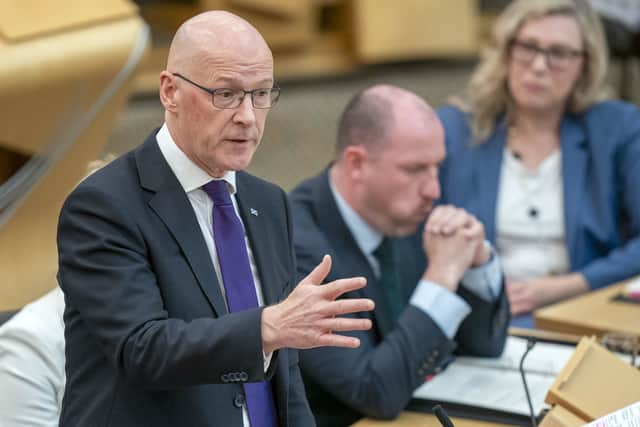
John Swinney has admitted piloting juryless rape trials is not “the best way of proceeding” with justice reforms after the SNP government was forced into a “humiliating u-turn”.
SNP Justice Secretary Angela Constance has confirmed that the juryless rape trials pilot will be scrapped from the proposed Victims, Witnesses, and Justice Reform (Scotland) Bill being tabled by the Scottish Government.

Ms Constance acknowledged “there is not enough cross-party support at this time for such a pilot, irrespective of the model”.
The proposals had been heavily criticised by lawyers and judges - with lawyers threatening to boycott any pilot scheme.
But the Scottish Government will press ahead with an ambition to scrap the not proven verdict in the Scottish legal system and other reforms.
The juryless rape trials pilot would have taken place during 2028.
Ms Constance added: “In the interests of building as much consensus as possible, I will no longer pursue this policy and bring forward relevant amendments to remove it from the bill.”

Mr Swinney told journalists that the Scottish Government has listened to concerns raised about the pilot of juryless trials for rape cases.
He said: “The government has recognised the evidence and the consultation.
“In light of the feedback that we’ve had, we’ve come to the conclusion that this does not represent the best way of proceeding in reform of the criminal justice system.”
He added that “there are a number of other reforms that are taking their course”.
Ms Constance has said that she will “remain committed to exploring the impact of rape myths and improving access to justice for rape victims”.
She added: “As part of this work, I will bring forward amendments to allow for research to be carried out into jury deliberations, which is currently heavily restricted by the Contempt of Court Act 1981.
“I also intend to bring forward amendments at stage 2 so that Scotland retains a 15 person jury in criminal trials.
“After reflecting carefully on the Criminal Justice Committee’s recommendations, and on the evidence, I believe that the most prudent approach to jury reform, including the abolition of the not proven verdict, is to seek support for a model with two verdicts (guilty and not guilty), 15 jurors, and a two-thirds majority requirement for conviction.”
The Scottish Solicitors Bar Association described the move as a “humiliating u-turn”.
In a statement, it said: “We are enormously proud of our efforts in defeating this dangerous proposal.
“The government resent us, hold us in contempt but never again should they underestimate us.
“Our opposition was a principled campaign based on a simple premise: either all of us matter or none of us matter.
“Once you start taking away some people’s rights, it never ends there.”
Roddy Dunlop KC, dean of the Faculty of Advocates, also said he was “very pleased” to see the proposal being axed.
Scottish Conservative shadow justice secretary, Liam Kerr, said the decision was “a belated victory for common sense”.
He added: “We opposed many of the radical proposals within this bill, which would have undermined the integrity of Scotland’s justice system.
“In particular, the SNP’s decision to drop their plans for juryless rape trials will come as a huge relief to rape victims. They had made it clear they still wanted to have their cases heard by a jury.
“It is also welcome that the SNP have accepted our scepticism of their changes to jury sizes and will now retain 15-person juries in Scotland.
“The SNP justice secretary has taken a step in the right direction, but her full focus should now be on ensuring this bill gives victims the voice they deserve – as it is still lacking in that regard.”
Ms Constance told journalists that there was “significant support for this proposition” from victims’ organisations, adding that “they deserved a fair wind and a fair hearing”.
She insisted that the remaining reforms “will make an immense difference”.
Six MSPs including deputy first minister Kate Forbes abstained from the first vote on the proposals.
Asked if there was a lack of support within her own government for the legislation, Ms Constance said that “deliberations within government remain within government”.
She added: “But there is a reality about parliamentary numbers and there isn’t a consensus on this issue.
“Ultimately, in the best interests of victims and witnesses, I want to build a consensus because they deserve to be at the very heart of our justice system.“
Ms Constance said there were “other alternatives to a single judge pilot” - pointing to a Norwegian model that included a panel of judges with lay members.
But she added: “I have to acknowledge that idea didn’t persuade other parliamentarians.”