
Scottish business hails ‘big win’ of Burnham’ s new EU trade deal
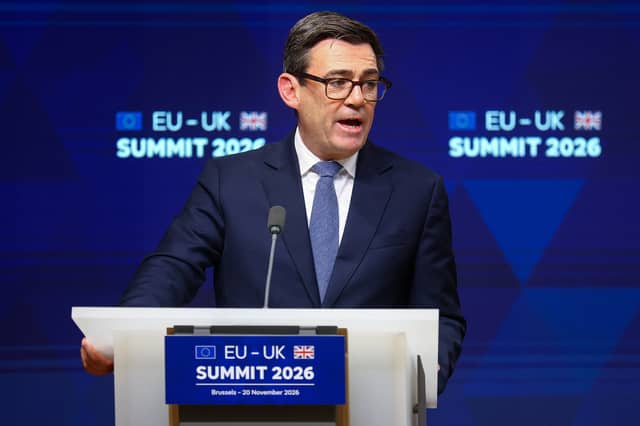

The Scottish Retail Consortium hailed the Prime Minister’s food and drink agreement as a “big win” but warned that firms need “at least 18 months” to transition to the new arrangements.
Scottish business leaders have hailed a ‘big win’ following Andy Burnham’s new trade deal with the European Union.
The Scottish Retail Consortium said the agreememnt would “cut costs” for the food and drink sector but warned companies needed “at least 18 months” to transition to the new arrangements.
The PM agreed a deal with the EU in Brussels covering food and agriculture exports, emissions trading and a youth experience scheme on what Mr Burnham described as a "good day" for Britain and Europe, adding the Treasury believes the deal could boost the UK economy by up to £17bn a year.
The food and agriculture part of the deal, aimed at ending post-Brexit export checks, would see Britain align with the EU on trade rules on sanitary and phytosanitary (SPS) goods, such as food and plants, from March 2028.
David Lonsdale, director of the Scottish Retail Consortium, said: “The food and drink deal is a big win for domestic retailers, the wider food industry, and consumers.
“Reducing border friction and simplifying trade will cut costs and support smoother trade in food, drink and plants between the UK and EU, including moving goods to Northern Ireland.
“The benefits will be felt across the entire supply chain, from producers and suppliers through to retailers and the millions of consumers they serve.
“The priority now must be to get the detail right and give businesses at least 18 months, alongside clear and early guidance, to transition to the new arrangements without unnecessary cost or disruption.”
The National Farming Union Scotland said the deal could “deliver significant benefits for Scottish agriculture”.
Director of Policy and Deputy CEO Jonnie Hall said: "This agreement has the potential to deliver significant benefits for Scottish agriculture, particularly by reducing trade barriers for our red meat and dairy sectors and reopening the EU market to Scottish seed potatoes.
"NFU Scotland has worked extensively with governments and industry throughout the negotiations, helping secure important protections around crop protection products. These are positive outcomes for our members following sustained engagement.
"However, significant challenges remain, particularly around animal disease controls, including avian influenza. Scottish agriculture has distinct production systems and geographical challenges, and we need practical solutions, appropriate transition periods and flexibility to avoid unnecessary costs and disruption."
Tavish Scott, chief executive of Salmon Scotland, said the sector would “benefit greatly” from improved trading arrangements between the UK and the EU.
He said that, after ratification, costs and border checks will be reduced amid increasing demand for Scottish salmon.
Mr Burnham said the deal paved the way for even closer ties to Brussels.
European Council President António Costa said the EU remains "open to have the closest possible relationship" with the UK.
Legislation to implement the deal signed in Brussels is expected to be introduced in the UK Parliament next week.
The agreement includes a youth experience scheme which could open the doors for 100,000 young Europeans to temporarily work in the UK, with Britons able to do the same on the continent.
The SNP said the measures were “welcome” but that Scotland should be returning to the bloc.
SNP Westminster Leader Dave Doogan said: "Any small moves to mitigate Westminster’s wasted decade of Brexit damage are welcome but the fact remains that rejoining the EU is the only real solution to the disaster of Brexit.
"Scotland should never have been dragged out of the EU against our will and our best future is to become an independent country in the EU - boosting our economy and advancing Scotland’s interests at the EU top table.
"As the UK government admits, Brexit will continue to cost Scotland and the UK billions of pounds every year in lost trade and growth - damaging our public finances, increasing the cost of living, and stripping away our European influence, rights and benefits.
"The fact that even the small moves being trumpeted by the UK government today aren’t fully secure underlines that small steps simply won’t cut it.”
The PM said the next 12 months would be spent “brainstorming” ideas with the EU for the future relationship between the UK and the bloc.
Mr Burnham said: “Incremental steps… only take us so far.”
The Prime Minister suggested the package was “probably the limit” of what could be achieved before the next general election.
He has committed to abide by Labour’s manifesto red lines ruling out a return to the single market, customs union or free movement.
Mr Burnham said: “We’re 10 years on from Brexit but I think we can all confidently say this is a good day for Britain and this is a good day for Europe.”
He said that the deal with the EU would “draw a line on a decade of drift and division by reconnecting with old friends”, and added: “I think people across Britain can look forward now to a better, more hopeful decade ahead of us.”
Mr Burnham said Treasury analysis suggested the deal would add up to 0.5% to gross domestic product by 2040, cut costs for business and help with “the cost of the weekly shop”.
The Prime Minister has promised to set out options for the future UK-EU relationship, including the possibility of seeking to rejoin the bloc.
That would involve an “informal brainstorming process” with the EU about what the options could be.
“What we are announcing today is probably the limit of what we can achieve in this Parliament, given what needs to be done to implement it.
“But we want to inform the Parliament after this one, so that decisions can be taken about that long-term relationship.”
Despite the show of goodwill between the Prime Minister and the EU’s chiefs, a potential stumbling block remains over the issue of the tuition fees charged to students from the bloc in British universities.
A six-month deadline has been set to reach agreement after EU member states called for their students to be charged the same rate as British counterparts, mean a cut from fees of up to £38,000 a year to £9,970 – something the UK has resisted because of the financial impact it would have on universities.
The row led to doubts being raised in Brussels about whether the rest of the deal could be implemented.
An EU official said: “I think this is an important element, so let’s hope that everything can go ahead.”
But Mr Burnham said there was “no confusion” over the status of the deal.
The joint statement said the “aim” is to apply the main elements of the agreement from 2028, with a January 2030 target date for ensuring the opportunities under the youth scheme are available.
“There are firm dates for the implementation of the changes to the different policy areas in the deal, and there will be further discussions coming out of it as referenced in the text, around various issues, of which tuition fees is one.”
Comments
Want to join the conversation? Please or to comment on this article.