
Rachel Reeves urged to show 'restraint' as fears grow Scots face more tax rises
The Scottish Retail Consortium said Ms Reeves’ focus should be on restraint, while the Federation of Small Businesses called for the VAT threshold to be raised for small businesses
Rachel Reeves has been urged to "show restraint" in her Budget next month amid growing fears Scots will face paying even more tax.
The Institute for Fiscal Studies (IFS) think tank urged the Chancellor to be “bold” after she acknowledged she was looking at potential tax rises and spending cuts to fill a black hole.
But the Scottish Retail Consortium said Ms Reeves’ focus should be on restraint, while the Federation of Small Businesses called for the VAT threshold to be raised for the self-employed.
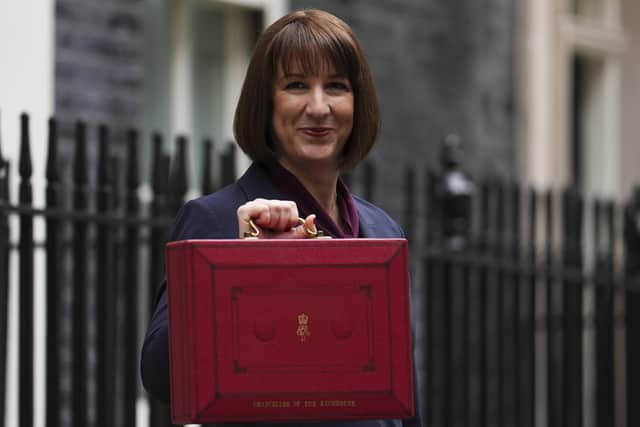

The SNP said "staggering" tax rises are likely because of the UK Government “refusing to acknowledge the damage of Brexit” or change its fiscal rules.
The Chancellor acknowledged she was looking at tax rises and spending cuts to fill a black hole in her Budget, which takes place near the end of next month. She said part of the reason was the impact of Brexit.
Ms Reeves said: "Already, people thought that the UK economy would be 4 per cent smaller because of Brexit.
"Now, of course, we are undoing some of that damage by the deal that we did with the EU earlier this year on food and farming, goods moving between us and the continent, on energy and electricity trading, on an ambitious youth mobility scheme.
"But there is no doubting that the impact of Brexit is severe and long lasting and that's why we are trying to do trade deals around the world, US, India , but most importantly with the EU so that our exporters here in Britain have a chance to sell things made here all around the world."
Admitting that tax rises could be coming, she added: “Challenges are being thrown our way, whether that is the geopolitical uncertainties, the conflicts around the world, the increased tariffs and barriers to trade and now this review looking at how productive our economy has been in the past and then projecting that forward.
“But I won't duck those challenges. Of course, we're looking at tax and spending as well, but the numbers will always add up with me as Chancellor because we saw just three years ago what happens when a government, where the Conservatives, lost control of the public finances - inflation and interest rates went through the roof."
The IFS warned Ms Reeves needs to be "bold" when she delivers her Budget or face " groundhog day " with more cuts or tax rises next year.
The think tank said it expected the Chancellor would need to find at least £22 billion next month, thanks to rising borrowing costs, weaker growth forecasts and spending commitments made since the spring.
That figure would restore the £10 billion of headroom Ms Reeves previously left herself against her self-imposed debt rules, although it does not include the cost of widely expected announcements on abolishing the two-child benefit cap and maintaining the freeze on fuel duty.
But the IFS said there was a "strong case" for the Chancellor to go further, arguing that a £10 billion buffer was not enough to ensure stability and would leave her "limping from one forecast to the next".
IFS director Helen Miller said: "For Rachel Reeves, the Budget will feel like groundhog day ."
She added that the situation was "to a large extent" of the Chancellor's own making, after choosing to "operate her fiscal rules with such teeny tiny headroom" that left her exposed to "run-of-the-mill forecast changes".
The IFS said implementing a larger fiscal consolidation in November would be "the most straightforward route" to avoiding similar challenges in future years.
It acknowledged that achieving consolidation through spending cuts would "pose challenges" due to a lack of parliamentary support for welfare cuts and the fact departmental budgets were only agreed in June.
But tax increases are also far from simple, with Labour's manifesto ruling out increases to income tax, national insurance or VAT.
Ms Miller suggested it would be possible to raise the required sums from changes to property taxes and levies such as capital gains tax or inheritance tax, but added these were "badly designed" and could harm growth.
The IFS also warned against seeking "large sums from a small number of taxpayers".
Instead, the think tank said the Chancellor "should be bold" and reform the tax system to be "more rational" and impinge less on economic growth.
The Scottish Retail Consortium urged the Chancellor to spend less rather than tax more.
The group’s director David Lonsdale said: “Retailers are having to contend with weak economic growth, cash-strapped consumers, and mounting government-mandated tax rises as a result of last year’s Budget which have, as the Bank of England has pointed out, added to grocery bills.
“Previous government decisions have left few politically palatable options available to the Chancellor, however the focus of the Budget ought to be on spending restraint rather than further tax rises on retailers which could stymie economic recovery and keep shop prices higher for longer.”
Guy Hinks, chairman of the Federation of Small Businesses Scotland, said: “We need to find ways of getting the economy moving again and giving businesses the confidence that things are moving in the right direction.
“Raising the threshold at which the self-employed and micro businesses must start paying VAT would be one clear way of doing that. That would be a win-win for the Chancellor. Not only would it stimulate extra economic activity, it would also generate greater tax revenues, according to Treasury forecasts.
“Currently, too many non-VAT registered small businesses deliberately slow down their activity - in some cases even turning away work - in order to remain under the £90,000 annual VAT threshold. Lifting the threshold would take the brakes off for many of those firms.”
SNP economy spokesperson Dave Doogan said: "These staggering tax rises for families and businesses are on Rachel Reeves budget menu because the Labour Party refuse to acknowledge the damage of Brexit and recognise the benefits that single market access would bring us.
"While countries across Europe adapt their fiscal rules to respond to the changed world we now operate in, the Labour Government is following in the footsteps of the Tories in the broken old Westminster way.
"This morning Rachel Reeves blurted out the world's worst kept secret - the Labour Party are cynically preparing the ground for another brutal budget - a budget of more broken promises that will hammer family finances and businesses compounded by cuts to vital public services.
"After promising 'change' only last year, people have already seen through Keir Starmer and seen that things have gone from bad to worse under the Labour Party. The only hope for people in Scotland to escape the never-ending doom loop of Broken, Brexit Britain is to choose a fresh start with independence."
A Scottish Government spokesman said: “We are calling on the UK Government’s Autumn Budget to deliver more funding for public services, infrastructure, and cost of living support – including by abolishing the two child limit in Universal Credit.
“The Scottish Government's progressive taxation choices enable us to deliver policies that not available anywhere else in the UK, including the game-changing Scottish Child Payment which is forecast to benefit the families of over 330,000 children in 2025-26.”
Comments
Want to join the conversation? Please or to comment on this article.