
Exclusive:Rachel Reeves told to fast-track windfall tax reforms or risk losing £40bn North Sea investment



The UK government has been warned a refusal to immediately bring in reforms to the controversial energy profits levy could scupper more than £40bn of investment in the North Sea.
Rachel Reeves has been told to fast-track her reform of the controversial windfall tax or risk Scotland missing out on investment to scale up floating offshore wind - with the North East potentially missing out on more than £40 billion.
The Labour Chancellor has been warned that Scotland’s “huge opportunity” to scale up floating wind technology could be put at risk if she refuses to immediately bring forward her permanent reforms of the controversial windfall tax on oil and gas giants, the chief of the North Sea industry has warned.
Speaking to The Scotsman ahead of the Chancellor’s autumn budget next month, David Whitehouse, CEO of Offshore Energies UK (OEUK) has admitted the permanent proposal to reform the energy profits levy (EPL) is “fair”, but has insisted instead of being rolled out in 2030, it “needs to come now”.
His comments came as Deputy First Minister Kate Forbes used her speech to the SNP conference in Aberdeen to urge Ms Reeves to scrap and replace the windfall tax on oil and gas at the next budget. She also reiterated the nationalists’ opposition to nuclear energy, declaring that Scotland “will not be the UK’s nuclear playground”,
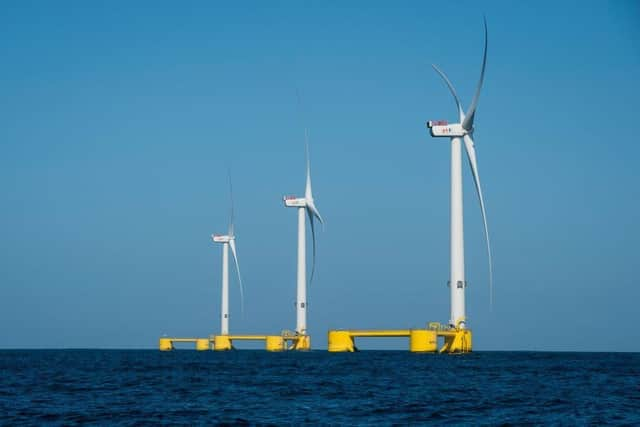
Mr Whitehouse warned that bringing forward the permanent regime for tax on energy profits will “unlock investment” amid fears that any delay could put Scotland’s potential of scaling up floating wind at risk - with many of the floating wind proposals tied to existing oil and gas platforms.
With a large proportion of Scotland’s floating wind proposals tied to existing oil and gas platforms, Mr Whitehouse has warned that a failure from the Labour UK government to bring forward its tax reforms could put future investment at risk.
The Innovation and Targeted Oil & Gas (INTOG) leasing round from Crown Estate Scotland, includes floating offshore wind projects connected directly to oil and gas infrastructure, to provide electricity and reduce the carbon emissions associated with production.
But Ms Reeves has been warned that her reluctance to bring forward her permanent overhaul of the EPL could put billions of pounds of investment at risk.
Speaking to The Scotsman at the SNP conference in Aberdeen, Mr Whitehouse pointed to the permanent proposal that is due to come into force in 2030. Under that plan, the top slice of extraordinary profits will be targeted with a trigger price where the levy kicks in.
Mr Whitehouse said it would be “an appropriate level that would maintain that 78 per cent tax rate” currently in force across the board.
He added: “It is fair and it would unlock investment."
The OEUK chief warned that instead of the reforms coming in 2030, “it needs to come in now”.
He said: “If we wait until 2030, we’re already seeing around 1,000 jobs lost a month - the damage to the sector will be significant.
“The EPL simply isn’t working. The EPL has raised less than a third of the tax it was designed to do. We are seeing investment stopped.”
Mr Whitehouse added: “If we flip it now, in reality we have identified over £40bn of investment that would go into oil and gas, that would add 2bn barrels of oil and gas.
“You would then see that wider support for other opportunities. That would unlock the opportunity for investors to make those decisions around Intog and the floating offshore wind tied back to offshore platforms.
“This is the right thing to do. It supports the government’s own narrative. It supports growth and the very companies we need for that very transition.”
He stressed that “we want to see the manufacturing of turbines come to the UK and Scotland”, amid fears it will not be sustainable to import manufacturing as the sector scales up.
Mr Whitehouse said: “I think floating wind is a huge opportunity for not just Scotland but the wider UK. It really plays to our strengths. I genuinely think it’s a real opportunity.
“The way we get these projects moving and give confidence to those projects to move ahead is to give confidence to the platforms that they are going to support that they have longevity.
“That comes back to Rachel Reeves making the appropriate decision to put in place that permanent regime and give confidence those assets will be there for a long time. That’s what will unblock floating wind at scale.”
SNP Westminster leader, Stephen Flynn, told The Scotsman there needs to be “an acceleration” of the scaling up of North Sea renewables.

He added: “That’s going to require government policy, that’s going to require investors being able to come together to create a framework to provide certainty of opportunity.
“That’s what industry is crying out for. It is already ready and willing to get on with the delivery of these projects.”
Mr Flynn said the Scotwind and Intog projects offer a “huge opportunity at our fingertips”.
He added: “We have to work in collaboration with industry with both governments, with investors, to make sure that these projects are delivered, so we can have the jobs and investment and safeguard the communities that I represent and safeguard the economy of the economy across these Isles.
”There’s an ability for politicians right across these isles to have shared goals. I think the shared goal that we can create jobs, clean energy and cheaper bills is an important one and a vital one.”
Comments
Want to join the conversation? Please or to comment on this article.