
New Scottish Greens leaders Ross Greer, Gillian Mackay demand 'serious internal reform' after low turn-out

The election of the new co-leaders of the Scottish Greens has been overshadowed only one in eight members casing a vote.
The new co-leaders of the Scottish Greens have been forced to deny the party is engulfed in crisis after only one in eight members turned out to vote at the leadership election.
Gillian Mackay and Ross Greer were on Friday confirmed as the party’s new co-leaders, with former co-convener Lorna Slater narrowly missing out after the second round of voting. Now-former leader Patrick Harvie announced in April that he would stand down.


But the new leaders have been forced to defend their mandate and have immediately called for “serious internal reform” after only 12.7 per cent of Scottish Green members cast their vote to elect the new leadership team.
Ms Mackay, who said the result represented a "generational shift in the leadership of the Scottish Greens", was elected in the first round of voting with 34 per cent. Mr Greer defeated Ms Slater in the second round by 317 votes to 304 after Dominic Ashmole was eliminated.
But with the new leaders only receiving the votes of around 4 per cent of party members, they instantly faced questions about the apathy held by the membership and what that means for their mandates.
Mr Greer told journalists the Scottish Greens had “allowed ourselves to become a radical bureaucracy”.
He said: “We need to see serious internal reform. Even the design of the ballot paper is something we need to look at here. We need to reform as a party if we are to grow as a party.”

Mr Greer, who at the age of 31 is the youngest ever leader of a Holyrood party, intends to begin reforming the inner workings of the party at the next conference.
He said: “At the moment, we are a party rooted in the principle of radical democracy, but not yet fully living that value out.
“What we need to do now is take the party on a journey, to change our structures, our processes and our culture to make it easier and more enjoyable to be a member of the Scottish Green party and to participate in our internal democracy.”
He suggested that “part of the turn-out is probably explained” by the contest “not [being] a debate about two fundamentally different philosophies”.
Mr Greer said the extremely low turnout was “a problem that we need to take seriously”.
He said: “There is no pretending that 12.7 per cent turn-out is good. We need to see a far greater level of turn-out.
“Our party is really well placed to make gains next year. Far more people intend voting Green next May than voted for us at the last election and 2021 was a record result for us.
“We are looking at making significant gains on what was already a record election result in 2021.
“That can exist at the same time as the internal challenges we have with a lack of membership engagement because we’ve built up this radical bureaucracy.”
But Mr Greer warned “we need to spend far less time talking to each other” and “far more time out speaking to voters”.
Ms Mackay said: “I think we need to find out why people haven’t turned out to vote. Until we ask them, we won’t know. It is a concern, but we need to find out why.”
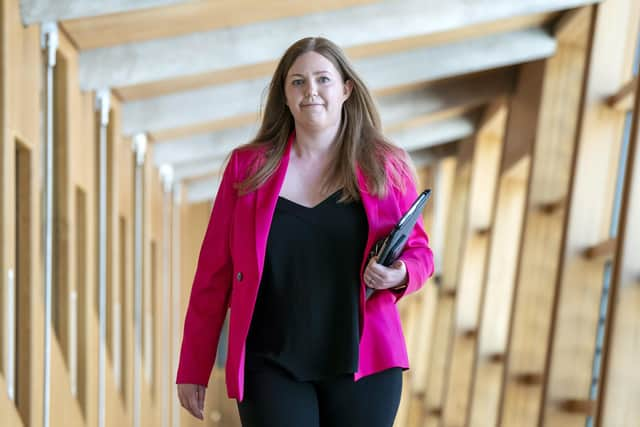
She added “I don’t think it is embarrassing.”
Ms Mackay told journalists the result was “a good platform to go forward”, and stressed she wished to focus “more on NHS reform”, wants the Greens to “talk more about a universal basic income” and the climate crisis.
Comments
Want to join the conversation? Please or to comment on this article.