
Kirk moderator: I get angry at the doom and gloom stories about the Church
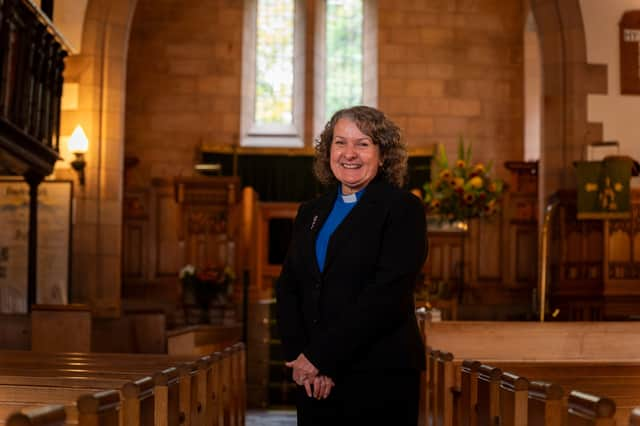
The Rt Rev Rosemary Frew on the challenges facing the Church of Scotland - and why she is optimistic about its future

Declining congregations. A worsening financial situation. Historic buildings sold off across the country. The Church of Scotland is, by its own admission, at a tipping point.
In the face of such challenges, it would be easy for members to despair. But the Rt Rev Rosemary Frew, the moderator of the General Assembly, has - if you will forgive the pun - more faith.
"I've actually seen a lot of positive stuff, I would have to say, in the last six months,” she told The Scotsman from the Kirk’s head office on George Street in Edinburgh. “It's not the doom and gloom that the papers would like to make out.

"Every church sale - 'the failing Church of Scotland', we're given that tag. I get a little angry that every time the Church is mentioned, a church sale is mentioned, 'the failing Church of Scotland'.
"Well, I've kind of seen the opposite. I've seen a really alive Church of Scotland, and Christians of all denominations working incredibly hard to share the mission of the Church and the love of God.
"As I say, there is a really positive story out there, but maybe that's the one that doesn't get heard because it's not a headline."
Ms Frew, who has taken temporary leave of her Bowden and Melrose parish in the Scottish Borders to become the public face of the Church for a year-long term, said the Kirk has undergone “an awful lot of reform” in recent years.
"We've had to address a financial deficit; we've had to address the fact that we've got far too many buildings,” she said. “We've been talking about that - we've got far too many buildings - since 1929, so you know, this shouldn't come as a surprise to people. But we're finally doing something about it."
The date refers to the reunification of the United Free Church and the Church of Scotland following the Disruption of 1843, which undeniably left the Kirk with a surplus of buildings.
"Yes, maybe by finance and falling membership, we are being forced into addressing that, but that's no bad thing,” Ms Frew said.
"And yes it's hurtful, I know that. People have a great attachment to buildings. But actually, what I would have to say is that in my six months as moderator, and visiting congregations, and visiting presbyteries, actually there's a really positive vibe out there.
"And people realise we've just got to get on with this.”
As of December last year, there were 245,000 members of the Church of Scotland, a fall of 5.5 per cent from 2023. Membership has slumped by 35 per cent over the last decade.
Meanwhile, the 2022 census marked the first time a majority of Scots (51.1 per cent) said they had "no religion”, up from 36.7 per cent in 2011. The number who identified with the Church of Scotland fell from 42.4 per cent in 2001 to just 20.4 per cent.
But the Kirk nevertheless continues to play an important role in Scottish public life. It is one of the country’s largest social care providers, running services in some 70 locations and employing around 1,600 staff through CrossReach, its social care arm.
Many churches sit at the heart of their communities, and the Kirk’s position on big issues still matters. It has spoken out against assisted dying legislation, although Ms Frew said it is “very, very divided” on this issue.
A report to this year’s General Assembly laid bare the challenge facing the institution, which has an operating deficit of £5.9 million.
“The financial situation since last year’s Assembly has in fact worsened and the Church of Scotland is at a tipping point in terms of its financial viability,” it warned.
Difficult decisions had to be made, including around redundancies and budget cuts. Rule changes could also see congregations effectively declared insolvent if they are unable to support themselves financially.
"If you're not, as a congregation, raising £50,000 to pay for a minister, you're not paying your way,” Ms Frew said.
"We are having to make hard decisions. In the past, we had congregations we would have described as 'aid-receiving', and so the rest of the church was paying for them, assisting them to have a minister. These days are going."
In reality, she said this would affect very few congregations. "Part of the adjustment process should mean these congregations are now part of something bigger, so that shouldn't actually be happening,” she added.
Some church sales are more emotive than others. Earlier this year, Arbuthnott Church in Kincardineshire, which is closely associated with Lewis Grassic Gibbon’s much-loved novel Sunset Song, was put on the market for offers over £45,000. A community group had hoped to take over the A-listed building.
Ms Frew said old church buildings are "incredibly expensive to run". The Kirk, she said, needed to be pragmatic. But she is optimistic about the future.
Asked where she sees the Church of Scotland in 10 years’ time, she insisted it will still be there.
"There's an awful lot of good that's happening out there,” she said. “There's an awful lot that the Kirk is involved in. There are so many good, hard-working people out there for whom the Kirk is incredibly important.
"So it will still be there. Absolutely, it will still be there. The shape of it might be slightly different, but I don't worry about it."
Comments
Want to join the conversation? Please or to comment on this article.