
I'm trying to avoid anger at Scotland's 'hokum' literary gender wars driven by Nicola Sturgeon, National Library
If you’ve ever had anti-social neighbours, you’ll know the heart-thumping flood of emotion caused by renewed noise after a period of quiet. Banging resumes, bass-notes re-boom, hollering intensifies.
Your entirely human, instinctive reaction is anger. But you must remain calm, diligently logging ongoing incidents.
You’ve tried repeatedly to resolve this cacophonous injustice: written letters, tried to speak in person, appealed to authorities. While aggrieved it hasn’t worked permanently, you’ll try again. Hope for the best. Through gritted teeth.
This is the nearest analogy I have to describe what it’s like addressing the ongoing harms of Scotland’s literary ‘gender wars’ as a gender-critical writer affected, personally and professionally. After the extremely loud month of August’s Edinburgh festivals, I’m not alone in feeling at the ‘calling the police’ stage of the above scenario.
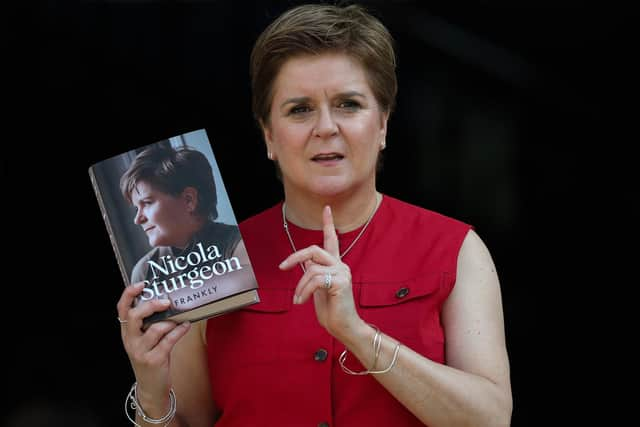

It was inevitable Nicola Sturgeon’s memoir would retraumatise many women harmed by her policy-agenda of ‘self-ID’, whereupon any male who feels so-inclined becomes a woman on his instant say-so.
The most recent doozy came on Thursday last week. When interviewed by LBC’s Ian Dale, Sturgeon said she’d “never accept” self-ID affects women’s rights.
This, despite how many tribunals? How many judgments? How much evidence? The same tune blasted through the proverbial walls again.
And earlier this month, the reproaches from Edinburgh International Book Festival director Jenny Niven. In an email to a festival attendee, who’d written to query the absence of gender-critical authors in this year’s programme, Niven explained that "if” any ‘reparatory’ books were written by such women “in the future”, she’d consider them.
She repeated this on BBC Front Row with Samira Ahmed days later, saying the books "in front of” her this year weren’t suitable.
That would be the Sunday Times best-selling anthology The Women Who Wouldn’t Wheesht, and my own book Hounded: Women, Harms and the Gender Wars.
Mine includes a chapter on the psychological harms experienced by women who’ve opposed gender-identity ideology. I have to presume Ms Niven hasn’t read it, or she wouldn’t be repeating them.
Describing women who’ve suffered often severe abuse as insufficiently "reparatory”, and their detractors, a great deal of whom were appearing at her festival, as “joyful” was the cherry-on-top insult from Ms Niven, in an interview with The Herald.
The noise-level reduced briefly. But it roared back, courtesy of arts venue Summerhall. This time, Deputy First Minister Kate Forbes was the target.
Booked for The Herald’s talk show, Ms Forbes presence reportedly horrified Fringe artistes at the venue, who set up a ‘safe room’ in response. Instead of laughter at such over-reaction, this led to a grovelling apology to them from venue management.
Meanwhile, also in Edinburgh – ground zero of literary stooshies – debut author Niamh Ni Mhaoileoin, was "profoundly disappointed”. She was longlisted for the Polari Prize for LGBT authors.
Surely a good thing for a first-time novelist? But no. John Boyne’s 16th novel Earth was also longlisted. Boyne has committed the grave sin of being a gay man and successful author who knows women’s rights are damaged by ‘self-ID’, occasionally criticising those who support it.
Soon enough, a familiar pattern: Ni Mhaolileoin and others weaponised the dark arts of social media, published an open letter signed by over 800 ‘writers’, merrily misconstrued Boyne’s views, putting pressure on authors to pull their long-listed titles.
After nearly a fortnight of ad hominem online attack, Boyne released a heartfelt statement encouraging writers who’d pulled out to return. In a move that pleased no one, Polari then cancelled this year’s award, saying they’d undertake a “review” following his “painful and upsetting” long-listing.
Boyne, treated despicably throughout, was blamed by the pitchfork-wielding children who caused this, for stealing their sweeties. He should’ve been hoofed off the long-list like they’d demanded, apparently.
Not directly affected by this particular scandal, I tried shutting the windows as these kids bounced on their trampoline of shrieking self-righteousness. Unfortunately though, many of those involved in attacking Boyne were instrumental in kickstarting my own historic harassment. Some are, as I quipped after scanning the signatories, writers only in the sense I’m a chef when I make a Pot Noodle. Others are well-known, featuring prominently at Ms Niven’s “reparatory” book festival.
The tunes were banging, the kids near-feral; then another clang-clang sounded, courtesy of the National Library of Scotland (NLS).
Once again, the Women Who Wouldn’t Wheesht was causing conniptions, this time with the LGBT Staff Network at NLS, who’ve demonstrated no evidence of having actually read it.
As revealed by FOI requests received by editors Susan Dalgety and Lucy Hunter Blackburn, the Staff Network were incensed the book would be displayed in the Dear Library exhibition at NLS, following a public vote.
To cut a very long series of internal emails short, Chief Librarian Amina Shah eventually caved to internal pressures to remove it. As one of the anthology’s 34 authors, I grit my teeth again, calmly writing a complaint letter, which is being progressed.
Meanwhile, opposing commentators reacted as if these are remotely normal incidents. Index on Censorship (motto: ‘a voice for the persecuted’) said NLS was wrong, but because some believe our book ‘promotes “hate”’, they were "entitled to protest its inclusion”.
But they’re not ‘entitled’ to that view if they’ve actually read it. Views based on zero evidence, or radical – perhaps purposeful – misinterpretation are hokum.
The stuff of life continued. Women like me tried to respond to the month-long din in good humour.
But, as Lucy Hunter Blackburn reflected: “As a relative newcomer to the official literary world, I’d like to ask: have they tried switching it off and switching it back on again?”
For the sake of my teeth and equilibrium, after six long years dealing with these high-volume literary world shenanigans, a reset would bring much-needed, overdue solace.
Comments
Want to join the conversation? Please or to comment on this article.