
'I asked for help 60 times': Women plead with Swinney over 'unbearable' miscarriage delays

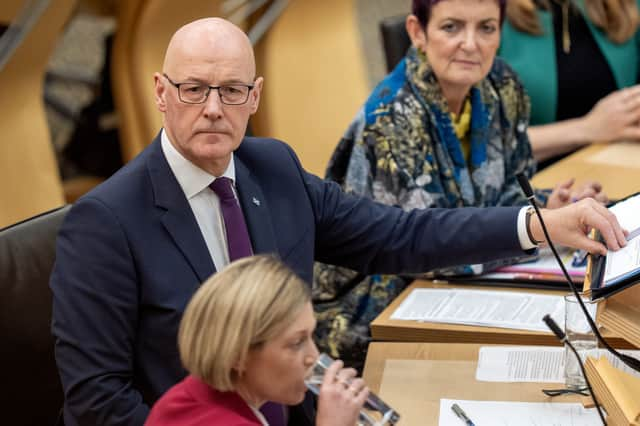
John Swinney has admitted systems have let women down after being told about the harrowing miscarriage experiences of two expectant mothers.
John Swinney has admitted two women were let down by the NHS after hearing their “unbearable” accounts of miscarriage - including one expectant mother who “asked for help 60 times but wasn’t seen”.
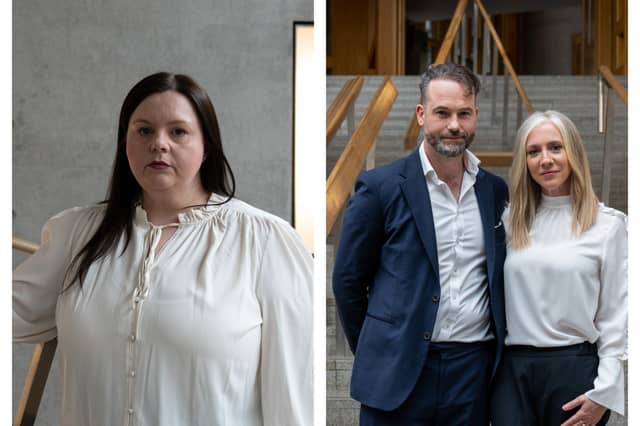
Katie Lyon and Elizabeth Crammond have spoken out about their experiences, with an admission from the First Minister that systems have “not delivered” to properly-support women experiencing miscarriage.

Mr Swinney faced accusations at First Minister’s Questions that his government is “failing on women’s health” after being told by Scottish Labour acting leader, Jackie Baillie, that women are facing “10 years of waiting in pain” to receive a diagnosis for endometriosis.
Dame Jackie warned that waiting times for endometriosis had “got worse on his watch”.
“The SNP are failing on women’s health”, she added.
In response, Mr Swinney admitted that “women wait too long for treatment for endometriosis in Scotland”.
He added: “The government is working very hard to ensure that waiting times are reduced so that treatment can be delivered in a credible and acceptable timescale.”
Dame Jackie highlighted Ms Crammond’s experience, and told MSPs that “after previous miscarriages….was a high-risk pregnancy”.
She added: “But when she experienced bleeding and pain she tried to contact the early pregnancy unit in Kirkcaldy - she asked for help 60 times but wasn’t seen.
“Elizabeth was so desperate she had two private scans. But nine days later when she was finally seen by the NHS, she was told she had miscarried. Nine days.
“Elizabeth feels ‘failed by NHS Fife and NHS Tayside’ and it has left ‘a devastating and lasting impact’ on her and her family.”
But Dame Jackie warned “her experience isn’t unique”, adding “there are lots more women in this situation”.
She said: “Katie Lyon was pregnant, following a previous miscarriage, when she noticed spotting on December 23.

“On Christmas Eve she had to go to A&E because her condition had deteriorated and there was no capacity to see her in the maternity service.
“While Katie waited anxiously for news of her baby, the staff struggled to co-ordinate with gynaecology and maternity care.
“When she finally got a scan, no heartbeat could be found.
READ MORE: Scottish hospital ordered to improve maternity safety decade after baby deaths investigation
“It was another seven days before her miscarriage was confirmed - only after had two further scans.”
Dame Jackie told the First Minister that “both Katie and Elizabeth are here today to demand change”.
In a statement, Ms Lyon and her partner, Edward Corrie, said: “Between 2025 and 2026, we experienced three miscarriages. Each loss was devastating.

“As we navigated the heartbreak of losing our pregnancies, we trusted that the care available to us was the same care that would be available to anyone in Scotland experiencing pregnancy loss. We were wrong.
“It was only after our third miscarriage that we became aware of the significant variation in miscarriage care across Scotland. The care we received depended not on our needs, but on our postcode.”
They added: “Families should not have to endure repeated loss before their concerns are taken seriously or before they gain access to support and investigations. Every miscarriage matters.
READ MORE: National investigation into Scotland's maternity services to be launched over 'serious concerns'
“We experienced delays simply because of when our miscarriages happened. For families experiencing the fear, uncertainty and grief of miscarriage, these delays can feel unbearable.
“Ultimately, the new framework must mark the end of the postcode lottery in miscarriage care. No family should experience repeated losses before learning that different care was available elsewhere.”
Mr Swinney said: “I am terribly sorry for the experience these two women have had within our health services.
“The framework for the delivery of maternity care should address the circumstances. It has clearly not done that.”
This came just hours after a key Holyrood committee heard that the centralisation of NICUs is a “dangerous move” and not backed by evidence.
Ministers are pressing ahead with plans to reduce the number of specialist neonatal units in Scotland from eight to just three. It would mean babies born under 27 weeks gestation or weighing under 800g will have to be transferred to Aberdeen, Edinburgh or Glasgow.
It would also mean Ninewells, Wishaw, Crosshouse and Princess Royal hospitals would have their NICU services downgraded.
The committee was discussing a petition submitted to the parliament two years ago by Lynne McRitchie, and it has been signed by 23,720 people.
Ms McRitchie’s son was born prematurely at just 23 weeks and two days gestation in Wishaw in 2019. Under the centralised model, she would have been transferred to Glasgow.
The committee agreed to keep her petition open and do more research, with Reform MSP Julie MacDougall arguing that the centralisation proposal “appears to be a dangerous move when there’s not sufficient evidence”.
Conservative MSP Meghan Gallacher warned that “the downgrading of the NICU in my own region is causing concern to a lot of families”.

She added: “I don’t understand why the government has not chosen to have five NICUs rather than three - I don’t believe that’s been properly explained.
“This puts families in limbo and new mums are fearful. If the government is serious about its best start plan, then they have to be honest with mums who will be impacted.”
The Scottish government is also facing accusations it did not do “any work” before announcing its “back of a fag packet” plans to cut the number of NHS health boards from 14 to just two.
Public Sector Reform Secretary Ivan McKee refused to say how many jobs will be cut – a figure unions put in the tens of thousands.
Tory MSP Murdo Fraser said it appeared the Scottish government had not done “very much” work on its key plans for NHS reform.
“It all sounds like you come up with this idea on the back of a fag packet and you haven’t actually done any work to back it up,” he said to Mr McKee.
Mr McKee said the government still had to “work through the details” of its plans.
He told MSPs the shake-up of NHS health boards was designed primarily to improve access for patients, although he said there would be “significant financial savings”.
Comments
Want to join the conversation? Please or to comment on this article.