
Almost 600 deaths linked to 'lethal' A&E waits in Scotland this year
The Liberal Democrats said problems in Scotland’s healthcare system had ‘exploded during the SNP’s time in charge’

Almost 600 deaths in the first eight months of this year may be linked to "lethal" waits in Scotland's A&E departments, ministers have been warned.
The Scottish Liberal Democrats said hundreds of deaths a year are now associated with long waits, compared to fewer than a dozen a decade ago.
The party said problems in the healthcare system had “exploded” under the SNP, and urged ministers to “urgently fix” the underlying crisis in social care.

The Royal College of Emergency Medicine (RCEM) said the data showed the “truly heartbreaking scale of the emergency care crisis”.
Liberal Democrat MSP Adam Harley said: “With hundreds of deaths a year now associated with long waits, the crisis in our A&E departments is quite literally lethal.
“The problems in Scotland’s healthcare system have exploded during the SNP’s time in charge. If things are to change, we must urgently fix the underlying crisis in social care.
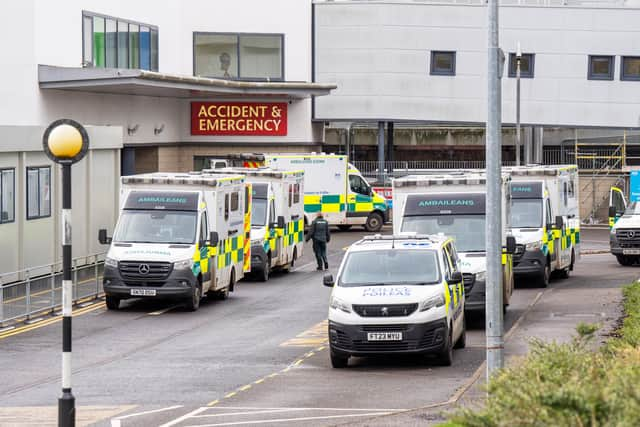
“Too many hospital beds are occupied by people who can’t get the care package they need to return home. It’s driving up waits at A&E and leaving ambulances stacking up outside.
“Ministers must finally listen to our plans to boost pay and conditions for care workers and attract more people into the profession, helping us free up life-saving space in A&Es.”
The party used a standard mortality ratio to work out the number of deaths linked to long waits.
This assumes there will be one additional death for every 72 patients who experience eight to 12-hour waits prior to their admission.
The calculation has previously been used by groups including the RCEM.
By applying this measure to the number who waited more than 12 hours between January and August 2026, 597 deaths were associated with these waits in that time.
Using the same measure, there were just 11 deaths associated with 12-hour waits in 2016.
The Liberal Democrats also used the standard mortality ratio to calculate an increase in deaths associated with A&E waits during the past 10 summers.
It found that whereas there were no excess deaths associated with 12-hour A&E waits in the summer of 2016, there were 185 in the summer of 2026.
Dr Fiona Hunter, vice president of RCEM Scotland, said: "This data shows the truly heartbreaking scale of the emergency care crisis we face.
"Each of these excess deaths represent a parent, sibling or child who is no longer with us because of delays to their care in an emergency department [ED]. I would like to offer my sincerest sympathies to anyone who has lost a loved one this way.
"It should never happen, and yet year after year the death toll rises. This is not a foregone conclusion; it is a fixable issue.
"Excess mortality after long stays in A&E is mainly caused by a breakdown in patient flow. The patients most likely to be impacted are those who come to us in need of a hospital bed, but then get 'stuck' in the ED because we cannot admit them due to a lack of beds.
"That lack of beds, in turn, is largely caused by an inability to discharge medically fit people back home or into social care. This issue is not caused by too many people turning up to A&E.
"In the short-term, to mitigate the impending pressures from winter the Scottish government must ensure that services essential for discharge – such as pharmacy or transport – remain open over the festive period and to keep as many beds open and staffed as possible.
"And, in the long-term, we need to see a concerted effort to tackle ED overcrowding through measures that speed up discharges and open up beds.
"We will continue to work with the Scottish government to address these issues, and we recognise that the Cabinet Secretary for Health and Social Care is looking into mitigating the worst of winter."
A Scottish government spokesman said: “Excessively long waits are clearly unacceptable and ministers are laser-focused on tackling the pressures facing our NHS and our exceptional workforce.
“The figures cited are not official statistics so we are unable to comment on how they were calculated. Published statistics show that around 97 per cent of all hospital discharges happen without delay, but clearly no one should have to wait longer in hospital than they need to.
“Whilst this situation is not unique to Scotland with all other UK nations experiencing similar pressures, we are taking action by expanding Hospital at Home services and implementing 'discharge without delay' in all health boards this winter, which will see people discharged within three days of admission if clinically appropriate.
“Ministers have been open about the need for reform of social care, but it is important to be clear the statutory responsibility for delivery of services lies with local authorities. Change is needed, but this must be done jointly with the NHS, the Scottish Government, local government and the third sector.”
Have you been affected by long A&E waits in Scotland? Please email [email protected] to share your story
Comments
Want to join the conversation? Please or to comment on this article.