
Police officers call for powers to remove face coverings


Scottish Police Federation says it is time for “legitimate discussion” as live facial recognition technology powers are proposed
Police officers have demanded powers to remove facial coverings and masks worn by those believed to be committing crimes, violence or serious disorder.
The Scottish Police Federation, which represents rank and file officers, warned there would be “little point” in investing millions of pounds in proposed live facial recognition (LFR) technology if people intent on committing crimes could simply hide their faces.
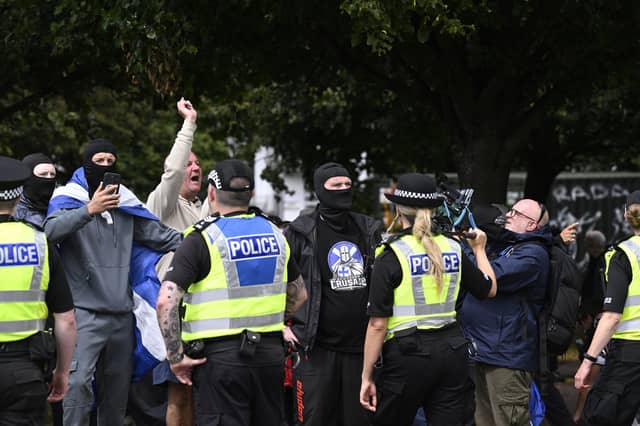
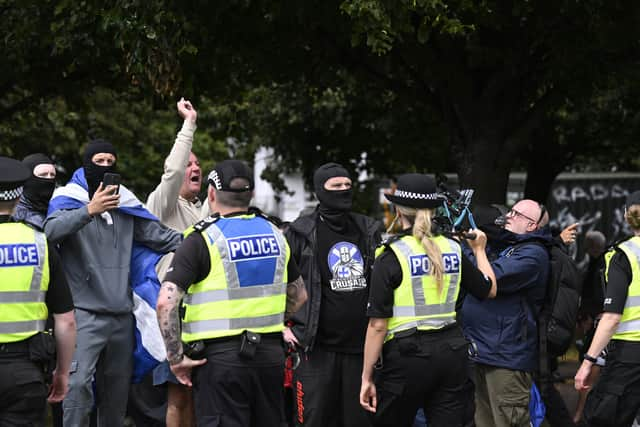
It comes in the wake of a spate of high profile flashpoints over the summer, with masked demonstrators involved in violence, disorder, and intimidation at various anti-immigration protests.
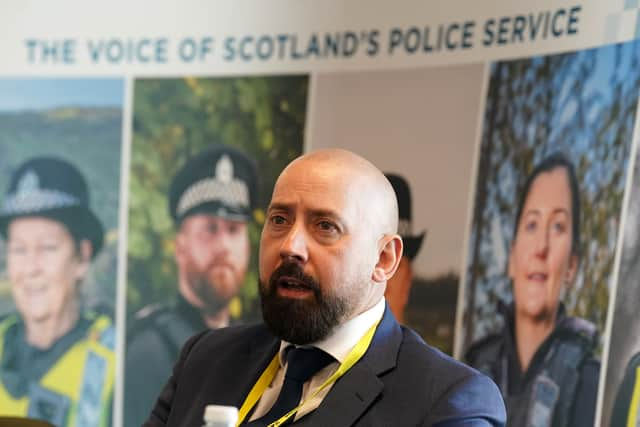
David Kennedy, general secretary of the federation, said at present, there were “limited circumstances” in which officers can require the removal of an item being worn to conceal someone’s identity, and argued that the time was right for a “legitimate discussion” around whether such powers were “sufficient for modern policing.”
He said: “There is little point investing millions of pounds in sophisticated technology capable of recognising a face if an individual intent on committing crime can simply hide that face behind a mask or covering.
“Before we get carried away with what technology might be able to achieve, we need to make sure police officers have clear and practical legal powers to require the removal of facial coverings where they reasonably believe those coverings are being deliberately used to conceal identity in connection with criminality, violence or serious disorder.”
In England, new legislation gives police powers to direct people to remove face coverings in designated areas and to seize face coverings where officers reasonably believe they are being worn for the purpose of concealing identity. Police can create ‘mask-free zones’ for 24 hours in certain areas, such as those where protests are due to be held.
Defences for religious, work or medical grounds can be used and offenders face a maximum penalty of £1,000 or one month in prison, or both.
Mr Kennedy said any such new powers in Scotland would not be designed to interfere with legitimate religious, cultural, medical or occupational reasons people have for covering their face, and stressed that “appropriate” exemptions and safeguards would be required.
He explained: “It is about people who deliberately conceal their identities in order to commit offences, intimidate others or frustrate the ability of the police to identify them.”
His intervention forms part of a push by the federation to ensure facial coverings form part of the wider discussion about LFR technology.
Mr Kennedy added: “If government and policing are serious about using technology to identify people suspected of serious criminality, they must also be prepared to address deliberate attempts to defeat that technology.
“We cannot have a situation where the state spends significant sums developing sophisticated facial recognition systems while somebody deliberately seeking to avoid identification simply pulls a mask over their face.”
The contentious artificial intelligence powered tool, which allows scans of human faces to be compared against police databases, is used by around 13 police forces in England and Wales.
Police Scotland is currently working on a detailed business case, with no decision made as to its adoption. Opponents of the initiative cite concerns including algorithmic bias, inaccuracies, and privacy and civil liberties issues.
Amnesty International UK has condemned the technology as “dangerous and discriminatory,” and warned its introduction would herald a “historic shift in the relationship between the police and the public in Scotland.”
Earlier this week, HM Chief Inspector of Constabulary in Scotland, Craig Naylor, called for the introduction of LFR and drones to address football-related disorder and threat posed by organised crime groups and violent offenders.
For its part, the federation said facial recognition should primarily be regarded as an “intelligence and identification tool.”
Mr Kennedy continued “Facial recognition should assist police officers, not replace them. If the technology indicates that somebody may be a wanted individual, that should provide an intelligence lead which allows officers to make further enquiries.
“We should never reach the position where a computer says somebody is a particular person and that is simply accepted as fact.”
The Scottish Government has been contacted for comment.