
Scotsman Obituaries: Prof William Turmeau, former Napier principal and first Chairman of the Scottish Environment Protection Agency
Professor William Arthur Turmeau CBE FRSE, engineer, academic and environmental watchdog. Born: 19 September 1929 in London. Died: 2 April 1926 in Stromness, Orkney, aged 96
Professor William Arthur Turmeau went to school at Stromness Academy in Orkney and after completing National Service, where he served in the United Kingdom and Germany, he attended the University of Edinburgh, graduating in 1952 with an honours degree in Mechanical Engineering.
He then emigrated to Canada and worked in Montreal as a design engineer, followed by some time in Goose Bay, Labrador, employed by the United States Air Force on the then Cold War Distant Early Warning line project.
In 1957 he returned to Orkney and married Margaret Moar Burnett, a school friend. They returned to Montreal and between 1957 and 1961 he was employed as Design Engineer and Contracts Manager for Godfrey Engineering Ltd, a company manufacturing aircraft ground servicing equipment.
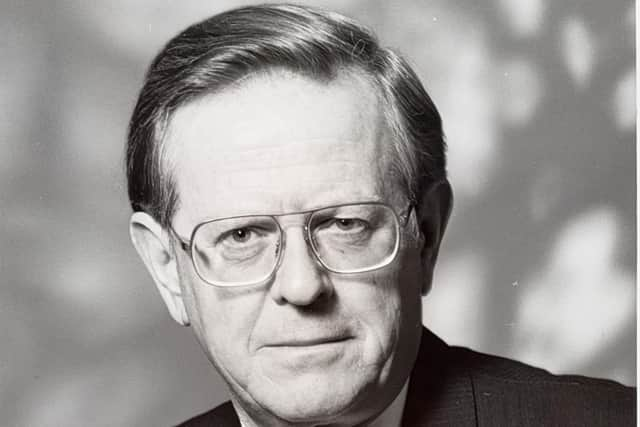

On returning to Edinburgh in 1961 he changed career, gained a Teaching Certificate at Moray House College of Education, and took up academic work, firstly at a local further education college and later as lecturer and senior lecturer in mechanical engineering at the newly opened Napier College in Edinburgh.
During that time he gained a PhD by research into thermodynamics and heat transfer, Promotion was fairly rapid and, after becoming Head of Department of Mechanical Engineering in 1968 and later Dean of Faculty and Assistant Principal in 1975, he was appointed Principal of Napier in 1982.
During the next decade Napier rapidly increased in size and status, and Bill led and oversaw the transition of the institute from, firstly, a further education college under Edinburgh City Council, then to a central institution named Napier Polytechnic of Edinburgh, controlled by the then Scottish Office, and finally, in 1992, to a fully independent Napier University.
He had firm views about the values of the future of the then non-university sector of higher education and was one of the leaders in the profound and radical changes which took place in higher education in the United Kingdom in the 1980s and 1990s.
Bill was a member of many high level academic bodies and committees and was the Scottish member of the small team from the Committee of Directors of polytechnics which finally persuaded the government, in 1991, to recognise that the Polytechnics should be granted university status. He served as the first Principal and Vice-Chancellor of Napier University from 1992 to 1994.
On retiring from Napier University in 1994 Bill was appointed, by the Secretary of State for Scotland, the first Chairman of the Scottish Environment Protection Agency.
In this capacity he presided over the formation of the national agency, which brought together existing and disparate regulatory bodies to form a coherent pollution control agency for Scotland.
During his time with SEPA the organisation was involved with, among other areas, fish farms, landfill, waste disposal, pollution control, nuclear and other power generation, and with Dounreay and its now discontinued nuclear processing issues.
Having completed his term of office as Chairman of SEPA in 1999, Bill continued to serve on various committees, including the Dynamic Earth Charitable Trust, the proposed University of the Highland and Islands, Scottish Action on Smoking and Health, the Kirk of Greyfriars, and the Institution of Mechanical Engineers.
After living in Edinburgh for 45 years Bill and his wife moved to their original hometown of Stromness in Orkney in 2006.
Bill received the award of Commander of the British Empire in 1989, was elected a Fellow of the Institution of Mechanical Engineers in 1973, a Fellow of the Royal Society of Edinburgh in 1992 and Napier University in 1995.
After all their adventures Bill and Margaret, who predeceased him, spent many happy years in the house by Stromness Harbour that had been his family home.
Looking back on his time at Napier, Bill said: “It has been a wonderful experience, and I shall miss the company, comradeship and so many devoted and hard-working people who have made Napier University the powerful institution that it is today. An institution truly poised on the brink of real greatness. I shall also miss the sound of young voices and the sight of our students. What a privilege to have been able to work with, and for, so many wonderful young people.
“Thank you, to everyone, for all that you have done for me, and for Napier.”
Bill and Margaret are survived by their daughter Rachel.
Obituaries
If you would like to submit an obituary (800-1000 words preferred, with non-copyright image), contact [email protected]