
Scotsman Obituaries: Pam Hogg, Scottish designer who dressed everyone from Debbie Harry to Princess Diana
Pam Hogg, fashion designer and musician. Born: 4 January, 1959 in Paisley, Renfrewshire. Died: 26 November, 1995 in London, aged 66
‘Give them what they don’t know they want”. This was the creative motto of the remarkable designer Pam Hogg, who has died aged 66. She made fashion a playful and sexy place with her punky patchwork creations coveted by musicians and fellow disruptors. Catsuits were a speciality, as well as body hugging dresses, earning her the nickname the Queen of Cling. “These garments fitted like a second skin and made their wearers look like superstars from the planet Venus,” hailed her fellow designer Bella Freud.
She dressed kindred rock’n’roll spirits including Debbie Harry, Paula Yates, Bjork and Siouxsie Sioux, who wore a Hogg-designed space age silvery jumpsuit and cape at her most recent Glasgow show in 2023, and attracted the likes of Nick Cave, Bobby Gillespie and Duran Duran’s Nick Rhodes to her catwalk shows. According to singer Shirley Manson, Hogg was “our revered Scottish fashion queen”, charismatic in her own right and immediately recognisable with her signature quiffed atomic blonde hair, red lipstick, shades and platform boots.
Punk as she was, her clothes were also worn by royalty, specifically Princess Diana and Princess Eugenie. Her provocative designs were stocked in Harrods, Harvey Nichols and Bloomingdale’s and featured in the pages of Vogue. She even made a memorably mischievous appearance on Terry Wogan’s BBC1 chat show in 1990.
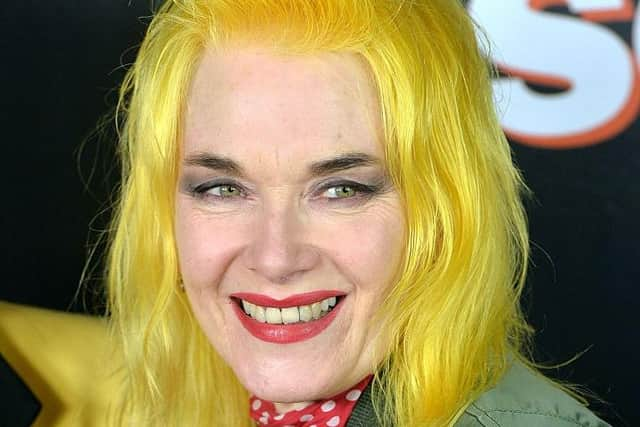

Fashion, music and art were all part of the same creative impulse for Hogg, who described her pieces as sculptures, stitched by hand for full DIY autonomy. Designs were eschewed, mistakes embraced and her own blood, sweat and tears were literally smeared into the work, a legacy of her early days in London, where she mixed with the likes of Boy George, John Galliano and David Bowie at the legendary Blitz Club. The club ethos was outlandish individuality on a budget so Hogg made her own outfits in order to be admitted by exacting doorman Steve Strange.
Hogg went on to specialise in one-off pieces created with punk spontaneity, producing her first collection in 1981, which chimed with the rogue style spirit of emerging magazines The Face and ID. By the time of her first catwalk show in 1985, Hogg was a doyenne of alternative couture.
She retired from design at the end of the decade to pursue a less illustrious musical career in her bands Doll and Hoggdoll, and then returned to fashion in the 2000s, designing for a new generation of pop star, including Kylie Minogue, Lady Gaga, Rihanna, Taylor Swift, Beth Ditto, Alison Mosshart, Yates’s daughter Peaches Geldof and supermodels Kate Moss and Naomi Campbell.
Pamela Elizabeth Hogg was born in Paisley and brought up in Renfrew and Bearsden. Inspired by her gardener father’s endless inventiveness, the young Pam was making her own clothes from the age of six, adapting hand-me-downs from her neighbours. She won prizes for her art at school but was often censured for daydreaming. Years later, she declared “my profession is dreaming” – and also discovered that she was dyslexic. She found her milieu at Glasgow School of Art where she studied fine art and printed textiles. The awards, prizes and bursaries kept coming, including the Newbury Medal of Distinction, and she moved to London to study at the Royal College of Art.
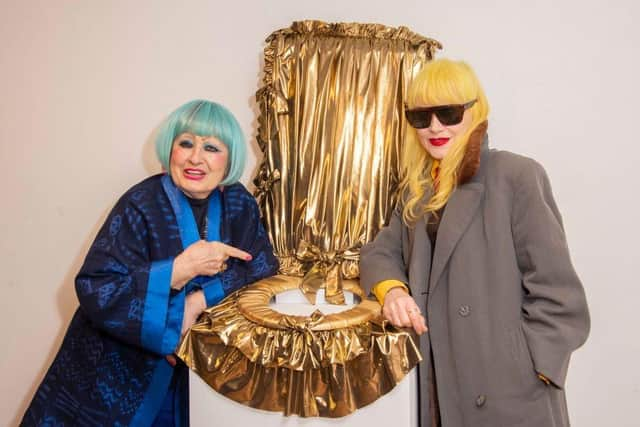
Hogg sold her designs from hip outlet Hyper Hyper in Kensington Market and eventually opened her own shop in Soho, remaining resolutely non-conformist even as her fame and reputation grew. Hogg’s creations were an irreverent alternative to the power dressing of the day and she was every bit as rock’n’roll as the musicians she dressed. She formed her first band, Rubbish, in 1980 and took up residency in a Kings Cross pub supporting rabble-rousers Pogue Mahone, soon to rebrand as The Pogues.
Fashion took over for the rest of the Eighties but when Hogg was pulled onstage to sing with her boyfriend's band Pigface in 1990, fellow Scot Chris Connelly spotted her potential as a performer. Her friend Debbie Harry extended an offer to support Blondie, whose drummer Chris Stein hailed her as “a weird Nico”. She hastily formed Doll and the band evolved into Hoggdoll with the addition of Jarvis Cocker collaborator Jason Buckle. She returned to designing in the 2000s, to great acclaim and affection but without the resources befitting an artist of her stature. She couldn’t afford to rent her own studio space, or employ a pattern-cutter or seamstress, or even buy a mannequin. Instead she foraged fabrics and designed from her kitchen, stitching the clothes on to her own body, and then adding a few inches for the statuesque models.
Nevertheless, she produced a steady stream of collections. The Amnesty International-commissioned Courage was inspired by political activists Pussy Riot and the fight for LGBTQ+ rights in Russia, while she dedicated her 2023 collection They Burn Witches Don’t They to Vivienne Westwood and 2024’s Apocalypse to Sinead O’Connor. Hogg addressed the humanitarian disaster in Gaza in her final collection, Of Gods and Monsters. She also designed costumes for the National Theatre of Scotland’s production of Cyrano de Bergerac and created bespoke statuettes for the 2016 Brit Awards.
Over the years, her work has been exhibited at Kelvingrove Art Gallery, the V&A, Summerhall and the Barbican. Hogg will be rightly celebrated in her birthplace when Paisley Museum opens next year with a display on her life and work and a special acquisition from her “Best In Show” collection featuring the Paisley Pattern teardrop motif.
“For me success is measured in different ways,” she told The Scotsman earlier this year. “It's still a beautiful surprise when I'm stopped in the street, from kids whose eyes speak even more than the words they say, that always takes me aback. That to me is everything.”
Obituaries
If you would like to submit an obituary (800-1000 words preferred, with jpeg image), contact [email protected]
Comments
Want to join the conversation? Please or to comment on this article.