
Scotsman Obituaries: Lord Sanderson, former Scottish Minister of State and businessman
Russell Sanderson, Baron Sanderson of Bowden, politician and life peer. Born: 30 April 1933 in Melrose. Died: 1 July 2026, aged 93
That the third day of the 1984 Conservative Party Annual Conference in Brighton should have started on time on the morning of 13 October was one of the most notable political events of the 20th century. Only six hours previously, a bomb had exploded in the Grand Hotel in an IRA attempt to assassinate the Prime Minister, Margaret Thatcher, and members of her Cabinet. Five people were killed and 34 injured. Russell Sanderson, as Chairman of the party’s National Union Executive Committee, had ultimate responsibility for the running of the Conference. Weighing the advice of the police and security experts, and sharing Thatcher’s refusal to give in to terrorism, Sanderson fully endorsed the decision that the day’s session would proceed on time and as planned.
Russell Sanderson was one of the most prominent business and political figures of the past 40 years in Scotland. His political career began in the early 1970s as Constituency Chair of the Roxburgh, Selkirk and Peebles Conservative & Unionist Association where David Steel was the constituency MP. This exemplified his approach to life in general, his motto being “Don’t stand on the touchline – get into the game!” He rose up the ranks quickly, being elected President of the Scottish Conservative & Unionist Association, the voluntary wing of the party, in 1977. He presided over the party’s Scottish annual conference in 1978 which, ahead of the following year’s referendum on Scottish devolution, underpinned the Conservative case for the Union, a cause Sanderson held dear. The outcome of the referendum and a successful result for the party in Scotland in that year’s UK general election cemented his position “in the game” as a shrewd political figure.
In 1981, the year he was knighted, Sanderson was elected Chair of the party’s UK National Union Executive Committee (a role he described as “chief volunteer and bottle washer”). He held the position for five years which included the infamous 1984 Brighton Conference.
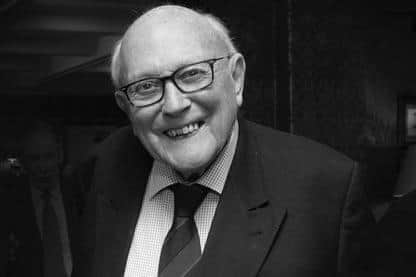

In 1985, he took his seat in the House of Lords, a political honour given to few at the time who were not former Cabinet members. In 1987, he was asked by Margaret Thatcher to join her government as Minister of State at the Scottish Office. He was given a wide portfolio: Minister for Agriculture and Fisheries, Tourism, Forestry and Highlands & Islands. The decision to accept the post meant relinquishing his many business interests, which he did without grumble. He relished the challenges of government and soon gained the respect of this famously demanding and outspoken community with his genuine concern for their wellbeing, his honest, no-nonsense approach and his energy. He was renowned for starting the day touring the fish market in Peterhead before visiting a farm or two on his way to the airport to catch a flight to London in order to speak on the frontbench in the Lords before concluding the day working through his ministerial Red Box.
He was an imposing figure in the Lords, relaxed and informal but sharp as a razor with highly tuned political antennae. He led the government in the passing of all Scottish bills in the Lords and was respected for always being on top of his brief. He oversaw the replacement of the Highlands & Islands Development Board (HIDB) by Highlands & Islands Enterprise (HIE), an employer-led economic agency that gave expression to the Thatcher spirit of entrepreneurialism.
In 1990, political turmoil within the Scottish Party led to a vacancy in the Chairmanship of the organisation. With his long experience of the Party and having served as a Minister in the Scottish Office with Malcolm Rifkind and Ian Lang, Thatcher asked Sanderson to take on the Chairmanship of the Party north of the Border, recognising his popularity with Party activists and MPs. He was the obvious person to bring people together and heal divisions. With his trademark sure touch, he quickly restored competence and focus to the Party organisation, rallied the Party faithful and won back the confidence of business supporters.
In the months leading to the April 1992 general election, Secretary of State for Scotland Ian Lang had persuaded prime minister John Major that the Party in Scotland should campaign solely on a Unionist platform in opposition to Labour’s devolution plans. Russell strongly supported this approach, their efforts being rewarded when, at the election, the widely anticipated wipe-out of Conservative MPs north of the Border was avoided. The Party retained all nine existing seats, won back another – Kincardine & Deeside – only recently lost at a by-election, and recorded the only gain from Labour anywhere in the UK (Aberdeen South). Sanderson went on to underscore this success with the Party gaining more than 40 seats in the District Council elections held in May. With the Party in considerably better shape, he stepped down as Chairman the following year.
Charles Russell Sanderson was born on 30 April 1933 in Melrose in the Scottish Borders. He attended the town’s St Mary’s prep school during the war before going on to Glenalmond College in Perthshire in 1946.
Being cast in the role of Yum-Yum in a school production of The Mikado gave him a lifelong love of Gilbert and Sullivan. Apposite quotes from G&S – often sung in his baritone voice – were a common and popular feature of the many speeches given during his business and political life. So, too, were the many wonderfully witty limericks he composed which always went down well with somewhat startled audiences.
After two years’ National Service with the Royal Signals, he was offered a place at Magdalene College, Cambridge to read Classics. Instead, he chose to embark on a career in the textile and woollen trade, following in the footsteps of his father who had built up a successful business in Scotland representing the sales from the spinning mills of Illingworth Morris, one of the country’s largest wool textile manufacturers. Years later, between 1982 and 1987, Sanderson was to serve as a director of that company. After a year studying both the theory and practice of the industry in Bradford, he returned to the Borders to study weaving and cloth design at Galashiels Technical College. He built an early career as a respected agent for cashmere and wool fibre and yarns, travelling throughout the country working with many textile producers. He was a director of the family firm, C P Sanderson Yarn & Wool Agents, from 1958-1987.
In 1991, Sanderson became a founder director and Chairman of the Hawico cashmere company when his son, David, and business partner, Jim Thomson, bought the Hawico factory from Illingworth Morris. This – now family – company was to remain a primary professional interest in the years ahead. Hawico has grown into one of Scotland’s best known producers of high-quality cashmere garments with a global distribution network and shops in Edinburgh, Milan, St Moritz, Geneva and Zurich.
Amongst his myriad directorships, he was Chairman of the Clydesdale Bank from 1999-2004 and Chairman of the Scottish Mortgage Investment Trust from 1993-2003. He was a director of United Auctions 1992-99, Edinburgh Woollen Mills 1993-1997, Morrison Construction PLC 1995-2000 and Eildon Housing Association 1978-1982.
For many years, he was proud to serve as a Trustee of the King’s Own Scottish Borderers (KOSB), a regiment he was particularly fond of and which he fought hard to save in the run-up to the 2006 amalgamation of the Scottish Regiments by Tony Blair’s Labour government. These appointments – and many others – amply demonstrate his wide range of interests as well as his business acumen, which was in high demand.
In July 1958, Sanderson married Elizabeth Macaulay, whose family were involved in the textile industry in Yorkshire. He proposed to Liz having crashed the car in which they were returning from a KOSB regimental ball. They set up home in the village of Bowden, near Melrose, where he was to live for the rest of his life and from which he took his title in the House of Lords.
He played an active role in the life of the area, his many roles including District Commissioner of the Duke of Buccleuch Pony Club (he described dealing with highly strung parents as one of the most challenging things he ever had to face in his life), Vice Lord Lieutenant of Roxburgh & Selkirk, President of the Royal Highland Show, Chairman of the St Mary’s School Board of Governors and Chairman of the Glenalmond College Council. Between 1955 and 1978, he was a leading member of the Melrose Amateur Opera company, performing annually in G&S productions to much acclaim – later even producing some of the shows and roping in the family to paint scenery and props.
In 2008, he became Chairman of the Abbotsford Trust charged with injecting new life into the famous Tweed-side home of Sir Walter Scott after the death of Dame Jean Maxwell Scott, the last of the novelist’s descendants to live in the house. He led a successful fundraising campaign, matching a £5.8 million donation from the Heritage Lottery Fund, which resulted in the renovation of the house and the building of a visitor centre which was opened by Queen Elizabeth II in 2013.
The couple had four children. A busy family life in the country provided some normality and happiness in the midst of his hectic professional and political activities. Tragedy was to strike with the loss of their younger son, Andrew, in 1991, followed later by the deaths of their daughter, Claire, and granddaughter, Fiona. These events cast an inevitable shadow, but the couple were helped by the love and closeness of their family, a growing number of grandchildren helping to preserve the momentum of a happy family life. The resilience the Sandersons showed ever since in the face of these tragedies leaves an indelible impression on everybody who knows them.
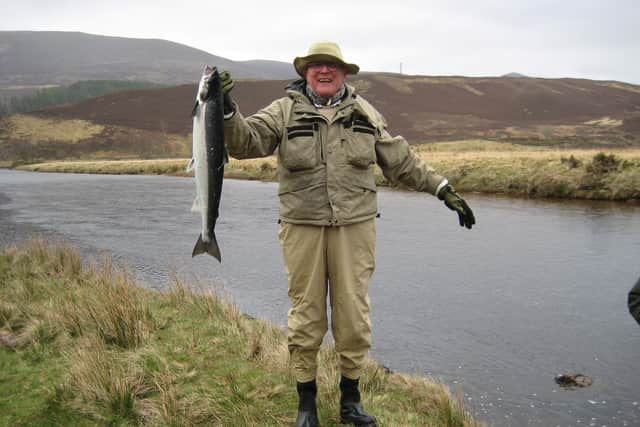
Like his parents a fine golfer, Sanderson was an active member of The Honourable Company of Edinburgh Golfers at Muirfield Golf Club for over forty years. Fiercely competitive and a demon putter, he and his partner, John Robertson, won the Club’s hotly contested 250th Anniversary foursomes tournament in 1994. Later in life, he and Liz developed a passion for salmon fishing, particularly on their beat on the River Tweed near their home but also on angling trips to many far flung parts of the world where ghillies never failed to connect them with a remarkable number of fish. An accomplished amateur photographer, his skills with a camera were amply demonstrated through his stunning wildlife shots taken during regular safari holidays. These featured in useful calendars gifted to grateful friends.
Russell Sanderson is survived by his wife, Liz, his children David and Georgina, sons-in-law Tom and James, daughter-in-law Laura, eight grandchildren and a great grandson.
Obituaries
If you would like to submit an obituary (800-1000 words preferred, with non-copyright image), contact [email protected]