
Scotsman Obituaries: Lesley Storm, talented poet who brought neglected writers back into print
Lesley Storm, poet. Died: 28 April 2025
Lesley Storm legally changed her name in August 2010 and had gender confirmation surgery in January 2014 in Brighton. She began writing poetry in 2015 and read in public for the first time in almost forty years in the autumn of 2016, after being invited to The Heretics by Richard Munro, whom she said she met quite by chance.
This revived poetry and song collective, started in 1970 by Dolina MacLennan, Liz Lochhead, Robert Garioch, John Herdman, Sorley MacLean and others, proved a welcoming launching ground for Lesley as a writer. Her work was always powerful, personal, and as well as occasionally commenting specifically on life as a trans woman the larger part of Lesley’s poetry concerned the most human emotions – love, loss, grief, joy. All of these Lesley mastered as a writer and presented memorably in her poetry.
From this burst of creativity Lesley produced a strong first and only collection, It’s About Time, published in 2021, which was likely the first full collection of poetry by a transgender person in Scotland.

Outside of her life as a writer and performer Lesley was committed to addiction and mental health support for others, and known and liked in transgender, queer and LGBT circles. As Lesley approached her sixties, she realised depression and alcohol dependency were leading her to ever darker places and she committed to seeking help. She began attending recovery groups in Edinburgh in 2013 and quickly found a supportive and loving home in the West End.
Her personal commitment to recovery was remarkable and, had she lived, she would have celebrated 12 years of sobriety last month, June. More than this personal achievement, however, Lesley threw herself into “service”, the action of passing on the support, guidance and love she had received so freely from fellow alcoholics to suffering “newcomers”. Hundreds of recovering alcoholics benefitted from her fellowship and probably thousands more from her unseen but untiring commitment to the unglamorous administrative and financial work required for all voluntary organisations.
Lesley had many useful hobbies such as carrying out the optical character recognition and reconstruction of out-of-print texts, some of which are now back in the public domain for the first time in machine-readable text. During lockdown, she began making e-book versions of favourite out-of-print books, including the Kindle edition of Poems of the Irish Revolutionary Brotherhood, early poems by Frances Cornford and a collected Thomas MacDonagh. When she died, Lesley had completed but not published four short editions of rare works by Sydney Goodsir Smith and a popular edition of the complete Robert Fergusson. Her complete Fergusson reflects a solid part of who Lesley was as a book and record collector – a completist.
Lesley was supportive to many writers, and despite lifelong depression was fun company, caustic, critical and gentle, as well as understanding, particularly of those marginalised. She thought Brexit was bollocks and Boris was the anti-Christ. She wrote poetry constantly and collected poetry books, and editions of Graham Greene and Ernest Hemingway, among others, and has left a good amount of unpublished work.
Lesley was open about being transgender, and wrote in detail in her book and pamphlets about the social and the medical. She also wrote about the emotions, and the fact of her being trans as a growing social issue, if not one of the main social issues of her time.
In It’s About Time she responded to gender pronouns, saying: “This is not a trans right issue. It has nothing to do with trans rights. And I do object to having this seen as something trans people are seeking to impose on others. The vast majority of trans people identify as male or female. I am female – I always was. Most of those who seek to use they/them as singular pronouns are not trans in the sense that I am trans. I welcome them as my fellow citizens in their struggle to assert their right to be recognised for who they are.”
Lesley was sexually assaulted twice between 2013 and 2019. She had many medical treatments over the years I knew her, and her attitude to the increasing complexities of life as a transgender person was necessarily complex. She wrote: “I’m a woman. I support them. I’m bisexual. I support them. I’m a feminist. I support them. I endure regular abuse for being trans. I support them. I am called a 'poof' by the unenlightened. I support them. My name is Lesley, and I'm a woman – that is to say: that I am human, just like you, and you like me.”
Lesley’s achievement in her few years as a published writer were many, but her aims were discreet, and she loved performing with poets, and getting to know them, usually those local to Leith, at The Alcove, The Heretics, the Summer Anywhere festival, and at fundraisers at The Artisan.
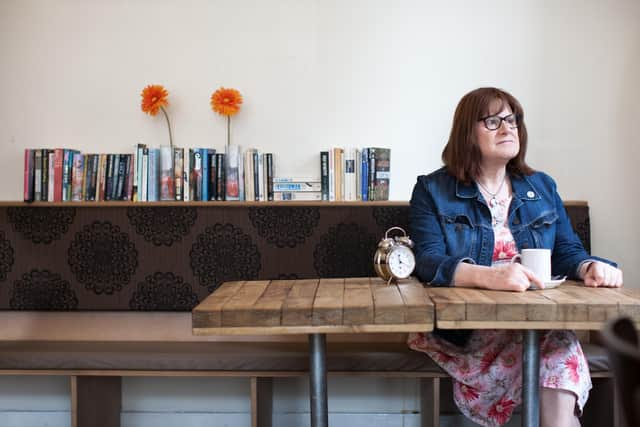
Her reputation as a writer reached far beyond the local and she had appeared on Damian Barr’s Literary Salon Podcast, and was surprised that even though her poetry was not recognised, the Saltire Society shortlisted her debut collection for its Cover Design of the Year Award, for Ryan McGovern’s bold photograph – reproduced here – of Lesley in her favourite café, Marmalade, in Bernard Street in Leith.
Lesley’s poems did attract much critical praise, although she enjoyed performing so much that she barely ever submitted to magazines. Jane Goldman, reader in Poetics and Creative Writing at Glasgow University, said of Lesley’s book: “These are powerful, moving and accomplished poems that speak to all humanity, written by a certain woman documenting her uncertain becomings over time. Whatever the certainties of those enforcing it or of those of us willingly or unwillingly defined by it, the category ‘woman’ has always been uncertain. ‘One is not born a woman’, Simone de Beauvoir observes, ‘one becomes one’. But what is it to be deeply certain of an urgent calling to womanhood all of one’s life yet violently excluded from such a becoming? What is it to win through?”
This powerfully sums up one side of Lesley’s life, for these were questions she answered in her work. Lesley will be remembered as more than a writer – most knew her as a performer and a friend, and a support, often an ally. There were many sides to her as well as the writer and the publisher.
Lesley died peacefully at home on 28 April.
Obituaries
If you would like to submit an obituary (800-1000 words preferred, with jpeg image), contact [email protected]