
Scotsman Obituaries: Giles Havergal, artistic director who led the Citizens Theatre to global fame
Giles Havergal, theatre director, actor, writer and teacher. Born: 9 June 1938 in Edinburgh. Died: 23 August 2025 in Polegate, East Sussex, aged 87
With the death of Giles Havergal at the age of 87, the world of theatre in Scotland and far beyond has lost one of its most brilliant, elegant, inspirational and beloved leaders; a man described by the actor Mark Rylance, at a recent celebratory event in London, as simply “the greatest artistic director of my lifetime”.
Alongside his two great creative colleagues, the writer and translator Robert David MacDonald and designer and director Philip Prowse, Giles Havergal led the Citizens’ Theatre Company of the 1970s and ’80s to global fame, offering a dazzling repertoire of European classics – staged with breathtaking radicalism, boldness and style – that helped transform a generation of Scottish artists, writers, theatre-makers and theatre-goers who witnessed the work.
As an artistic director and theatre impresario, Havergal possessed an almost legendary combination of skills, not only directing, acting in, and occasionally writing many of the shows produced at the Citizens’, but also mastering every detail of theatre administration, meticulously balancing the books so as to maintain the triumvirate’s creative freedom, and famously acting as a superb and welcoming host, always waiting to greet every member of the audience – with exactly the same perfect courtesy and intense attention – as they entered the foyer.
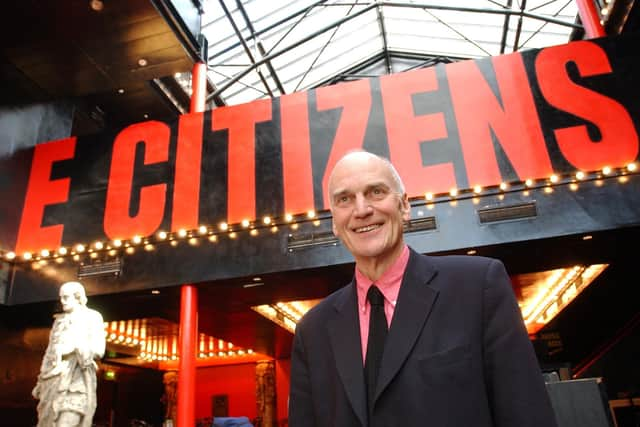

And even after he and his fellow directors stepped down from the Citizens in 2003, after a magnificent 34 years, he maintained his many friendships and connections in Scotland with such characteristic diligence and energy that it almost felt as if he had never left. He continued to teach regularly at the Royal Conservatoire of Scotland, where his father, Henry Havergal, had been principal from 1953 to 1969, while also fulfilling directing and teaching commitments from London and Manchester to Sydney and San Francisco. And at the time of his death, he was busily planning a visit to Glasgow for next month’s gala reopening of the beautifully refurbished Citizens’ Theatre – a visit complete with the usual accompanying social diary of meetings with old friends. “I am so sorry that Giles will never see the newly restored theatre,” said the Citizens’ artistic director Dominic Hill this week. “But his legacy is hard-wired into the fabric of the building; and his name will always be associated with it.”
Giles Havergal was born in Edinburgh in 1938, the younger son of musician, choirmaster and teacher Henry Havergal, and his wife Hyacinth, who encouraged Havergal’s interest in theatre and dance from a very early age. He was educated at Harrow and then at Christ Church, Oxford, where he became intensely involved in student theatre, and made lifelong friends – including the writer Ferdinand Mount, the broadcaster David Dimbleby, and fellow radical theatre makers John McGrath and Elizabeth MacLennan, who founded their legendary 7:84 Scotland Theatre Company soon after Havergal arrived at the Citizens in 1969, and often presented their shows there.
Havergal’s first theatre jobs after graduation took him to Carlisle (where he first encountered Robert David MacDonald), as well as Oldham and Barrow-In-Furness, and then to Watford Palace, where he became artistic director in 1966.
It was when he arrived at the Citizens’, though, that he was able to form a full-blown creative partnership with MacDonald and the brilliant young designer Philip Prowse; and to embark on the sensational and sometimes scandalous programme of radically reimagined classics that was to make Havergal and his theatre famous across Europe. His shocking opening production of Hamlet in 1970 – featuring what the critic Michael Coveney calls “nudity, copulation, reams of black satin, and a rock-star leading performance by David Hayman” – drove The Scotsman’s distinguished arts editor and theatre critic Allen Wright onto the paper’s front page in protest; schools cancelled their bookings, but Glaswegians flocked to the box office, and the theatre’s name was made.
And Havergal’s Citizens’ Theatre was not only radical in its sexual mores. Despite his strong instinct to challenge and shock, Havergal also shared with his establishment ancestors a strong if unconventional moral backbone – he prayed every day, throughout his life – and an instinct for practical reform and improvement. So the Citizens’ also instituted a radical pricing policy of 50p for all seats; a offer which, emblazoned in ten-foot high letters on the side of the building facing the Clyde, signalled unmistakably that this theatre was accessible to everyone in Glasgow.
And over the next three glorious decades, Havergal, MacDonald and Prowse treated Glasgow audiences (and audiences elsewhere, at international festivals) to a luscious diet of wildly theatrical classics by writers ranging from neglected Jacobeans like Webster and Beaumont & Fletcher, to European giants including Genet, Goethe, Goldoni and Brecht, among others.
Their 1980 production A Waste Of Time – adapted from Proust’s A La Recherche Du Temp Perdu, and set on a stage of four giant receding picture frames – simply took the breath away; in 1983, when John Drummond staged an Edinburgh International Festival on the theme Vienna 1900, they dazzled the Assembly Hall with two stunning productions, of Rosenkavalier – set on a stage like a giant wedding cake – and Karl Kraus’s The Last Days Of Mankind, featuring an unforgettable central performance from Havergal as Kraus.
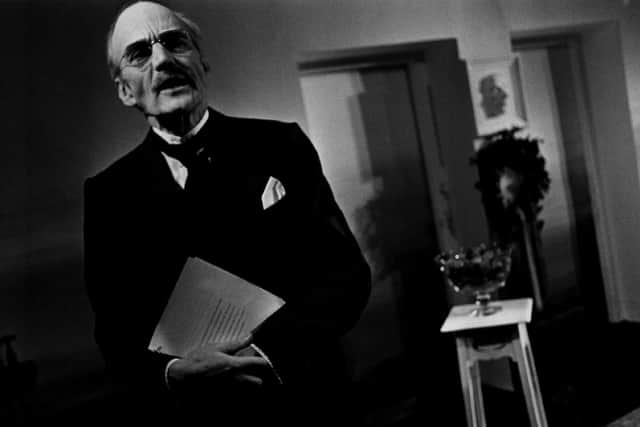
In 1989, when the Citizens’ briefly ran out of money, Giles Havergal took one of his favourite novels, Graham Greene’s Travels with My Aunt, and swiftly adapted it into a brilliant stage show for four male actors (including himself) in grey lounge suits with maroon V-necked sweaters. And in 2000, Havergal pulled off a similar triumph with his and MacDonald’s superb monologue version of Death In Venice, which Havergal continued to perform, across the world, for the rest of his working life.

Actors including Gary Oldman, Rupert Everett, Mark Rylance, Glenda Jackson, Celia Imrie, Jane Bertish, David Hayman, Ciaran Hinds, Gavin Mitchell, Paola Dionisotti, Ron Donachie and dozens of others owed all or part of their careers to Havergal and the Citizens; and the brilliance and ambition of the theatre’s work undoubtedly changed lives, both on and off stage. “I came to Glasgow as a student in the early 1980s,” says Ricky Ross of the band Deacon Blue, who is co-writing the Citizens’ reopening production Small Acts Of Love, “and I went to see everything at the Citizens’. And it just changed me, as it changed many people in my generation - the idea that Glasgow could have this fabulous theatre that was challenging and exciting audiences all over Europe - it was just transformative.”
If the glory days of the triumvirate at the Citizens’ represented an exceptional and unrepeatable moment, though, Havergal was never a man to dwell on past achievements. His instinct, in the words of his Glasgow friend April Chamberlain, was to “live life forward”; and when his goddaughter Georgia Graham, and her brother the comedian Ivo Graham, told him earlier this year that they wanted to stage an event celebrating his work and life at his local theatre space in Clapham, he was reluctant, spending hours with them making sure that the event had a strong structure, and did not seem too self-indulgent or congratulatory.
When it took place, though – just a month ago – the evening, titled Travels With My Godfather, was a huge success, with Havergal in sparkling form giving an interview about his life in theatre. He opened the performance, though, with the speech from Robert David MacDonald’s great 1977 play Chinchilla, about the impresario Diaghilev and his Ballets Russes, that sums up so much of the philosophy of the Citizens’ company in its heyday; the speech about the making of art as “a passion for reform, a passion for power, a passion for beauty, a thirst to show, a lust to tell, a rage to love” – the rare and remarkable “purity of creative intention”, in Mark Rylance’s words, that Glasgow audiences came to recognise, and then to love.
It’s therefore not surprising that towards the end of his life, Havergal was surrounded by love. He outlived his parents, his much-loved stepmother Nina Havergal, and his brother Malcolm, who died earlier this year. He had, though, the deep love and respect of his niece Louise and a huge family of cousins, of his godchildren, of his many friends and their children, of myriad students and young people he taught and encouraged, and of the generations of colleagues he helped and empowered in his own unique style, always supportive, never less than honest.
And he died – suddenly, of heart failure – while visiting much-loved friends in Sussex, at the very moment when, 500 miles away, the theatre he loved was reopening its doors again, after its long restoration. Even Giles Havergal himself could not have planned a more fitting exit; and thousands whose lives he touched and changed will share this moment of profound gratitude for his remarkable, passionate and dedicated life, as he leaves the stage for the last time.
Obituaries
If you would like to submit an obituary (800-1000 words preferred, with jpeg image), contact [email protected]