
Scotsman Obituaries: Frank Dunlop, former Edinburgh International Festival artistic director
Frank Dunlop, theatre director. Born: 15 February 1927. Died: 4 January 2026, aged 98
Frank Dunlop is best known in Scotland as the artistic director of the Edinburgh International Festival in the late 1980s. But his connection to Edinburgh long predates that.
Dunlop, who has died at the age of 98, was the man who helped two aspiring songwriters on the way to stardom. Their names were Tim Rice and Andrew Lloyd Webber and their show was Joseph And the Amazing Technicolor Dreamcoat.
This was 1972 and Dunlop had been invited by artistic director Peter Diamand to present a music-theatre double bill at the 25th Edinburgh International Festival. This he did in a big top built inside Murrayfield Ice Rink. The show was billed as Bible One: Two Looks At The Book Of Genesis.
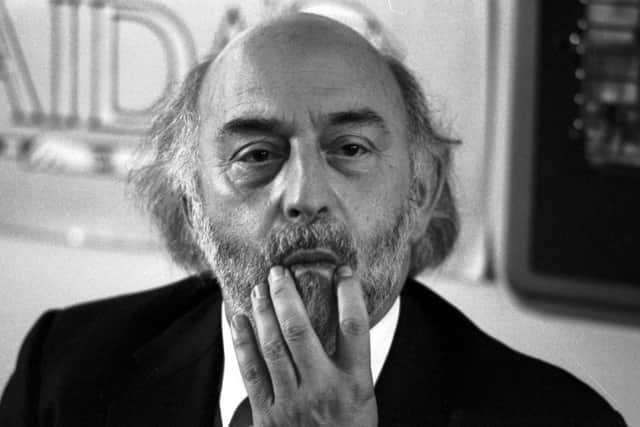

The first biblical look was a series of Wakefield mystery plays. The second, was the first professional production of the musical that would secure the place of Rice and Lloyd Webber on the map. Allen Wright, the theatre critic on The Scotsman, loved it. “Frank Dunlop conjures up the happiest half hour of the Festival,” he wrote. “His production of Joseph And The Amazing Technicolor Dreamcoat bubbles with joy.”
The score had been around since 1968, when it was performed by a school choir, but Dunlop had seen its theatrical potential. With Jesus Christ Superstar playing on Broadway in 1971, people wanted to know what the duo would do next. Dunlop provided the answer. “Every production since then owes something to Frank,” Rice told The Scotsman as the show hit its 50th anniversary.
Dunlop made two changes that turned Joseph And the Amazing Technicolor Dreamcoat from an oratorio into a mega-hit. The first was to have it performed by adults, the second was to give the characters lines that had previously been sung by the chorus, making it dramatic. “Now, what Frank wanted was to have the brothers sing the lines,” said Rice. “He changed the structure without changing the show."
Born in Leeds in 1927, Frank Dunlop was the son of Mary (née Aarons) and Charles, a mechanical engineer, of Scottish heritage. He did National Service in the RAF, then studied English at University College, London, before training as an actor at the Old Vic Theatre School. In 1954, with a belief that theatre should be popular, cheap and accessible, he set up Piccolo, a young people’s theatre company in Manchester.
From there, he was quick to make his mark, working at Bristol Old Vic and in the West End before becoming one of the artistic directors of the newly built Nottingham Playhouse.
In 1965, he was invited to the Edinburgh International Festival with Too Good To Be True by George Bernard Shaw, which played at the Royal Lyceum. The cast included Dora Bryan, Kenneth Haigh, Alastair Sim and James Bolam. He was back the following year with The Winter’s Tale and The Trojan Women at the Assembly Hall.
Those plays were performed by his new Pop Theatre, as were the 1967 productions of Shakespeare’s A Midsummer Night’s Dream, Ionesco’s The Lesson and Moliere’s The Tricks of Scapin, again at the Assembly Hall. His cast included Cleo Lane, Bernard Bresslaw and Jim Dale.
At around the same time. Laurence Olivier made Dunlop an associate director of the National Theatre, which was then based at the Old Vic in London.
In 1970, he crossed the road to set up the Young Vic, which remains one of London’s key producing theatres. Originally pitching itself at the under-24s and succeeding in attracting a crowd as lively and energetic as Dunlop himself, it kicked off with a season that included Sophocles’s Oedipus and Shakespeare’s The Taming of the Shrew. He did much to disrupt the elderly middle-class stranglehold on audiences.
In 1977, he moved to the Brooklyn Academy of Music, where he worked with actors including Denholm Elliott and Richard Dreyfuss.
He was the most flamboyant of the Edinburgh International Festival’s artistic directors and his appointment in 1984 was controversial. His predecessor, John Drummond, was not alone in his surprise that someone with little knowledge of music should have landed the job.
Not that Dunlop cared. He was a showman and iconoclast, and enthusiastically accepted the brief to upturn the Festival’s elitist image – something the left-leaning city council was pleased to see. He said there was no reason a football match could not be part of his programme. He did not go that far, but he did bring the Chinese Magical Circus to the Playhouse and the Flying Karamazov Brothers to Leith.
He programmed weightier stuff too. In his first year, he brought Rudolf Nureyev to the city and had a hit with Berlin’s Komische Oper in an otherwise depleted opera programme.
His line-ups included conductor John Eliot Gardiner, dancer Michael Clark and the premiere of A Wee Touch of Class by Rikki Fulton and Denise Coffey.
Drama was his strength and people still talk about Yukio Ninagawa’s outdoor production of Medea in the university’s Old College Quad in 1986. His line-ups included everyone from Kenneth Branagh to Mike Leigh, Evelyn Glennie, Ravi Shankar, Jimmy Logan, Ingmar Bergman, Miriam Margolyes and the Wooster Group.
He brought the dates of the Festival forward a week, the better to cater to summer visitors and, in 1990, staged his own production of Treasure Island at the Assembly Rooms.
Frank Dunlop’s term came to an end in 1991 when he returned to the life of a freelance director – and an irrepressible one at that.
Comments
Want to join the conversation? Please or to comment on this article.