
Readers Letters: Would it be so wrong to charge for gallery entry?
The treasures in Scotland’s galleries are worth paying to see, says reader
Once again the National Galleries of Scotland is raising the problem of their dire financial state (“Closure of Scottish National Galleries ‘remains on the table’ as maintenance backlog costs soar to £20m”).
If one goes abroad and visits the Prado or the Louvre or the Uffizi one pays an entry charge. Fair enough. Why do our galleries not do the same for visitors to see our wonderful collections? Visitors from abroad are astonished that they are free. The answer always seems to be, “But it's aye been”.
If an entry fee for all is a step too far then perhaps British citizens, schoolchildren and students could be exempt. Charges paid by visitors from abroad alone would at least make a substantial contribution to the running costs. The current suggestion that we should all have ID cards would be helpful here.
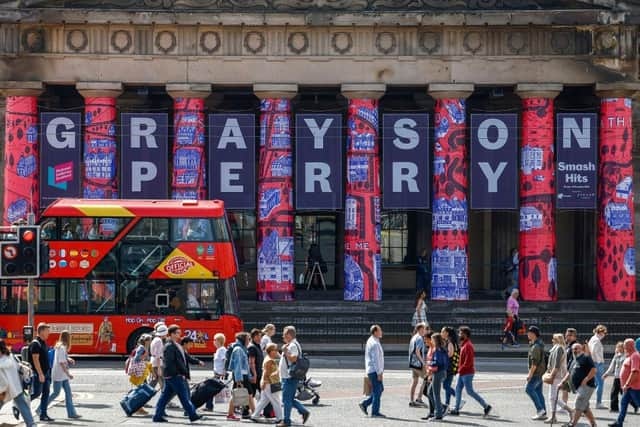

In the same edition of The Scotsman there is an interesting article about a forthcoming exhibition at the Portrait Gallery of what sounds like fascinating old photographs. It is to be free. Why? We pay to go to the theatre and concerts. Why not to exhibitions?
Michael Grey, Edinburgh
Failing Labour
Joyce McMillan speaks with wisdom and political acuity about the sense of alarm people share, both in Scotland and the UK at large, over what feels like a very deep crisis in the UK government (“Flag-waving right wingers are just latest sign UK is falling apart”, Perspective, 12 September).
After a lifetime of voting Labour I am sorely tempted towards the SNP. Does Scottish Labour leader Anas Sarwar really think he is improving his cause by accusing First Minister John Swinney of ignoring shoplifting? As Swinney rightly says, he is scraping the bottom of the barrel. Sarwar might be better advised to look at what drives people to shoplift! What has Labour achieved so far in closing the gap between the rich and the desperately poor? I see little evidence of anything.
Joyce Gunn Cairns, Edinburgh
Asinine law
The dystopian society portrayed by George Orwell is echoed today in the words of those masquerading as concerned politicians but who are undermining the fabric of a truly democratic and egalitarian society. At FMQs, without the slightest hint of irony or shame, Anas Sarwar cynically accused the First Minister of being “soft on crime” because of the increase in shoplifting in Scotland, without acknowledging the regrettable situation across the UK with police resources limited and most prisons already full.
Unlike the rest of the UK though, recorded crime in Scotland has been reduced by around 40 per cent since the SNP came to power at Holyrood, but the police in Scotland have to enforce UK law, including the Labour Government’s misguided recent proscribing of Palestinian Action as a “terrorist organisation”. It is not the fault of John Swinney, the SNP or the Scottish Government that the police have to go after old-age pensioners wearing T-shirts or holding up placards essentially condemning genocide rather than devoting resources, limited in large part due to spending choices made at Westminster, to arresting shoplifters.
The British establishment’s leading politicians – Keir Starmer, Kemi Badenoch and Nigel Farage – all back arresting peaceful protestors who by no stretch of the imagination could be considered terrorists or a threat to the British state.
Stan Grodynski, Longniddry, East Lothian
Nordic lessons
According to Franz Kafka “productivity is being able to do the things you were never able to do before”. As this week’s growth figures indicate, the UK remains in the productivity doldrums. In this age of heightened risk and uncertainty, it’s time to do long-term economic development differently.
The Nordic states are venerated for their unique blend of inclusive prosperity, while balancing economic dynamism with social protection. These small, open economies have delivered and rank among the highest globally for living standards, income equality, and social mobility.
A robust welfare state, funded by taxation, is a powerful buffer against major external shocks and downturns. Citizens are protected from job losses, and knock-on effects on health (mental and physical) via universal access to good healthcare, generous unemployment benefits and pensions, and provision of high-level education and training. Consequently, anxiety levels in the Nordic states are among the lowest in the world.
High and sustained productivity growth has been the fundamental enabler. Today’s Nordic model has evolved over 100 years or so – and is strictly non-replicable due to social and cultural factors specific to Nordic history. Elements, however, are instructive. The Danish economy is more diverse and better balanced than those of other Nordic states. Innovative policies have been doggedly pursued recently under the banner of “smart specialisation”. Underpinning this has been significant investment in Danish universities and R&D.
Ever-deepening pools of rich human and intellectual capital are recognised as key enablers of future productivity growth. Among small economies, Scotland enjoys an advantage in the number of its academic and R&D institutions. Whatever the political hue of government, repurposing and upgrading these institutions to genuine world-class is one of the fundamental challenges we face. A quantum leap in smart investment will be needed over a sustained period.
Can government, the taxpayer and business rise to this? Worryingly, the jury remains out!
Ewen Peters, Newton Mearns, East, Renfrewshire
Reform Lords
Unlike Gerald Edwards (Letters, 12 September), I don't believe another election is the solution to the UK’s problems. What is actually needed is to scrap the First Past The Post electoral system and replace it with proportional representation and get on with House of Lords reform, or abolition and federalism.
Failing that, let’s have Scottish independence.
Doing the same thing over and over will not produce a different result – in fact it is the definition of insanity, I understand.
Peter Ovenstone, Peterhead, Aberdeenshire
Lording it
The Prime Minister this week said on numerous occasions that he had full confidence in Lord Mandelson, saying: “Lord Mandelson was playing an important role in the US/UK relationships.” A week is a long time in politics and, from yesterday’s headlines, 24 hours is a long time in parliament for the PM.
But, the question now for Labour came from SNP MP Stephen Flynn in the House of Commons: “Will Lord Mandelson lose the party whip in the House of Lords?” I would go further in suggesting Lord Mandelson should be stripped of his peerage.
Catriona C Clark, Banknock, Falkirk
Trump time bomb
If Peter Mandelson deserved to be sacked as UK Ambassador to the US, which he did, where does that leave Donald Trump as President? It seems a bit unfair and unacceptable that he's rewarded with an unprecedented second state visit, which Peter Mandelson helped so much to broker.
The chances are that the ongoing Jeffrey Epstein saga will topple Trump eventually. Few, if any, believe his denials any more, even a growing number of his own supporters. Trump's own increasingly pathetic claims that it's all a “dead issue” or “a Democratic hoax” simply betray his desperation.
The Epstein saga is a story that just won't go away. Far from it! Epstein's damning 50th birthday book is just the latest of the dripping revelations, appearing in the press and social media. Dripping may well turn into a flow, which will carry Trump away in its presidential wake. Not before time.
Ian Petrie, Edinburgh
Kemi’s semi-right
Kemi Badenoch was right to question Keir Starmer’s judgment about appointing Peter Mandelson US Ambassador, given Mandelson’s past mis-judgments. Where her own judgment is questionable is in ditching Tory ideology of much of the last 15 years to do things “my way”. I see parallels with an intransigent Liz Truss rejecting traditional “one nation” Tory centre right politics, espoused by David Cameron and Theresa May, to crash the economy.
The Tories under Badenoch are a far cry from the 2010s when they won four elections in a row – helped initially by the LibDems – pushing up the starting rate of income tax, implementing the pensions triple lock and increasing employment by nearly 2 million in their first term.
Badenoch has ditched what worked for the Tories then, attacking Labour on welfare, immigration and energy rather than Reform who, with a ten-point lead in the polls, are the bigger threat. Once again a Tory leader is given free rein to take the party to the far right and take a position close to Reform.
Badenoch should heed recent YouGov polling and concentrate on the environment and protecting minority groups, issues that Tory voters see as a weaknesses for Reform. She won’t, of course; her personal ambition will steer her to attacking Labour to help Reform secure victory at the next UK election, hoping for a coalition. That’s worrying given polling suggests fewer than a quarter of people see a Reform-led government would do a good job of running the country. This would surely see Badenoch’s bad judgment risk party implosion.
Neil Anderson, Edinburgh
Write to The Scotsman
We welcome your thoughts – NO letters submitted elsewhere, please. Write to [email protected] including name, address and phone number – we won't print full details. Keep letters under 300 words, with no attachments, and avoid 'Letters to the Editor/Readers’ Letters' or similar in your subject line – be specific. If referring to an article, include date, page number and heading.
Comments
Want to join the conversation? Please or to comment on this article.