
Readers' Letters: Why would any biological woman vote for the SNP?
First Minister’s continuing position on trans ruling baffles reader
When “trans” activists began their campaign for “gender” reform, they targeted the prison service as their “wedge” issue – win recognition for men identifying as women there, and other institutions would easily follow.
Now that John Swinney has had to surrender, unwillingly, on biological sex being the criterion for use of facilities in schools and other areas, following the Supreme Court decision as long ago as April 2025, he seems, for some unknown reason, to have decided to hold the line at Scotland’s prisons. Biological men identifying as women are to continue to be allowed to choose to serve a sentence in a women’s prison, with all the ramifications that holds for women prisoners’ dignity, privacy and safety – think of communal showers, for example. For Women Scotland (FWS) – who have not yet received the funds owed to them by the Scottish Government for FWS’s victory in the last round of their legal challenge on this issue – will contest the prisons issue in court. It is inconceivable that they will lose.
Why has John Swinney chosen this as a fundamental critical issue for his party and government? The SNP's entire posture on the “gender” issue in the year before an election makes it an election issue.
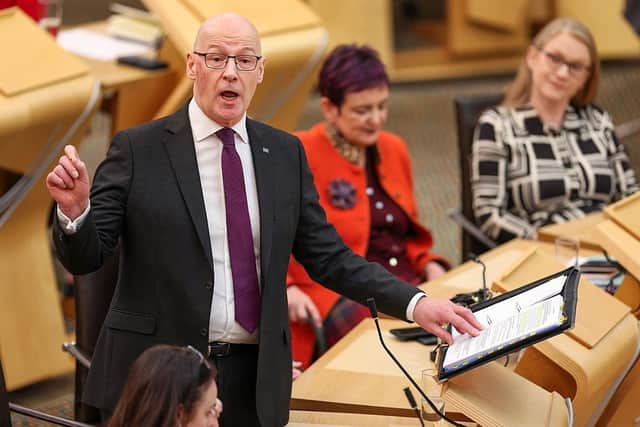

It will be very hard to understand why any biological woman would even consider voting SNP – let alone for the Greens, for whom this is an existential cause – next May. If you support these parties in the election, you are endorsing their repudiation of the biological difference between “man” and “woman”.
Jill Stephenson, Edinburgh
Wasteful SNP
Angela Constance, the Justice Secretary, is apparently angry at the UK Government for not covering the £24 million costs related to Donald Trump and JD Vance’s visit to Scotland (your report, 27 November).
She’s not half as angry as I and many more of the Scottish electorate are, not just for the utter waste of money by her and her current and past bosses, John Swinney and Nicola Sturgeon, on futile court cases, but we’re also furious that the Scottish Government has yet to pay the element of the For Women Scotland (FWS) legal costs relating to the Supreme Court judgment in April this year, believed to be up to between £250,000 and £400,000. This is on top of the £374,000 the Scottish Government spent fighting this case.
This SNP government had to pay the UK Government £170,000 in legal costs when it decided to fight Westminster’s decision to block the proposed gender reform. All of this is not including the Scottish Government’s own legal costs, which amounted to £228,000.
We also had the nonsensical Supreme Court case which the SNP initiated regarding the Scottish Parliament’s powers to hold an independence referendum. Another £250,000 of costs.
Clearly the SNP love losing in court as it wasn’t enough that they lost the FWS case in the Supreme Court. They have now gone back to court to argue that men should be held in the women’s prison estate if they claim to be women. The Supreme Court made it clear this is against the law.
This is taxpayers’ money that the SNP throw at court cases like confetti. We’ve had 18 years of this waste, please don’t let us have to endure another five!
Jane Lax, Aberlour, Moray
Predictive text?
Surprise surprise! The government doesn’t believe in increasing private sector employment; nor in economic growth despite paying it frequent lip-service; nor in our national (and many individuals’) need to save more; nor in fairness between public and private sector pension benefits and funding; nor in abolishing the fiscal nonsense of a 62 per cent marginal tax rate on earnings from £100-125,000 directly affecting the leaders of thousands of the small and medium-sized enterprises (SMEs) on which we all depend and which employ 60 per cent of total private sector employees (versus 40 per cent in large household-name companies); nor in a common-sense rationalisation of our NIC, Income Tax and Welfare regimes; nor... Plus ca change.
John Birkett, St Andrews, Fife
Tackle banks
It was interesting to see the amount of the national debt actually admitted during the Chancellor’s Budget speech, and the shocking fact the interest on that debt is £1 in every £10 the government spends.
The problem we have is clearly with the banks. Why is that not being addressed, as much of the national debt is magic money from thin air. It makes everything else pale into insignificance.
Malcolm Parkin, Kinnesswood, Kinross-shire
Dead amendments
MSP Liam McArthur’s claim that his Assisted Dying’ Bill is now fortified with “strong protections and safeguards” is disingenuous at best (your report, 27 November).
While modest amendments were accepted by the Holyrood Health Committee, vast swathes of attempted safeguards were rejected, with much of the steer given by Mr McArthur himself. Rejected amendments included: a six-month life expectancy limit to qualify; safeguards to detect coercion; a requirement to inform patients of possible side-effects and complications; and provisions for where the patient takes the medication but doesn’t die. A proposed conscientious objection clause for care homes and hospices was also rejected, as was a requirement that the Chief Medical Officer provide guidance for diagnosing terminal illness in anyone under 25.
The blunt reality is that regardless of good intentions, so-called assisted dying can never be made safe because no safeguards can guard against the invisible pressure it would place upon vulnerable people.
Ultimately, enabling people to prematurely end their lives via lethal medication is not a compassionate response to suffering. MSPs should reject this path when it comes to the final vote on the Bill, and prioritise better palliative care Scotland-wide as the means to achieve a compassionate and comfortable death.
Michael Veitch, Scotland Policy Officer, CARE, Glasgow
Hardly better
I was interested to read Alistair Majury’s impassioned plea for Scottish people to vote Reform (Letters, 27 November), but as a regional organiser for the party he would say that.
If, as he claims, the electorate will get “something better” by voting for the one-issue Reform, maybe it should bear in mind the chaos currently happening in those English councils “run” by Reform, where promised spending cuts are proving to be impossible and since May of this year 38 of 677 Reform councillors have either been suspended, expelled or quit. However, they did remove some flags.
It’s also important to bear in mind such things as Reform figurehead Nigel Farage’s recollection of his schooldays which are at odds with the allegations of 14 of his school colleagues, leaving something more than a nasty taste in the mouth.
Reform leader Richard Tice rarely comments on the chaos ensuing in English councils or the civil war taking place amongst his handful of MPs, one of which has left the party already. Maybe he thinks it will go away. Mr Majury claims a vote for Reform will be “better”. If voters believe that utter chaos, even more than the previous Tory government mismanaged, is better, they know where to put their cross.
D Mitchell, Doune, Perthshire
Deer vs trees
Alison Campsie’s article on repairing mountain footpaths strikes a chord (26 November). A good footpath to follow when climbing a hill is a joy but, as is stated in the article, many are in poor condition due to heavy use and the weather. The article mentions that in the European Alps, which have more tree cover, the problems of erosion are not so severe, but fails to mention why Scottish hills are so bereft of such protection. The lower slopes of An Teallach, and indeed, all Scottish hills, would naturally be covered in native trees such as oak, aspen, willow, birch, rowan and the rest and on the higher slopes there ought to be naturally occurring montane scrub or low growing willow, birch and other hardy plants. Alas no more, these hills are bare because of over-grazing by sheep and deer over the last couple of hundred years.
An Teallach, we are told, is on a sporting estate i.e. deer shooting. It is not uncommon in Scotland for such estates to encourage a high level of deer to enhance the sporting element. However, other estates in Scotland have shown that if deer numbers are reduced, trees will grow again. Reducing deer numbers across the Highlands would increase biodiversity and make the hills much more pleasant for all, as well as reducing the need to constantly repair footpaths.
Benedict Bate, Edinburgh
Head in the sand
Unfortunately for him and fortunately for us, Grant Frazer has his facts wrong (Letters, 26 November). A majority of Scots favour SNRs (small nuclear reactors) – 77 per cent in one recent poll. As regards the essential nuclear deterrent, again, a majority of Scots (56 per cent) support this. Only 22 per cent support the SNP policy of scrapping it and leaving us at Russia's mercy. Quite amusingly, even 45 per cent of SNP supporters support it and only 36 per cent of them want it scrapped! It is Mr Frazer who needs to “understand the needs and wishes of the Scottish people”, such as wanting to stay British, a right the Scottish people won by a sizeable majority over the SNP.
Mr Frazer tries to tell us that what we want is, in fact, what our enemies want and that is the real disgrace. He should pull his head out of the sand.
Andrew HN Gray, Edinburgh
Write to The Scotsman
We welcome your thoughts – NO letters submitted elsewhere, please. Write to [email protected] including name, address and phone number – we won't print full details. Keep letters under 300 words, with no attachments, and avoid 'Letters to the Editor/Readers’ Letters' or similar in your subject line – be specific. If referring to an article, include date, page number and heading.
Comments
Want to join the conversation? Please or to comment on this article.