
Readers Letters: Why Starmer must stay Prime Minister
Reports of Keir Starmer’s political death are exaggerated, says reader
The media is full of stories about the possibility of Keir Starmer being replaced as Prime Minister, and while there may be some benefits for Labour and the government we should be careful as the law of unintended consequences could come into force.
Any attack on Sir Keir would see the pound plummet, increasing import prices and sparking an increase in the cost of living, which is one of the problems the government is targeting.
And who will take over if he is ousted? There is no one in the party with real experience of government, and the Labour Party has been left with a number of major problems which have been exacerbated by increases in National Insurance and some other policies.
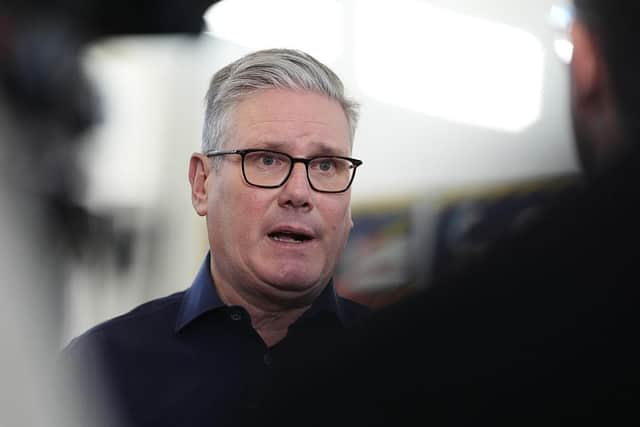

Keir Starmer could still be Prime Minister at the next election.
James Macintyre, Linlithgow, West Lothian
NHS success
I recently had an NHS operation. From appointment to theatre the organisation was seamless; virtually no waiting between the pre-operation stages. The staff were energetic, cheerful and engaging. There was obvious mutual respect between the various grades. The design of the operation was state of the art, and, as is not general in the NHS, they employed the checklist, which saves thousands of lives every year. As I walked out there was a gale of happy laughter from the theatre nurses. Sadly, this is nothing like the story we hear from across the NHS, But why? I cannot imagine that the ophthalmology department of the Jubilee in Clydebank is preferentially showered with cash.
The difference can only be administration. Tellingly, when thanked and complimented, they remarked that they were a small department.
Do we have the right people with the right education, training, culture and, critically, accountability with teeth? I fear not. But I see no way out of this since the only tool the government has, the Civil Service, probably suffers from the same deficiencies.
David Hogg, Edinburgh
Defending Donald
Whatever you might think of the methodology, legality and politics of Donald Trump's Venezuela actions and declared interest in Greenland, he is bringing to the fore several issues that threaten, and will determine, the future of western democracies, namely immigration, drugs, access to rare earth minerals and hydrocarbons (which are going to be required for much longer and in much larger quantities than our leaders will admit), defence and the influence, threat and how to deal with China.
Our own leaders are struggling to respond and, to pick one topic, I wonder what the reaction would be if Russia or China colonised Greenland. Surely there can be a deal done between Denmark, Nato countries and the US to ensure that never happened.
Allan Sutherland, Stonehaven, Aberdeenshire
Data centres
Are hyper-large data centres the mirage of the late 2020s in Scotland or the saviour of jobs? Pressing hard on the heels of wind turbines, battery storage and solar farms we hear that data centres are now going through the planning process in our local council areas, where they will face the hurdles of environmental considerations.
We have to wonder if those we elect to run our country live in a world where everything is singular and nowhere do other considerations have to be taken into account. We are informed that the energy requirements of those data centres being considered at present will exceed the whole of Scotland’s peak requirement of energy in the depths of winter, every day for as long as they are required.
Given the obvious strategic requirement of these vast processing centres it would be sensible for planning approval for any more to be carried out at UK level rather than ad hoc at local council planning departments. Without this level of control the chances of overkill and impact on energy usage could well spiral out of control, leading to rationing and mayhem.
Government needs to urgently rethink how we process these applications.
A Lewis, Coylton, Ayrshire
Not all welcome
Adam Morris has two South Asian friends who have jobs and pay their taxes and are obviously intelligent and hard working (Perspective, 6 January). Yes, the UK needs more such people, but not those illegal migrants crossing the Channel who are not educated and are never likely to pay tax, and since these people are seldom deported they will milk the taxpayers.
All over the UK large numbers of people are actively demonstrating against the tens of thousands of unvetted male migrants being put into hotels, army barracks and other accommodation at taxpayers' expense. No wonder, since 59 of them have been jailed for sex offences and hundreds more for criminal offences. Yet they all pretend to be asylum seekers.
What is this government doing to arrest and return those who have committed crimes in EU nations and have been fleeing across the Channel to the UK to escape justice? Thousands of extradition requests have been made by Germany, Belgium, France, Austria, Romania, Sweden and Cyprus.
Migrant lawyers should no longer get taxpayer-funded fees and then these unwelcome invaders could be more quickly deported and thus deter others.
Adam Morris needs to remove his rose-tinted spectacles and write an article about the influx of illegal migrants, and how to encourage more people like his friends to come and contribute to Scotland.
Clark Cross, Linlithgow, West Lothian
Good results
Another day and another desperate, simplistic and misleading attempt at scaremongering by Alexander McKay (Letters, 6 January), this time on the proposed nationalisation of Ardrossan Harbour.
While again trawling the diversionary waters traversed by Scottish ferries Mr McKay conveniently ignores examples such as the SNP Scottish Government’s building of the Queensferry Crossing, which was completed on time and under budget, and the acquisition of Prestwick Airport, which not only saved more jobs but is now operating profitably. What Mr McKay does not wish readers to think about is the much greater costs to Scotland of projects overseen by the UK Government, such as HS2, which at a cost of around £100 billion will bring little, if any, benefit to Scotland, or the tens of billions of pounds wasted on useless PPE and an ineffective Test and Trace Programme. Worse still, another £10bn has recently been identified by the UK Government as lost to fraud, an amount equivalent to building 50 duel-fuel ferries (without bolstering the offshore bank accounts of wealthy individuals).
Instead of attempting to provoke fear over further SNP governance and Scottish independence it would seem more logical to fear further government from Westminster, especially if led by a devoted Trump acolyte who has moved on from selling Brexit to selling “Reform”, with likely even more disastrous consequences for all the UK. Mr McKay himself should “be afraid, be very afraid” at the possible proclamation of “Prime Minister Farage”.
Stan Grodynski, Longniddry, East Lothian
Terrific trams
Correspondent Neil Anderson doesn’t support Edinburgh trams on grounds of cost (Letters, 6 January). He should take a longer view. Infrastructure spend like this repays the investment. I took a tram to the airport today and it’s clear to see the economic benefit the tram corridor has brought in the course of a decade or so.
A similar effect is visible in Leith and Newhaven already. The trams have a much bigger impact than buses.
Buses are not a good way of moving lots of people around, as anyone who has tried to commute from Leith/Newhaven before the tram can tell you – full buses queuing behind one another made the journey much longer and more prone to delays.
The bus route times are slowing year on year. More light rail is vital to keeping Edinburgh moving and attractive.
I also hope the “ghost line” will reopen – there is an exciting tram/train plan for the Edinburgh circular rail line that was taken out of passenger use in the 1960s.
Jackie Kemp, Leith, Edinburgh
Global radio
I discovered the Iain Anderson show on BBC Radio Scotland about a year and a quarter ago, really connected to the playlists aired week after week, and never looked back!
I recognised very quickly that here was a collection of contemporary music from the 1960s to the present that I could not find anywhere in the United States, where I live, nor online from any of the other English-speaking countries that I could grab on my phone or computer.
Here were new and old Scottish artists whose music rarely made it out of Scotland. Here was a cultural gem available from Scotland and nowhere else. And then, in November of last year, BBC Radio Scotland pulled the show for reasons I still don’t get.
I hope the BBC realises it had an export as well as a domestic product that is humanly decent, culturally excellent, and great fun for those of us who thrive on quality contemporary music. There is nothing like Iain Anderson’s collections and playlists anywhere else in the world.
Surely, there must still be some place for such unique quality from BBC Scotland? It’s part of what makes the UK a leader in both audio and video.
Please return Iain Anderson to the Anglosphere.
Richard Simonelli, Fenton, Missouri USA
Write to The Scotsman
We welcome your thoughts – NO letters submitted elsewhere, please. Write to [email protected] including name, address and phone number – we won't print full details. Keep letters under 300 words, with no attachments, and avoid 'Letters to the Editor/Readers’ Letters' or similar in your subject line – be specific. If referring to an article, include date, page number and heading.
Comments
Want to join the conversation? Please or to comment on this article.