
Readers' Letters: What on Earth has happened to this island?
The UK has gone downhill in many areas, says reader
We live on an island. The sea around us is an impregnable moat, yet we assist illegal immigrants to cross that moat. The moat is full of fish but we allow continental Europe to fish there.
Our island is made of coal and fields of shale yet we ban using it. We invented nuclear power but refuse to build nuclear stations. We produce the finest meat in the world but are persuaded not to eat it. We have the finest agricultural land yet import 60 per cent of our food and seek to cover most of the rest of that land with solar panels and windmills that only work on sunny and windy days. And we pay foreign nations to erect those ugly devices, and pay the windmill owners when the grid doesn’t want their meagre power, or when the wind doesn’t blow. We keep gas-fired stations running for when the windmills that disfigure our landscape can’t cope. So we pay twice for our heat and light.
Foreign companies own the windmills in Scotland that disfigure our countryside and spoil our tourist industry and compel people of the Highlands to live beside pylons and transformers and the other machines never mentioned in planning applications, and while the grid warns of power cuts in winter, we persuade people to use electric cars.
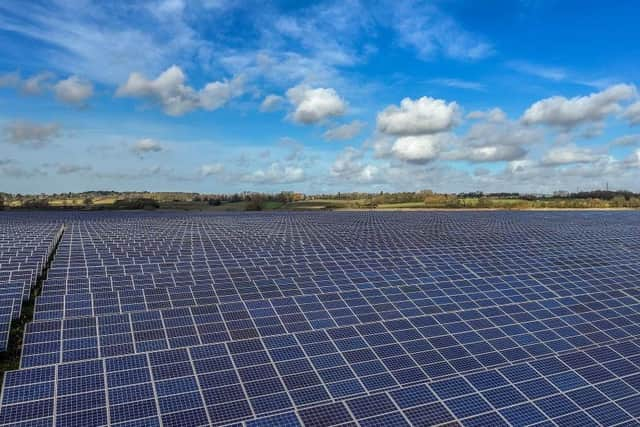

The green people are deluded and thoughtless. Meanwhile the rest of the world powers on to prosperity with nuclear and fossil fuel, as many of our own homeless people sleep in doorways at nights.
If you had told that to the people of the recent last century, they would not have believed you. Not even Aldous Huxley could have made it up.
Malcolm Parkin, Kinnesswood, Kinross-shire
Off balance
“Balanced” is not the word that springs to mind when I read any article by Brian Wilson, including his partial perspective on the latest GERS figures. Dr Steven William Welsh (Letters, 18 August) apparently accepts Mr Wilson’s “lop-sided equation” as “thoughtful and thought-provoking” yet does not question why this seeming anomaly has arisen.
Reading the ONS report for 2024-25 reveals that Northern Ireland has the highest public spending per head and that Scotland and Wales have lower levels of spending (although also higher than the UK average), but as with Northern Ireland have benefited less from UK government major infrastructure investment than have London and the South East of England. The underlying cause of the spending imbalance across the UK, including a number of English regions, is the disproportionate focus of investment in one corner of southern Britain over a long period, including the time Mr Wilson served as a Minister under Tony Blair at Westminster.
Another perspective on the latest GERS figures recognises that Scotland raises £98 billion in revenues but the Scottish government only spends, via a balanced budget, £77bn. While £50bn of the £77bn represents the return of a portion of Scotland’s tax take via Barnett consequentials, £21bn is withheld by the UK government to be allocated along with other notional expenditure, including close to £10bn of interest on UK government debt, resulting in a UK government determined notional deficit for Scotland of £25bn. This apparently sad story reflects long-term mismanagement of Scotland’s abundant natural resources by the UK government and is hardly evidence of Westminster “generosity”.
Others can determine for themselves what they consider to be a balanced view of Scotland’s fiscal position within a UK economy that has struggled to achieve sustained economic growth in recent decades.
Stan Grodynski, Longniddry, East Lothian
Last resort
We should not be surprised that the Scottish National Investment Bank is encountering headwinds. It, like the failed Scottish Stock Exchange, was conceived by a Scottish government driven by aspiration rather than any understanding of finance.
Firstly, SNIB is not an investment bank. Unlike Goldman Sachs and its peers, it does not have trading desks in equities, bonds and forex etc, nor does it offer investment banking services. Rather, SNIB is an investor of last resort for start-ups. As such, losses of £110 million to date on a portfolio of £1.16 billion, while without question significant, shouldn’t be a surprise.
Getting hung up on impact ambitions will do nothing towards delivering acceptable returns on its portfolio. Come 2030 and investment of £2bn will there be much, if anything, to show to justify the existence of SNIB? Certainly, it must be doubtful that SNIB will attract any external mandates which would help to cement its status as a bona fide start-up portfolio investor.
Robert Miller-Bakewell, Whiterigg, near Melrose
Cone of shame
I wonder how many citizens of Boston, US, who so affectionately and patronisingly admired our new, cute, iconic national emblem, the "Wellington Cone" during our humiliating World Cup campaign, watched the shocking BBC documentary on Glasgow and saw these fun items being used as clumsy weapons by racist thugs in street clashes .
Bring back the thistle and CU Jimmy wigs!
Allan Sutherland, Stonehaven, Aberdeenshire
Same old story
A funny episode of BBC sitcom Blackadder Goes Forth sees General Melchett proudly show off a piece of turf representing territory gained but it turns out the scale is 1:1, a gain of 17sq ft, recalling the painfully slow progress at the Battle of the Somme in 1916.
I was reminded of that when the Defence Investment Plan (DIP), belatedly, came out. We were reminded that every war begins by being fought like the previous one eg the British Expeditionary Force went to France with five cavalry brigades in 1914 but machine gun power and modern trench warfare put paid to that. In early 2022 we saw the ominous 2,800 Russian tanks in Belarus. They then encountered the Ukrainian drones and few survived. Crews got lost with out-of-date maps, they ran out of food and fuel, they even got snarled up in a traffic jam. The Russian advance was slower than at the Somme.
DIP is based on the premise that drones are a turning point in warfare. Ukraine produced 3,000 in 2022, it is believed they have up to 3 million today – 70 times more than the USA. The latest are autonomous and, alarmingly, AI selects a target. Yet advances on the ground are still measured in single figure square yards!
What lessons have the UK learned and how has DIP prepared us for war? An extra £15 billion is going on defence but experts like the BBC’s Frank Gardner and Sky News’s Michael Clarke echo our despairing Nato allies, the defence chiefs and Conservative and Liberal Democrat parties, arguing £28bn was required. The defence budget is curtailed, unlike the £440bn spent on welfare.
Against that backdrop the UK defence strategy, in recent months, has changed alarmingly from defending Ukraine to sending 150,000 drones to Ukraine and then being ambivalent when they are used to penetrate far within the Russian mainland. All week European media have covered the furious reaction in Russia because, while some were military and economic targets, the optics arose when the British-made missiles repeatedly targeted the Russian Wildberries (their version of Amazon), a civilian target. The Russian media highlighted the British collaboration and their public are not drawing a distinction. The latest British missiles evade Russian defences and have allegedly targeted Moscow. For most of the week, the English media ignored or underplayed this.
The Public Accounts Committee said our defence spending has left the country less safe and less credible. This new tactic needs to be aborted and Parliament recalled.
Andy Burnham’s response? Not to worry, Russia often makes threats but is dangerously inadequate.
John V Lloyd, Inverkeithing, Fife
Outthink midges
The Scottish midge has acquired something of a reputation. For many visitors, the prospect of being eaten alive seems to be an unavoidable part of experiencing the Scottish outdoors.
It isn't.
The trick is to understand that midges are remarkably localised. You can be bothered by them in one place and barely notice them a short distance away. They favour still, damp and sheltered conditions, and are most active around dawn and dusk. Wind, on the other hand, is their enemy.
This makes camping beside a loch in a sheltered hollow at sunset a rather poor strategy.
When camping, move away from water and damp ground and, where possible, find an elevated, exposed site where there is a breeze. Avoid the still periods around dawn and dusk and it is possible to enjoy a summer evening in the Highlands without giving the midges much opportunity to enjoy you.
The secret isn't particularly sophisticated. It is simply knowing where they are likely to be and choosing somewhere else.
Perhaps, rather than fighting Scotland's midges – and let's face it, you're not going to win – visitors should learn to outsmart them.
Steven Scott Taylor, Edinburgh
Just the jobbie?
I have been emailed by a company who seem to be based in Scotland who are offering a new Artificial Intelligence product related to finding a new job.
This is always a useful thing in a dire market like the one we are facing at present.
However, I almost fell off my seat when I read their sales letter.
The product they are selling delights in the name of “Jobbie”! I kid you not. “Meet Jobbie”, they say, but to be honest, I don't know that I really want to.
Can anybody blame me?
Peter Hopkins, Edinburgh
Write to The Scotsman
We welcome your thoughts – NO letters submitted elsewhere, please. Write to [email protected] including name, address and phone number – we won't print full details. Keep letters under 300 words, and in the body of the email – no attachments – and avoid 'Letters to the Editor/Readers’ Letters' or similar in your subject line. If referring to an article, include date, page number and heading. No poems.
Comments
Want to join the conversation? Please or to comment on this article.