
Readers’ letters: We need answers to fundamental energy questions
A reader says politicians need to focus on energy concerns, not placing journalists in a pen
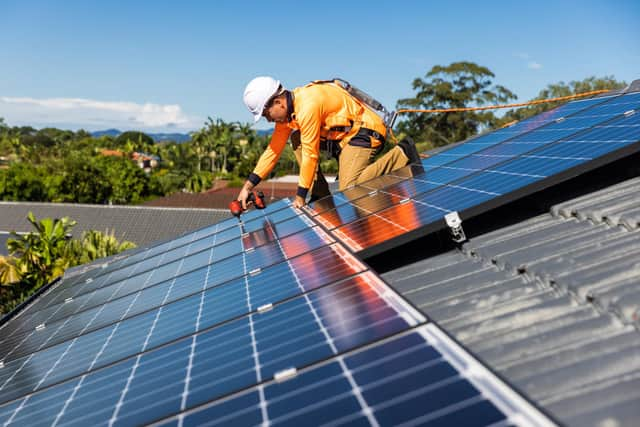
David Haskell’s “Dump pump” letter (26 June) raises several fundamental problems for Scotland’s energy market. The first is that, if all properties have solar panels and battery units, what is the role of ScottishPower, EDF or SSE when no one will require their products?
Then there is the question of why does the SNP draft energy paper of 2023 need 45GW of ScotWind projects plus 25GW of hydrogen generation plant when all dwellings produce their own power needs ?
Why are power companies spending billions in grid upgrades if, like David Haskell, everyone is independent of the grid for the bulk of their energy needs?

That raises a final point: what will be the unit cost of electricity from the grid when there is very little demand for the product?
Surely, instead of penning media correspondents at Holyrood, politicians should be addressing the type of energy production that will be needed in Scotland over the next 50 years.
Ian Moir, Castle Douglas, Dumfries and Galloway
Scare story
Elizabeth Marshall’s scare story about solar panel efficiency declining at temperatures over 25C (Letters, 25 June) omits two important facts.
Firstly, the decline is only about 0.3 per cent for each degree above 25C – so, even if the temperature rises to 40C, efficiency declines from 100 per cent to 95 per cent, which is too trivial to worry about.
Secondly, the reason why temperatures have increased year by year since about 1850 is because we have been burning fossil fuels – so the ‘solution’ that we burn yet more fossil fuels from the North Sea will just make things worse.
Barry Hughes, Edinburgh
Wrong fire
The “overheating paradox” describes the paradox of housing optimised strictly for cold climates often failing to adapt to extreme summer heatwaves. Other impacts on the UK of the recent heatwave are school closures, effects on farm animals, travel disruption, water shortages, fires, deaths, crop failures and calls for “something to be done” – and that’s before we get to floods, coastal erosion, and hurricanes, the defence against which involves billions in civil engineering and new housing.
The irony is we only cause one per cent of the problem but will suffer more of the consequences, not least huge immigration pressure from parched countries. Our solution? Build more windmills, plant more solar panels, shut down the oil industry and install heat pumps to reduce our climate footprint.
A fitting analogy might be the Times’ comment about legendary England centre half Billy Wright being completely wrong footed by Hungarian striker Ferenc Puskas “like a fire engine going after the wrong fire” during a 6-3 drubbing by Hungary at Wembley in 1953.
Allan Sutherland, Stonehaven, Aberdeenshire
Sized up
Government inflation figures are wrong, because they take no account of the way manufacturers have reduced the size of their products, while either maintaining – or still increasing – the price.
Confectionary items in particular have become smaller, as have many toiletries and household goods..
The buying public have noticed, and treat inflation statements with derision.
Malcolm Parkin, Kinnesswood, Kinross-shire
Free speech
A free society should be cautious when government starts deciding which voices deserve greater prominence. The Labour Green Paper’s proposal to make selected “trusted” news providers more easily discoverable online risks crossing an important line.
This is not a harmless technical change. In an age when many people find news through search, social media, video platforms and mobile feeds, prominence matters. If the state shapes which sources are pushed forward, it is no longer merely protecting debate; it is influencing the conditions under which debate takes place.
First, free speech is not just the right to say approved things. John Stuart Mill understood that liberty depends on hearing unfashionable, inconvenient, and unpopular opinions.
Labour should re-embrace its liberal roots, dust off Mill’s defence of free speech, and start taking responsibility for its own actions. Perhaps the rest of the left could follow.
Second, ordinary citizens are not children. Scots are perfectly capable of judging arguments about energy, tax, public spending, local services and national policy for themselves.
Third, the state should focus on real harms: threats, fraud, incitement, and hostile foreign interference. It should not become a quiet referee of acceptable opinion.
Supporters will say this is about trust and cohesion. Those are worthy aims, but trust cannot be manufactured by Whitehall preferment. It is earned through accuracy, independence, humility, and accountability.
Britain can fix this. A confident country trusts its people, enforces the law where genuine harm exists and leaves open debate open.
Alastair Majury, Dunblane, Perthshire
Libraries matter
Scotland’s recent election tells us something important about the national mood. The return of an SNP-led administration under John Swinney, the rise of the Greens, the fragmentation of traditional party loyalties, the emergence of Reform UK at Holyrood, and low voter turnout together point to a political landscape that is more divided, volatile and uncertain than at any point since devolution began.
At the same time, Cosla’s recent white paper on strengthening local democracy argues that Scotland must rebuild democratic participation and place power closer to communities.
These are not separate conversations. The central question facing Scotland’s new administration is not simply how to govern, but how to rebuild trust, participation and civic confidence in an age of fragmentation.
That is where libraries matter.
For too long, libraries have been framed narrowly as cultural amenities, repositories of books or discretionary local services under financial pressure. Those roles remain important, but they no longer capture the full significance of libraries in modern Scotland. Libraries are democratic infrastructure. In communities across Scotland, libraries remain among the very few public spaces that are free, trusted, accessible and open to everyone.
The election exposed a growing sense of democratic disconnection. Turnout fell in many parts of the country. Political loyalties are becoming more fluid and polarised, while public debate is increasingly shaped by social media algorithms, misinformation and distrust.
Libraries can help Scotland respond to these challenges. Democracy is strongest when decisions are made closest to communities but local democracy requires more than changes to governance structures. It also requires trusted local spaces where people can access information, build confidence, participate in discussions and connect with one another. Libraries already provide that infrastructure.
Imagine if libraries were recognised formally as civic participation hubs in every community: places where citizens’ assemblies, local consultations and participatory budgeting discussions could happen; where young people could develop media literacy and critical digital skills; and where communities could engage with regeneration, climate transition and public service reform.
If Scotland is serious about prevention, community empowerment and democratic renewal, libraries cannot continue to sit at the margins of policy discussions.
Democracy depends on more than elections and institutions. It depends on trust, participation, shared spaces and equal access to information. Libraries provide all four. In the Scotland emerging from this election, that may make them more important than ever.
Alison Nolan, Chief executive, Scottish Library & Information Council, Glasgow
Lame ducks
Oh dear, it seems we are stuck with a lame duck SNP government for the next five years and a lame duck Scotland manager for the next four.
The SNP were voted in before the reality of the Murrell revelations and the decision not to develop a new Monklands hospital; our national manager was given a new contract before the reality that he seems to have little idea about how to pick a team. What have we got to look forward to in the next few years?
Ken Currie, Edinburgh
Football geography
Mark Boyle (Letters, 26 June) makes an interesting point on the selection of the national football team.
However, he is labouring under a popular misconception. The SFA, who are responsible for such things, is actually an acronym for the Strathclyde Football Association.
So any footballing clubs that operate, say, east of the Baillieston junction on the M8 do not qualify. Although I understand that in some circumstances exceptions can be made and players, while at such clubs, can be selected for token membership of the full squad.
Note that this principle of just making up the numbers also applies to domestic footballing competitions.
I trust this clears up the matter at hand.
David J Mackenzie, Inverness, Highland
Write to The Scotsman
We welcome your thoughts – NO letters submitted elsewhere, please. Write to [email protected] including name, address and phone number – we won't print full details. Keep letters under 300 words, and in the body of the email – no attachments – and avoid ‘Letters to the Editor/Readers’ Letters’ or similar in your subject line. If referring to an article, include date, page number and heading. No poems.
Comments
Want to join the conversation? Please or to comment on this article.