
Readers Letters: Time Scottish Government got tough on young criminals
The Scottish Government is too soft on knife crime, says reader
David Kennedy, general secretary of the Scottish Police Federation, said existing stop and search powers were insufficient to combat knife crime (your report, 26 May). SNP ministers have long ignored this escalating threat. Last year Police Scotland confiscated about 900 weapons, of which over 200 were from those aged 17 or under.
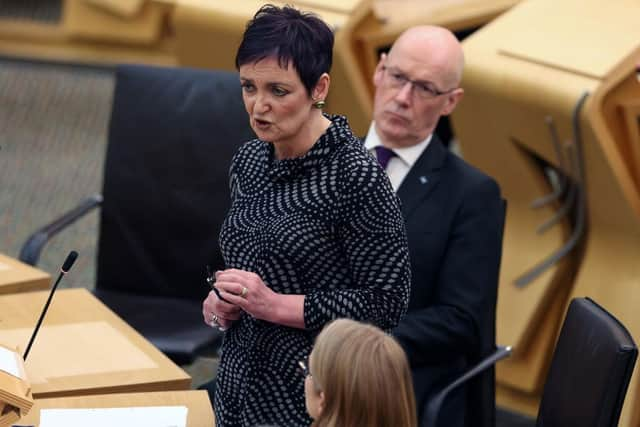
Too many young criminals are referred to the Children's Panel, where there is a history of soft touch justice. The SNP Justice Secretary, Angela Constance, is out of her depth since all she has to offer was: “Some of the rhetoric around discipline, around being tough, that we need a tougher justice system, I would suggest is misplaced.”
Misplaced? Tell that to parents who have lost children through the SNP’s failure to get tough on those carrying knives. Schools are no longer places of learning but are places where a few create disruption for many, yet avoid punishment. Teachers are getting no backing from the SNP government so are leaving in droves. Under the Scottish Government's sentencing guidelines criminals aged under 25 are far less likely to be jailed.

May 2026 should see a change of government and a tougher approach to this long-running deadly problem.
Clark Cross, Linlithgow, West Lothian
Exclude offenders
Angela Constance thinks the classroom is the best place for violent and disruptive pupils, and that “children don’t learn and don’t change if they are absent from schools”. What evidence is there that disruptive children do learn and do change when they are included in mainstream schooling?
No doubt inclusion suits the offenders and their families. It is not, however, a solution to the problems disruptive children inflict on other members of their classes and on teachers. Teachers have no sanction they can invoke that will restrain these children, and the bad behaviour affects other children, whose learning is disrupted. You educate a child only once, and disruption to children’s education undoubtedly has a lasting effect.
Ms Constance rejects calls for a tougher justice system and claims: “Families want interventions that work.” This is because sorting out a mess largely created in the family has become the responsibility of schools, with teachers bearing the brunt of it. There is a need for families to take responsibility for their children, and for politicians to stop expecting teachers to act as social workers.
I suggest that disruptive children be identified as early as possible and their families summoned, with their children, to attend a course in acceptable behaviour, for as long as it takes. That would be money well spent if badly behaved children were shown clearly that violence in the classroom will not be tolerated.
Jill Stephenson, Edinburgh
Out of touch
It is only four months since SNP Westminster leader Stephen Flynn declared we are facing a renewed cost-of-living crisis. As I wrote previously (Letters, 12 January), the crisis never went away, with many living between pay cheques.
Mr Flynn perhaps did not think that, given his 5.5 per cent MP pay rise, while his ministerial colleagues here are set to receive an extra £19,000, is rewarding failure. No wonder he wanted to become an MSP minister. As ministers become richer they’re more likely to become out of touch, something the Tories were guilty of when in power.
The cost-of-living crisis is worsening, with nearly half of respondents of a recent study not able to find £500 for emergencies without borrowing and over 20 per cent not able to find £100 at short notice. Susan Murray of the David Hume Institute, which commissioned the research, cites difficulties in paying for essentials like housing and childcare.
The causes are more complex, deep rooted in a stalled economy that fails to create highly skilled jobs and is too heavily reliant on the public sector. The tax system here is weighted towards low-paid jobs so companies offering highly skilled jobs go elsewhere. No wonder there is little growth and productivity improvement.
Scotland is increasingly stuck in a cycle of welfare dependency with no stimulus for self-help. It attracts people to Scotland from beyond working age while those of working age are turned off coming here due to the high tax, low-skilled economy.
Haddington-born author Samuel Smiles wrote “lost wealth may be replaced by industry… but lost time is gone for ever”. It’s time both the UK and Scottish governments prioritised skilled job creation and social mobility, otherwise poverty and poor health will spiral Scotland into terminal decline.
Neil Anderson, Edinburgh
Poor service
Another day, another reminder that appearance is more important to our SNP government than actually delivering improved services.
The BBC reports on Tracey Meechan’s situation. With an ovarian cyst, she is unable to work and suffers severe pain. She has been on an “urgent” NHS waiting list for surgery for 100 weeks.
Women’s Health Minister Jenni Minto has said that, in August 2021, Scotland was the first country in the UK to publish a Women’s Health Plan and that “timely access to gynaecology services will be a priority in the next phase of our plan”.
I am sure that will be a great comfort to Ms Meechan as she continues to wait.
George Rennie, Inverness
Falklands beware
James Scott calls the Chagos deal “decolonisation” (Letters, 27 May). But to transfer the islands’ sovereignty to Mauritius over 1,000 miles away – with which it has minimal, if any, historical, cultural or ethnic links (other than the UK’s administrative convenience in the final years of the Empire) and without any reference to the wishes of Chagossians, who oppose it in large numbers – is in fact a new colonisation of which one would expect, in 2025, any UK Government and the UN to robustly disapprove.
To ignore the very credible security concerns regarding China’s influence in Mauritius, and our paying billions for a partial 99-year lease-back instead of the new owner paying us, merely magnifies the literally “incredible” nature of the “art of this deal” which, maybe not surprisingly in view of his “negotiations” on Ukraine, Donald Trump seems to accept.
If, or more likely when, the UN rules that Argentina is the “legitimate” owner of the Falkland Islands, will Sir Keir Starmer accept that too?
John Birkett, St Andrews, Fife
Reeves will pay
Chancellor of the Exchequer Rachel Reeves does not like men who drive seven-seater pick-up trucks, or businesspeople, or rich people, but these are the taxpayers who contribute almost 50 per cent of the UK tax take. She also does not understand the law of unintended consequences, or the power of the grey vote. The Prime Minister is about to throw her under a bus by including another tranche of pensioners who can receive the winter fuel payments. This should have been done in the first place.
The Chancellor is guilty of not researching the detail, or by not having it ready in time, and making decisions 'on the hoof.
She is also blinkered by Labour Party policy; she should remember that change can go both ways.
What's next – a reset on National Health Insurance?
James Macintyre, Linlithgow, West Lothian
One-man band
Dismissed in the past, as a “Poundland Trump”, Nigel Farage could, like Donald Trump, slip through, by stealth, and become the next prime minister. Stranger things have happened, dangerously so. Just look at Trump's America!
We, in Scotland, underestimate to our peril Reform UK's threat, even to democracy itself.
The party poses as a superficially attractive alternative to the sorry state of current UK politics, emphasised, not least, by the floundering present government.
Frankly, Reform UK, far from being a government in waiting, are a protest group, led, as one former disgruntled member suggested, by a messiah. They're very much a one-man band.
Like his mentor, Donald Trump, Nigel Farage has a short attention span, enjoying a massive ego trip, whose desired destination is 10 Downing Street.
The question is, once, heaven forbid, he is there, what exactly will he do?
Ian Petrie, Edinburgh
Elephant in pothole
While in no way wishing to encourage dangerous driving, Edinburgh City Council’s plan to reduce 40mph limits to 30mph on major routes in Edinburgh, many of which have no pedestrians crossing other than those using controlled crossings, feels like change for the sake of change. The West Approach Road at 30mph? Crazy!
Like the needless 40mph limits at Edinburgh Airport and after the Cramond Brig, it's ideology made real for no reason.
Despite all this, the huge elephant in the room is the utterly appalling state of Edinburgh's roads, with potholes, warped and ancient cobbles and botched repairs causing untold damage to cars and their passengers, and seriously endangering pedestrians and cyclists.
It's time the Council got their priorities sorted out!
As for consultation, we only ever seem to read about them after the event, suggesting that they are so low key as to be almost invisible!
Brian Bannatyne-Scott, Edinburgh
Write to The Scotsman
We welcome your thoughts – NO letters submitted elsewhere, please. Write to [email protected] including name, address and phone number – we won't print full details. Keep letters under 300 words, with no attachments, and avoid 'Letters to the Editor/Readers’ Letters' or similar in your subject line – be specific. If referring to an article, include date, page number and heading.
Comments
Want to join the conversation? Please or to comment on this article.