
Readers’ letters: The SNP is marking its own education homework
The SNP will do anything it can to avoid scrutiny of its education policies, a reader says
Your leader (“SNP should expect education scrutiny”, 22 December) should be correct, but I fear that scrutiny will be impeded by SNP claims and propaganda.
One obstacle is the absence of any meaningful international comparison beyond Pisa. This is because, precisely in order to avoid scrutiny, the SNP withdrew Scotland from two major international surveys, the TIMSS (STEM subjects) and PIRLS (literacy), as well as discontinuing its own Scottish Survey of Literacy and Numeracy. Why would it have done that if it were genuinely confident of there being high standards in Scotland’s schools? More than 70 countries, including England, participate in the TIMSS and PIRLS. Scotland is supposed to be rejoining both of them but the first results will not be available until 2027 at the earliest – after the 2026 election, of course.
Meanwhile, the SNP administration makes extravagant claims for standards in Scottish schools, particularly in literacy and numeracy: for example, “74 per cent of primary pupils and 88.3 per cent of secondary (S3) pupils achieved expected literacy levels under the Curriculum for Excellence (CfE)”. For numeracy, the reported figures are even higher: 80.3 per cent for primary pupils and 90.3 per cent for S3. But, again, these are figures based on levels that are “expected” under the CfE. Without explanation of what these CfE levels are, we cannot come to an informed opinion of what they mean. And, given the low regard in which CfE is held, including in the teaching profession, where it is known as “Curriculum for Excrement”, it is difficult not to be sceptical of these claims.
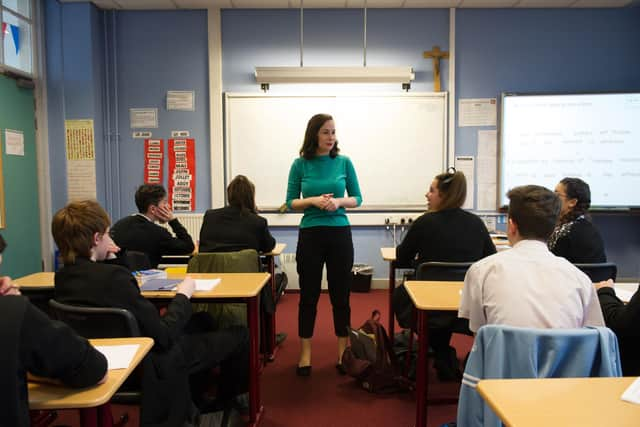

The clear impression is that, as so often, the SNP regime is marking its own homework.
Jill Stephenson, Edinburgh
No half measures
Your editorial (December 23) wonders where the money to pay more to Scottish doctors will come from. So consider this. When a country decides that it must defend itself, it creates an army, a navy, or an air force, or all three. Because that defence is against an unknown enemy, it must be kept up to date at all times, with every member fully trained, and properly paid, regardless of cost. There can be no half measures or economies. Defence costs what it costs.
Similarly, a country may decide to have a health service, and the same ethos applies. It must be ready for the unknown, with fully trained and properly paid staff. Health costs what it costs.
There are no half measures with any all-embracing state service, and doctors are merely demonstrating what happens when there are.
Let us hope this is understood by the Scottish Government and dealt with accordingly.
Malcolm Parkin, Kinnesswood, Perth and Kinross
Renewables action
Lyndsey Ward (Letters, 23 December) makes claims that don’t reflect how renewables are carefully planned and responsibly delivered in Scotland.
First, planning. Scotland’s National Planning Framework (NPF4) requires comprehensive environmental assessments to ensure projects avoid, minimise, and mitigate impacts on the landscape, peat, water, biodiversity, and amenity. These assessments include community health and safety considerations, are tested through independent scrutiny, and are enforceable. Battery storage and grid works are held to the same standards. This is the opposite of industrialisation at any cost.
Repeated reviews of the evidence have not found a causal link between wind‑turbine infrasound and harm to human health. Modern noise limits, setbacks, and monitoring are designed to ensure safety, which should reassure the public about health concerns.
While some commercial forestry has been felled for wind infrastructure, these are rotations that would be harvested regardless, with replanting secured through the consenting process. Scotland’s woodland expansion and replanting programs demonstrate a commitment to environmental restoration, which should make the public feel confident about responsible land use.
Finally, communities. Government guidance and industry practice place communities at the centre – typically around £5,000 per installed MW per year in community benefit – and include transparent mechanisms for sharing benefits. Projects are increasingly offering shared ownership and local supply‑chain commitments, with precise monitoring to ensure benefits reach residents. Under NPF4 Policy 11, projects must now maximise local socio‑economic benefits, including jobs, skills, energy‑efficiency funds, and targeted bill support.
We should keep demanding high standards on design, routing, peat protection and restoration. But portraying renewables as seasonal hypocrisy does a disservice to the facts and to the thousands of Scots working to decarbonise our energy system while delivering tangible benefits for communities, so that our children have a planet they can inhabit.
Cris Thacker, East Lammermuir, East Lothian
Religous lesson
A committee of MSPs has voted against introducing an independent right for young people to withdraw from religious observance in schools.
Bizarrely, young people will have the right to opt into religious observance against their parents’ wishes, but parents are not to be similarly allowed to opt their kids out!
The UN Convention on the Rights of the Child is now part of Scots Law. Articles 12 and 14 enshrine a child’s right to be heard and to freedom of religion and belief. Furthermore, polling shows two-thirds of Scots support an independent right of withdrawal.
Learning about different worldviews is important but it is not the job of government or schools to impose Christianity on families.
Neil Barber, Edinburgh Secular Society
Write to The Scotsman
We welcome your thoughts – NO letters submitted elsewhere, please. Write to [email protected] including name, address and phone number – we won’t print full details. Keep letters under 300 words, with no attachments, and avoid ‘Letters to the Editor/Readers’ Letters’ or similar in your subject line – be specific. If referring to an article, include date, page number and heading.
Comments
Want to join the conversation? Please or to comment on this article.