
Readers' Letters: SNP must be worried as experienced MSPs abandon Holyrood
Reader is unsurprised to see John Swinney put spotlight on Scottish independence once again
I was once told that the health of the UK economy can be gauged by an unusual factor. That factor is the increase or decrease in the sales of sulphuric acid, as it is an essential in the production of steel. Steel, of course, is used in a huge number of industrial processes, from construction to the motor industry.
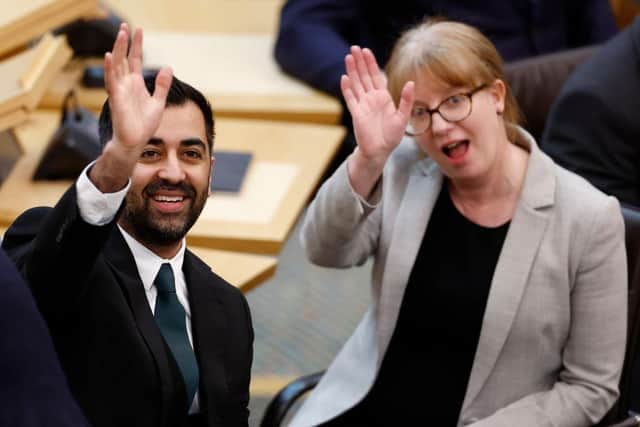
In a quite dissimilar way, one can tell when things are going badly for the SNP because they immediately begin to talk of holding another referendum on independence. Leader John Swinney knows that a party with nothing to show for 18 years in power is in great danger of being considered irrelevant, as most of us know it to be.
However, the main concern among nationalists must be that most of them are retiring at the forthcoming election and many of those left are well aware of how tarnished they are by the gender legislation they tried to push through. Women, who are half the population, are only too aware of that epic miscalculation and cheered when the Supreme Court announced their decision.

As Keir Starmer is changing his position on so many things these days, perhaps he could be persuaded to pass a Clarity Act, regarding any future referendum on Scottish independence in the same way Canada has done. He could even take a leaf from the SNP, whose constitution states: “This Constitution may not be changed, except by a vote of at least two-thirds of the delegates present and voting at National Conference.”
If it’s good enough for their own constitution, I am sure they would agree that it is just as relevant to the UK’s constitution.
Andrew HN Gray, Edinburgh
Vicious circle
Who would have thought Keir Starmer would say that we are becoming an “island of strangers”, freeze work visas for care workers when there are 130,000 vacancies, and tighten up on qualifications and language requirements?
It sounds desperate given Labour’s disastrous recent local election results, as opposed to Reform’s showing.
Starmer expects to reduce the number of workers entering the UK by 50,000, a drop in the ocean compared to 700,000 net migration.
Most foreign workers are essential given the lack of skills education and the inability of the UK Government to get some of the two million people of working age not in work to take jobs. Bizarrely, the number of dependents of those coming to work or study is currently higher than work applicants. With this expected to fall, the biggest opportunity is to ensure 400,000 non-EU students entering to study each year leave when their visas expire as only around 100,000 are currently leaving. There are legitimate reasons some stay – many will be taking skilled jobs that would otherwise not be filled.
According to Migration Policy Scotland in 2024, 42 per cent of Scots wanted less immigration, compared to 52 per cent across the UK. Scotland needs immigration to fill jobs given its working age population is falling. A greater proportion are coming to retire here than work from the rest of the UK.
This may be partly due to the tax position for workers and better welfare for people over 60. It puts more pressure on housing and on higher rate taxpayers to fund the added welfare bill and more worker demand from abroad. It’s a vicious circle that needs to be addressed.
Neil Anderson, Edinburgh
Despicable acts
Now we have Labour creating policies to appease the threat of Reform, but at what cost? The cost will be catastrophic to our public services here in Scotland, the construction industry and higher education institutions. Labour’s new proposals will require migrants to have degree-level qualifications before being considered for entry to the UK; however, despite Scotland’s doors being opened, immigration is a reserved matter to Westminster and Scotland’s needs are not a priority.
The Prime Minister’s statement on Monday included, and I quote: “If we do need to do more to release pressure on housing and public services, then mark my words, we will.” Is this a mere threat or could Labour go further and close down our public services, including our care sector?
In coming to government Labour first went after the pensioners, then it was employers and benefit claimants, now it is the turn of those we desperately need to provide essential services, migrants. Those proposals by a Labour Government will incur costs. Take the care sector – if those currently on lower earnings need a degree to be employed, then increased costs, through increased wages, will be demanded.
The actions of this Labour Government have been despicable on a number of counts and I am sure few Labour voters expected such “change” – after all, those proposals were not in their manifesto in 2024.
Catriona C Clark, Banknock, Falkirk
Green sexism?
The Scottish Greens are obviously not content with the damage done to women by their insistence on gender reforms. Now it appears men are in their sights too.
Gillian Mackay is challenging for the co-leadership of the Scottish Greens alongside current co-leader Lorna Slater. It appears their rules allow a man and a woman to take these roles or two women – but not two men. What is Scottish party politics coming to when such blatant discrimination appears to be the norm?
Gerald Edwards, Glasgow
Poor marks
The Supreme Court judgment which defined a woman by biological sex has clarified that a male-born trans person can be excluded from female-only spaces. This includes female toilets or girls' changing rooms.
Up pops the National Education Union, (NEU), which says it will defy the Supreme Court ruling and insists trans women in schools must be allowed to use the ladies' toilets, and will provide legal assistance for trans teachers.
This proposed defiance of UK law was by 52 executive members of the NEU without consulting their 445,000 members, the majority of whom are women. The 52 should be forced to pay all legal costs incurred and not use the NEU funds provided by the members.
Clark Cross, Linlithgow, West Lothian
Union betrayal
With regards to the letters by Jill Stephenson (13 May), unionists like her don't seem to understand that the Union, as it currently is, is not fit for purpose.
The Better Together campaign promised both Yes and No voters change if the country voted to stay within the Union, but to both the Tory and Labour Party change is some sort of optional extra.
Most countries in Europe have moved away from the “first past the post” electoral system, certainly don't have a huge unelected House of Lords, and as for the federalism promised by Gordon Brown, well that’s not about to happen, is it?
They hang on to this notion that Scotland could not cope without the Barnett formula and yet New Zealand, Australia, Canada and Republic of Ireland seem to manage just fine.
So, just when is the “change” promised by the Better Together campaign actually going to happen?
Peter Ovenstone, Peterhead, Aberdeenshire
Plane frustrating
I am a regular flyer between Edinburgh and European cities. I am not all all surprised that when arriving at my various European destinations, I am, post-Brexit, treated as a second-class citizen, and fully expect and anticipate longer passport control waiting times than those experienced by European passport holders.
What does surprise me is the same feeling I have, as a local, when landing back in Edinburgh, disembarking from an international fight. Through a combination of invariably faulty self scanners, poor queue management systems, inexperienced staff, an emphasis on ease of transition for non-UK passport holders, and the under-utilised, part manned security stations, it is not unusual to take at least an hour from wheels down to passing through passport control. As most observers in the Edinburgh airport UK passport queues can easily observe, slightly better management could significantly reduce waiting times.
I just wonder whether it would make sense to give control of passport control to VisitScotland, with delegated authority for security matters. Hopefully that organisation would appreciate the importance of first impressions to new visitors to our country.
Alternatively, I dread to think about the length of queues and feelings of frustration for all our international guests (not to mention the locals) in the forthcoming peak tourist season, if nothing changes.
Ian Gray, Edinburgh
What necks?
Watching Russia's impressive military parade to mark the 80th anniversary of the Soviet victory in the Great Patriotic War on television, I was disturbed by the way Russia's troops are drilled to turn their head to face the Commander-in-Chief as they march past.
Leaving to one side the fact that they cannot properly see where they are going, relying on the end soldier of each rank to keep them on track, one questions what effect that has on the physiology of their necks and shoulders, and ultimately on the accuracy of their rifle fire. Does it have a rightward bias? Similarly, when guards officers are standing to attention to form a ceremonial detachment facing a walk-past of some visiting dignitary they extend their necks and look up in a manner which is strange, if not downright silly.
William Loneskie, Oxton, Lauder, Berwickshire
Write to The Scotsman
We welcome your thoughts – NO letters submitted elsewhere, please. Write to [email protected] including name, address and phone number – we won't print full details. Keep letters under 300 words, with no attachments, and avoid 'Letters to the Editor/Readers’ Letters' or similar in your subject line – be specific. If referring to an article, include date, page number and heading.
Comments
Want to join the conversation? Please or to comment on this article.